
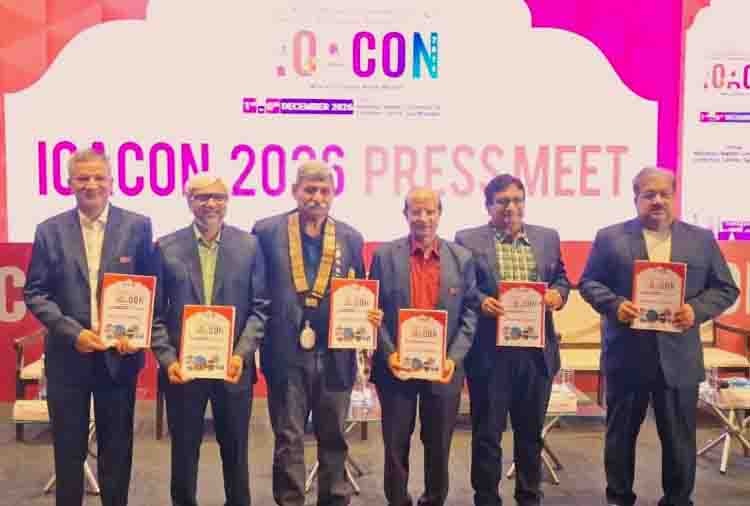
- 4,500 orthopaedic specialists to converge in Gandhinagar for six-day IOACON 2026
- Indigenous implants, global quality standards and medical-device exports take centre stage
- Dr Navin Thakkar highlights India’s and Gujarat’s growing manufacturing capabilities
- Medical ethics, informed consent and patient-centred care under the spotlight
- Robotics, artificial intelligence and surgical innovations to headline 700-plus scientific presentations
- Mahant Swami Maharaj to inaugurate the 71st national conference themed ‘Where Brilliance Meets Bharat’
R MANICKAVASAGAM
AHMEDABAD, NOV 22
The next big test for India’s orthopaedic revolution may not be confined to the operating theatre. It is whether Indian-made implants, surgical instruments and advanced medical technologies can earn greater acceptance among doctors and patients at home while establishing themselves as trusted products in the world’s most demanding healthcare markets.
As Gandhinagar prepares to host the 71st Annual National Conference of the Indian Orthopaedic Association (IOACON 2026), the gathering offers an opportunity to examine the intersection of clinical excellence, indigenous manufacturing, affordability and medical ethics. With more than 4,500 delegates expected, the conference will bring the orthopaedic fraternity together at a time when robotics, artificial intelligence and precision-engineered implants are reshaping patient care.
The Make in India question, therefore, is not merely about how many implants are manufactured domestically. It is also about quality, clinical evidence, surgeon confidence, patient safety and India’s ability to become a globally competitive source of advanced orthopaedic solutions.
Indigenous implants: From affordability to international acceptance
Responding to the question, “Make in India: Can Indian implants compete globally?”, Dr Navin Thakkar, Organising Chairman of IOACON 2026, said India, and Gujarat in particular, had developed manufacturing capabilities for implants and world-class surgical instruments used in Indian hospitals and exported to international markets.
“India in general and Gujarat in particular manufacture implants and world-class instruments used in Indian hospitals and also cater to the world market. Attracted by Indian companies maintaining increasingly matching global standards of quality and affordable cost, many developed countries import our products,” he said.
His assessment comes against the backdrop of a medical-device industry that is expanding its manufacturing footprint but continues to face a substantial import-export gap.
According to the Department of Pharmaceuticals’ Annual Report 2025-26, India’s exports of implants increased from US$99 million in 2020-21 to US$350 million in 2024-25. However, implant imports also rose from US$226 million to US$640 million during the same period. The figures underline both the growing international reach of Indian manufacturers and the considerable scope for reducing dependence on imported products.
The broader medical-device trade figures reinforce the challenge. India exported devices worth US$4.014 billion in 2024-25, against imports of US$8.822 billion.
There is, however, an important distinction between manufacturing capability and actual domestic market penetration. The Union Government has stated that production data for medical devices are not centrally maintained by the Central Drugs Standard Control Organisation. Consequently, a reliable nationwide percentage of orthopaedic implants and instruments used in Indian hospitals that are domestically manufactured is not presently available from this official dataset.
The policy environment is also evolving. On November 10, 2026, the Department of Pharmaceuticals announced an extension of the Production Linked Incentive (PLI) Scheme for Medical Devices up to 2035-36, with an indicative outlay of approximately ₹2,700 crore for the extended scheme. The government said the existing initiative had facilitated domestic manufacturing of more than 60 high-end medical devices and components, including orthopaedic and cardiac implants.
The next phase will require sustained investment in research and development, precision engineering, advanced materials, internationally recognised quality certifications, clinical validation and robust post-market surveillance. Equally important will be building confidence among surgeons and patients through transparent clinical evidence rather than allowing price or brand perception alone to determine implant selection.
Medical ethics: Putting patients before technology and commercial interests
The conference will also bring the ethical dimensions of modern healthcare into sharp focus. As sophisticated technologies and expensive implants become increasingly available, ensuring that treatment decisions remain clinically justified and patient-centred is an important responsibility for the orthopaedic community.
Asked what safeguards the Indian Orthopaedic Association advocates to prevent unnecessary interventions and commercially driven treatment recommendations, Dr Navin Thakkar said the association’s Ethics Committee monitored compliance with established professional standards.
“The Ethics Committee of the IOA ensures that all members adhere to all standard procedures in letter and spirit to maintain transparency, including patient-centred care,” he said.
The issue assumes particular significance in an environment where patients may find it difficult to distinguish between medically necessary interventions and procedures influenced by commercial considerations. Informed consent, disclosure of treatment alternatives, rational implant selection, clear communication of costs and respect for patient autonomy must remain central to ethical orthopaedic practice.
India must move from adopting global practices to shaping them
Highlighting the academic and international significance of the gathering, Dr Jawahar T Jethwa, Chairman of the Scientific Committee, said IOACON 2026 would demonstrate India’s growing contribution to global orthopaedic knowledge and practice.
“IOACON 2026 will showcase to demonstrate that India is not merely adopting global orthopaedic practices but increasingly contributing to them. With India’s orthopaedic expertise increasingly matching global standards, we will share our specific achievements, innovations or clinical capabilities with all participants,” he said.
The conference is expected to provide a platform for Indian and international specialists to exchange knowledge, present research findings and discuss emerging surgical approaches, with particular emphasis on translating scientific advances into better patient outcomes.
Spirituality meets healthcare at inauguration
Adding a distinctive spiritual dimension to the scientific gathering, the conference will be inaugurated by His Holiness Mahant Swami Maharaj, the spiritual head of BAPS Swaminarayan Sanstha and the sixth spiritual successor of Bhagwan Swaminarayan.
He is also scheduled to address the gathering on the connectivity between spirituality and healthcare, bringing into focus the role of spiritual values in healing, compassion and holistic patient care.
Six days of science, skills and international collaboration
IOACON 2026 will feature an extensive scientific programme designed to bring together established orthopaedic specialists, researchers, young surgeons and industry representatives.
The highlights include:
- 4,500 registered delegates: Participation expected from across India and overseas.
- 500-plus faculty members: Including 21 international faculty from the US, UK, Germany and Malaysia.
- 700-plus podium presentations: Providing a platform for clinical research, scientific exchange and new ideas.
- 20 workshops: Including five cadaveric workshops at NHL Municipal Medical College and sawbone workshops at Mahatma Mandir.
- 100-plus exhibitors: Showcasing implants, surgical instruments, pharmaceutical products and medical technologies.
- Robotics and artificial intelligence: Exploring the growing role of technology in precision surgery and patient care.
Dr Kamlesh Devmurari, Organising Secretary, said, “We have curated a comprehensive scientific programme featuring expert sessions, research presentations and interactive learning opportunities to ensure delegates gain meaningful academic and clinical insights.”
Dr Ketan Thakkar, Co-Organising Secretary, said, “With robotics, AI and emerging surgical technologies transforming orthopaedics, IOACON 2026 will provide an important platform to explore innovation and its practical application in patient care.”
Industry-academia partnership takes centre stage
The trade and scientific exhibition, under the chairmanship of Dr Vikas Jain, will feature more than 100 exhibitors, including implant manufacturers, pharmaceutical companies and medical technology brands.
“The platform will bring together industry leaders to showcase advancements while encouraging young orthopaedic professionals to exchange ideas, learn from experts and explore innovations shaping the future of orthopaedic care,” he said.
Beyond product displays, the exhibition is expected to facilitate interaction between manufacturers, clinicians and researchers, creating opportunities to discuss indigenous product development, technological improvements and the evolving requirements of modern orthopaedic practice.
Gujarat had previously hosted the national orthopaedic conference in 2001. Returning to the state after 25 years, IOACON 2026 is expected to reinforce Gandhinagar’s standing as a destination for major medical and scientific gatherings.
The larger message of the conference is that the future of orthopaedics must be measured not merely by surgical sophistication or technological advancement, but by safer procedures, affordable implants, ethical medical decisions and better quality of life for patients.