
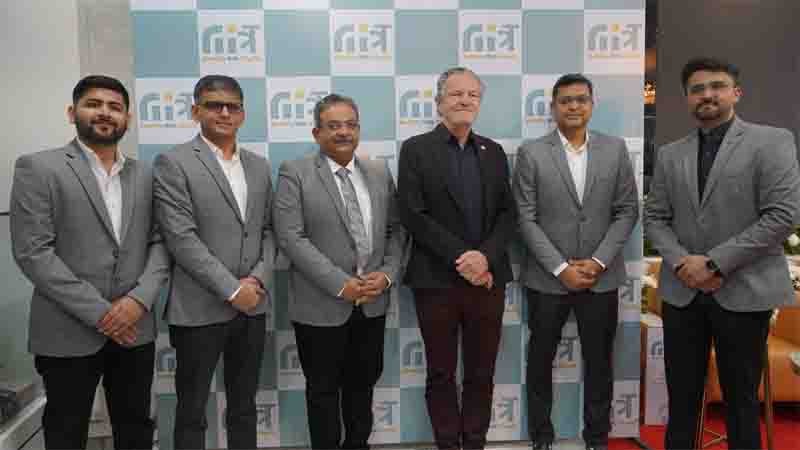
- Internationally acclaimed Oxford surgeon Dr. Christopher Dodd shares expertise at Mitra Hospital, Ahmedabad
- Partial knee replacement targets the damaged compartment while preserving healthy parts of the joint
- Kartik Shukla says only 10% of patients visiting Mitra undergo knee replacement; others receive OPD treatment
- Indian surgeons explore anatomical variations and refinements to improve outcomes for patients
R MANICKAVASAGAM
AHMEDABAD, NOV 28
Can the future of knee surgery be measured not by the number of artificial joints implanted, but by the number of natural joints saved? That compelling question took centre stage at an international medical interaction in Ahmedabad, where leading British knee surgeon Dr. Christopher Dodd brought the philosophy of ‘Less Surgery. More Life.’ into focus, highlighting the growing importance of accurate diagnosis, joint preservation and patient-specific treatment in tackling knee osteoarthritis.
The interaction, organised by Mitra Orthopaedic Superspeciality Hospital under the title ‘The Oxford Knee Story – In Conversation with Dr. Christopher Dodd’, spotlighted the Oxford Partial Knee Replacement procedure and its potential to offer appropriately selected patients an alternative to total knee replacement.
The central message was clear: not every knee affected by osteoarthritis needs to be replaced in its entirety. Where the damage is confined to one compartment, a partial knee replacement may address the affected portion while preserving the healthy structures of the remaining joint. The choice, however, depends on detailed clinical evaluation and the extent and location of the disease.
Dr. Dodd, Consultant Knee Surgeon at Manor Hospital, Oxford, UK, Honorary Clinical Lecturer at the University of Oxford and former president of the British and European Knee Societies, shared his extensive experience of the Oxford Partial Knee Replacement, a procedure with which he is internationally associated.
The discussion brought together Dr. Kartik Shukla, Dr. Darshan Thakkar, Dr. Ravi Chhajed, Dr. Darshan Rajani and Dr. Aman Saraiya, along with other orthopaedic specialists, to examine advances in knee surgery and the importance of selecting the right intervention for each patient.
The case for preserving natural knee function
Unlike total knee replacement, which resurfaces the entire joint, a unicompartmental or partial knee replacement addresses the damaged compartment alone. In suitable patients, this allows the unaffected portions of the knee to be retained.
The Oxford Knee is a mobile-bearing partial knee replacement system designed primarily for patients with arthritis affecting the medial compartment. Its clinical application requires careful assessment of the condition of the other compartments, ligaments, joint alignment and overall knee function.
The potential advantages of partial replacement include a smaller surgical intervention, preservation of more natural knee structures and the possibility of a quicker recovery. However, these benefits are not automatic, and partial replacement is not appropriate for every patient. Long-term outcomes also depend on patient selection and surgical expertise.
Dr. Dodd elaborated on the philosophy behind the Oxford Knee procedure, emphasising that understanding the individual patient’s condition must precede the choice of surgery. Advances in orthopaedics, he explained, are expanding the treatment options available to patients, with a greater focus on retaining natural knee function, restoring mobility and improving quality of life.
A public-health question for an ageing India
The interaction also raised a larger question about the responsibilities of modern orthopaedic care in a country with a growing burden of age-related joint disorders.
Addressing Dr. Dodd, the discussion posed a thought-provoking question: “Your theme is ‘Less Surgery. More Life’. But in an ageing society such as India, where millions suffer from knee osteoarthritis, shouldn’t the ultimate measure of medical progress be not how many sophisticated implants we can insert, but how many patients we can help retain their natural joints, avoid unnecessary operations and lead pain-free lives? Where does the Oxford Knee fit into that larger public-health responsibility?”
The question underlined the need to distinguish between patients who require surgery and those who can benefit from appropriate non-surgical management. Exercise-based rehabilitation, weight management where appropriate, medication and other conservative measures remain important components of osteoarthritis care.
The UK’s National Institute for Health and Care Excellence (NICE), in its osteoarthritis guidelines, identifies therapeutic exercise and weight management as core treatments. It recommends considering joint replacement when symptoms substantially affect quality of life and non-surgical management has proved ineffective or unsuitable.
This reinforces an important message for patients: persistent knee pain deserves timely medical assessment, but it does not automatically mean that a replacement operation is inevitable.
Indian anatomy and the need for surgical refinement
An important dimension of Dr. Dodd’s visit was an in-depth exchange with the Mitra team on anatomical variations and their implications for knee replacement techniques.
Drawing on his international experience and observations across diverse patient populations, he discussed how geographical, gender-related and genetic variations may influence anatomical characteristics and surgical planning, particularly in the Indian context.
The discussions explored the importance of understanding these differences while refining surgical approaches and striving for better patient outcomes. Such exchanges between international experts and Indian specialists are valuable in adapting global surgical knowledge to the needs of local populations.
Mitra’s experience and patient-first approach
Dr. Kartik Shukla, Founder of Mitra Orthopaedic Superspeciality Hospital, highlighted the hospital’s approach to ensuring that surgery is recommended only when clinically warranted.
“Only 10 percent of the patients visiting our hospital are subjected to knee replacement surgery and the rest get treatment at our OPD. This treatment is covered under the PMJAY and other insurance schemes,” he said.
He also acknowledged Dr. Dodd’s longstanding contribution to training and capacity-building among Indian orthopaedic surgeons.
“Dr. Christopher Dodd has been our mentor for decades. He has been regularly visiting our country every year to upskill hundreds of orthopaedic surgeons in all parts of the nation. We are indebted to him for his valuable contribution to this specialised field,” Dr. Shukla said.
Dr. Shukla and his team at Mitra have over a decade of experience performing the Oxford Partial Knee Replacement procedure, placing them among the experienced teams in the country, according to the hospital.
The interaction reaffirmed Mitra’s commitment to bringing international expertise, advanced orthopaedic techniques and patient-centric treatment to Ahmedabad, while strengthening professional exchanges with specialists from across the world.
Ultimately, the Oxford Knee story is about a larger shift in orthopaedic thinking: the best operation is not necessarily the biggest operation, but the one that is clinically appropriate for the patient. For people living with knee osteoarthritis, understanding the available options, seeking an informed specialist opinion and exploring conservative treatment before surgery can make a meaningful difference to their mobility and quality of life.