
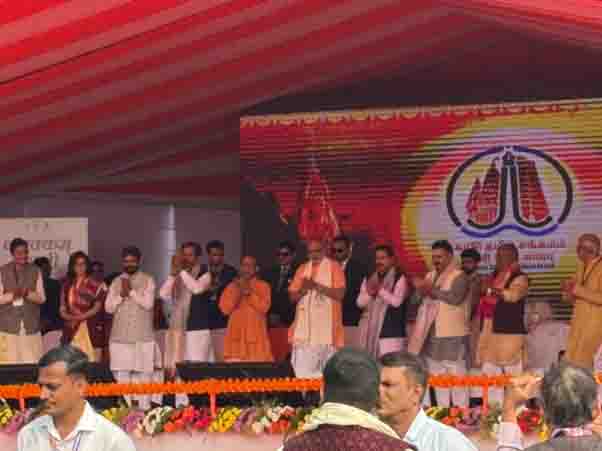
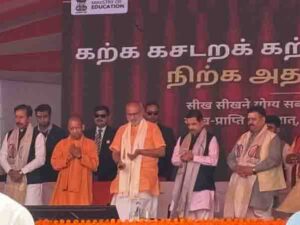
- Vice-President C. P. Radhakrishnan inaugurates fifth Kashi Tamil Sangamam in Varanasi
- Thirukkural translations released in 50 languages, including 10 foreign languages, in a major literary milestone
- “Love for one’s own language should never become hostility towards another language,” he says
- Calls Kashi Tamil Sangamam a movement to reinforce national unity and civilisational connections
- Envisions Ganga waters reaching Cauvery through national river-linking initiative
NE LITERARY BUREAU
VARANASI, NOV 28
In a powerful celebration of India’s linguistic diversity and civilisational unity, Vice-President C. P. Radhakrishnan on Saturday inaugurated the fifth edition of Kashi Tamil Sangamam (KTS 5.0) in Varanasi, marking a significant milestone in the global outreach of Tamil literary heritage with the release of the Thirukkural in 50 languages, including 10 foreign languages.
Describing the enduring relationship between Kashi and Tamil Nadu as a civilisational bond spanning thousands of years, the Vice-President underscored that Kashi Tamil Sangamam was much more than a cultural gathering. It was a movement to rekindle India’s shared heritage, strengthen national unity and celebrate the country’s extraordinary linguistic plurality.
The release of the multilingual editions of the Thirukkural, the timeless literary masterpiece of Tamil poet-philosopher Thiruvalluvar, emerged as the centrepiece of the inaugural ceremony, symbolising the universal appeal of Tamil wisdom and its relevance across geographical and linguistic boundaries.
Addressing the gathering, Radhakrishnan said Kashi, regarded as the spiritual capital of the world, occupied a special place in the hearts of Tamil people. A visit to the holy city and darshan of Baba Vishwanath remained a cherished spiritual aspiration for generations of Tamils.
He observed that India’s immense linguistic, regional and cultural diversity had never weakened its unity because the country was bound by a shared civilisational and spiritual ethos.
This enduring connection, he said, had inspired the launch of Kashi Tamil Sangamam under the leadership of Prime Minister Narendra Modi. What began as a cultural initiative had evolved into a significant national movement, strengthening the historic relationship between Tamil Nadu and Kashi and advancing the spirit of Ek Bharat, Shreshtha Bharat.
Thirukkural takes a giant linguistic leap
The fifth edition is being organised around the theme “Thirukkural Payilvom – Thirukkural Abhyas Karen”, aimed at taking the timeless wisdom and ethical teachings of the Thirukkural, particularly to students and young people.
Describing the Thirukkural as a universal guide to life, the Vice-President said its teachings of equality, humanism and righteousness transcended linguistic, regional and national boundaries. He urged people to study its wisdom and translate its principles into everyday conduct.
Highlighting the significance of the latest translations, he recalled that the Thirukkural was published in 13 languages during the first edition of Kashi Tamil Sangamam, followed by translations into 16 additional languages in the second edition.
Its availability in 50 languages, including 10 foreign languages, in the fifth edition represented a major milestone in taking Tamil literature to a wider international readership and reaffirming the universal relevance of Thiruvalluvar’s philosophy.
Mother tongue pride, multilingual harmony
Making a strong case for linguistic harmony, Radhakrishnan called upon people to take pride in their mother tongue while respecting every other language.
“Love for one’s own language should never become hostility towards another language,” he said, stressing that India’s strength lay in its many languages and shared ideals.
He also recalled Prime Minister Modi’s reference at the United Nations to the celebrated Sangam-era Tamil poet Kaniyan Pungundranar’s immortal words, “Yaadhum Oore, Yaavarum Kelir” (Every place is our home; everyone is our kin), which had taken the Tamil ideal of universal brotherhood to the global stage.
The Vice-President urged young people to draw inspiration from national leaders such as Perunthalaivar K. Kamaraj and Pasumpon Muthuramalinga Thevar and carry forward the values of national unity and India’s civilisational heritage.
Viksit Bharat must embrace civilisational values
Looking ahead to India’s centenary of Independence in 2047, Radhakrishnan said the vision of Viksit Bharat must extend beyond economic growth and development.
India, he said, should also emerge as a global exemplar of civilisational heritage, cultural values and humanism.
Emphasising the continuing relevance of the Indian philosophies of Vasudhaiva Kutumbakam (the world is one family) and Sarve Bhavantu Sukhinah (may all be happy), he observed that these timeless ideals carried particular significance in a world confronting conflicts, uncertainty and divisions.
Referring to Uttar Pradesh’s development under Chief Minister Yogi Adityanath, the Vice-President appreciated the State’s transformation and progress in economic development and public safety. He also recalled his longstanding association and friendship with the Chief Minister, dating back to their time together in Parliament in 1998.
From Ganga to Cauvery: A larger national vision
Concluding his address, the Vice-President expressed confidence in India’s vision of connecting its rivers and articulated an aspiration that resonated with the gathering.
He envisioned a future in which the waters of the Ganga would reach the Cauvery through the national river-linking initiative, symbolically reinforcing the enduring connections between northern and southern India.
1,400 delegates celebrate cultural connections
Around 1,400 participants from Tamil Nadu, representing diverse sections of society, including students, teachers, writers, journalists, farmers, artisans, women and industry representatives, are participating in the fifth edition.
The programme is being organised through the coordinated efforts of the Department of Higher Education under the Ministry of Education, IIT Madras, Banaras Hindu University, the Central Institute of Classical Tamil, Chennai, the Government of Uttar Pradesh and various Ministries and departments of the Union Government.
Uttar Pradesh Chief Minister Yogi Adityanath; Union Minister of Education Pralhad Joshi; Uttar Pradesh Ministers Anil Rajbhar, Ravindra Jaiswal, Dayashankar Mishra and Hansraj Vishwakarma; Secretary, Department of Higher Education, Deepti Gaur Mukerjee; Chairman of the Bharatiya Bhasha Samiti, Chamu Krishna Shastry; IIT Madras Director V. Kamakoti; Banaras Hindu University Vice-Chancellor Ajit Kumar Chaturvedi; spiritual leaders, scholars, delegates from Tamil Nadu, students and members of the public attended the inaugural ceremony.
Earlier, the Vice-President, accompanied by the Chief Minister, visited the Kashi Vishwanath Temple and Kaal Bhairav Temple in Varanasi and offered prayers.
The fifth Kashi Tamil Sangamam thus seeks to reinforce a message that transcends languages and regions: India’s diversity is not merely a collection of distinct identities but a shared civilisational inheritance that continues to bind its people.