
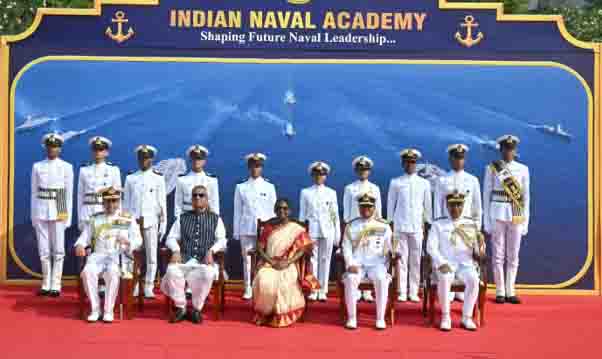
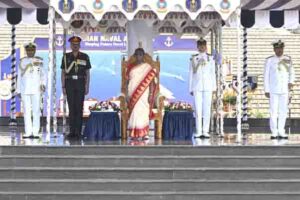
- President reviews Autumn Term 2026 Passing Out Parade at Ezhimala
- More than 400 officer trainees participate in the ceremonial parade at the Indian Naval Academy
- Women cadets’ growing presence hailed as a source of national pride and inspiration
- Secure maritime routes vital to global trade, supply chains and the everyday lives of citizens, President says
- Integrity, courage and compassion must define the character of future naval leaders
NE DEFENCE BUREAU
NEW DELHI, NOV 28
Can a disruption thousands of kilometres away at sea affect the lives of ordinary Indians? President Droupadi Murmu believes the answer is unmistakably yes. Underscoring the direct link between maritime security, economic stability and citizens’ everyday lives, she has called upon young naval officers to recognise that their service at sea is ultimately a commitment to the security and prosperity of people on land.
The President reviewed the Passing Out Parade (POP) of Autumn Term 2026 at the Indian Naval Academy (INA), Ezhimala, in Keralam, on Saturday, marking the culmination of training for officer trainees, including personnel from the Indian Coast Guard and friendly foreign countries.
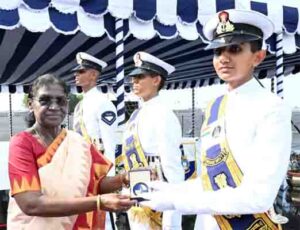
Congratulating the graduating trainees, Murmu particularly welcomed the presence of a significant number of young women among them, describing it as a matter of pride for the nation.
“You have demonstrated that determination, courage and competence know no boundary,” she told the women trainees, expressing confidence that their achievements would inspire many more young women to aspire to challenging responsibilities in the service of the nation.
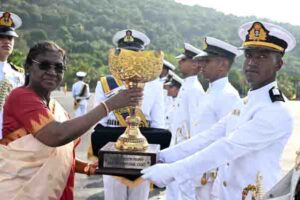
The parade saw more than 400 officer trainees from various courses participate at the Academy’s Pereira Parade Ground. The ceremony marked their transition from training to commissioned service, with distinguished trainees receiving medals and trophies. The time-honoured ‘Shipping of Stripes’ ceremony signified the conferment of commissioned officer ranks.
Maritime security is people’s security
Highlighting the strategic and economic significance of the maritime domain in an increasingly interconnected world, the President pointed out that a substantial share of global trade moves through the seas.
“The security of maritime routes is, therefore, closely linked to the economic well-being of nations and the everyday lives of their people,” she said.
Any disruption to shipping movements, she cautioned, could affect the availability of essential goods, push up costs and impose an additional burden on ordinary citizens. The cadets, therefore, must understand that their responsibilities at sea extend far beyond protecting maritime boundaries.
“You should remember that your service at sea is connected to the lives of people on land. It contributes directly to their security, prosperity and well-being,” she emphasised.
Leadership beyond the command
Murmu said the integrity, professional competence, courage and compassion of young officers would shape the character of the Indian Navy. Their careers would expose them to difficult weather conditions, prolonged deployments and uncertain situations, often demanding critical decisions under pressure.
She reminded the graduating cadets that leadership was not merely about issuing orders.
“Leadership is not merely about giving commands; it is about undertaking responsibility, setting an example and standing by those who serve with you,” she said.
The President expressed confidence that the trainees’ professional grounding, adaptability and commitment would equip them to meet emerging challenges. She also urged them to remain lifelong learners and continuously upgrade their knowledge and skills as new technologies reshape warfare and maritime security.
Indigenous strength, a stronger Navy
Referring to India’s expanding indigenous defence capabilities, Murmu said an increasing number of naval ships and submarines were being designed and built in Indian shipyards. This, she noted, reflected the country’s commitment to self-reliance and the capabilities of its engineers, scientists, skilled workers and industry.
The graduating officers, she said, would be part of the journey towards a stronger and more self-reliant India.
She also recalled the impressive demonstration of the Indian Navy’s growing capabilities during the International Fleet Review at Visakhapatnam in February this year, describing the present period as an important phase of transformation for the service.
Uniform carries the nation’s trust
Emphasising the responsibility that comes with wearing the naval uniform, the President said it carried the expectations and confidence of more than a billion Indians.
“Every citizen, irrespective of where they live or what they do, looks towards our Armed Forces with confidence and pride,” she said, urging the young officers to uphold the highest traditions of the Indian Navy, perform every duty sincerely, face challenges courageously and treat those under their command with fairness and respect.
She also acknowledged the sacrifices and support of the trainees’ parents and families, whose encouragement had helped the young officers complete a demanding course of training.
The President concluded by wishing the graduating officers a fulfilling and professionally rewarding career, invoking the spirit of the Vedic prayer, “Sam No Varuna!”