
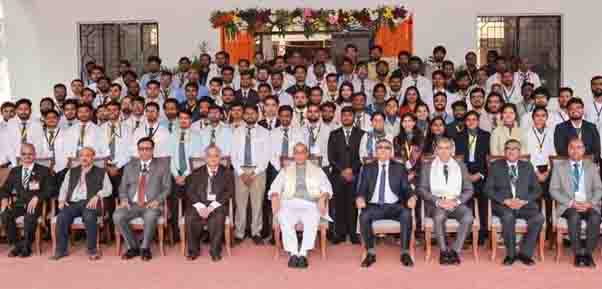
- Defence Minister calls for cutting-edge research and indigenous solutions to emerging national security challenges
- Says swift adoption of emerging technologies in line with national interests is the need of the hour
- AI, quantum computing, autonomous systems and advanced materials reshaping future warfare
- Urges stronger military-academia-industry collaboration to build a globally competitive defence research ecosystem
- 518 students receive degrees at DIAT’s 15th Convocation; highest-ever number in the institute’s history
NE DEFENCE BUREAU
PUNE, NOV 29
Can India translate its growing scientific talent into decisive technological superiority on tomorrow’s battlefield? Calling for a decisive shift from participating in technological disruptions to leading them, Defence Minister Rajnath Singh on Sunday exhorted the Defence Institute of Advanced Technology (DIAT), Pune, to emerge as a modern-day ‘Takshashila’ — a globally recognised centre of excellence driving cutting-edge research, innovation and indigenous solutions to critical national security challenges.
Addressing DIAT’s 15th Convocation in Pune, Maharashtra, Defence Minister emphasised that swift adoption and harnessing of emerging technologies in accordance with national interests was imperative to safeguarding India’s security and strategic autonomy. He also called for attracting talented researchers and scientists from India and abroad to work on futuristic defence technologies.
Highlighting the transformative impact of Artificial Intelligence (AI), Machine Learning (ML), Quantum Computing, Autonomous Systems, Advanced Materials, Cyber Security, space-based capabilities and directed-energy technologies, Rajnath Singh said these developments had fundamentally altered the character of warfare, creating both unprecedented opportunities and complex challenges.
“The challenge before us is not merely to develop new technologies, but also to understand, adopt and harness them swiftly in line with national interests. DIAT must move beyond being a participant in these technological disruptions and emerge as a leader in developing technologies for the future battlefield,” he said.
Technology leadership is the foundation of national security
Describing military strength and scientific and technological capabilities as two vital and interdependent pillars of national power, Rajnath Singh said that while the Defence Forces safeguarded the country’s sovereignty and territorial integrity, science and technology strengthened the nation from within by driving economic growth, industrial development and self-reliance.
“A nation that leads in technology also leads in security; and those who excel in security are better able to firmly safeguard their independence, sovereignty and development,” he said.
The Defence Minister underlined that defence research must not remain confined to military applications, as technologies developed for the armed forces often generate wider benefits for civilian sectors such as healthcare, agriculture, communications and transportation.
“Even a modest research initiative undertaken in a laboratory today could, in the future, provide a new tool to a farmer, an innovative solution to a doctor or a life-saving technology to a soldier. Our researchers need to ensure that their work strengthens both our defence capabilities and technological prowess,” he added.
Calls for stronger military-academia-industry partnerships
Stressing the need to make DIAT a recognised destination for research addressing critical security challenges and operational requirements of the Defence Forces, Rajnath Singh advocated deeper collaboration across the defence research ecosystem.
He called for stronger engagement with the military, interdisciplinary research, expanded academic partnerships with leading global universities and renewed collaboration with industry to accelerate the development and deployment of indigenous technologies.
“The Institute has the potential to serve as a robust bridge connecting advanced education, scientific research and national security. The responsibility of taking the institute forward rests not only with its faculty and administration but also with its alumni. The graduating scholars must contribute to its growth in their respective fields,” he said.
DIAT has a key role in realising Viksit Bharat@2047
With India pursuing its ambition of becoming a developed nation by 2047, the Defence Minister said DIAT had a significant responsibility in strengthening the country’s defence technology ecosystem and advancing its scientific capabilities.
He also expressed satisfaction over the significant participation of women at the institute, observing that their growing presence in advanced science, engineering and defence technology would further enrich and strengthen India’s defence research ecosystem.
518 students conferred degrees; highest-ever tally
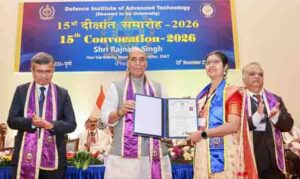
A total of 518 students were conferred degrees at the 15th Convocation, marking the highest number of degrees awarded in DIAT’s history.
The graduating cohort comprised 27 Ph.D. scholars, one MS (by Research) scholar, 401 M.Tech graduates and 89 M.Sc. graduates.
Among the M.Sc. graduates, 30 specialised in Tank Technology, three in Food Technology, eight in Information Technology and the remaining 48 in other M.Sc. programmes.
New Academic Block to strengthen research infrastructure
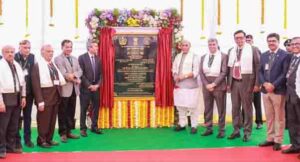
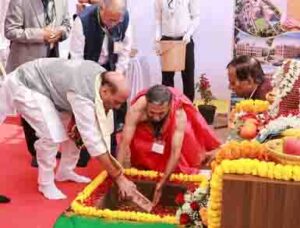
Rajnath Singh also laid the foundation stone for a new Academic Block at DIAT, aimed at supporting the institute’s expanding academic, research and technical requirements and reinforcing its position in advanced defence technology.
The proposed complex will feature modern and virtual classrooms, state-of-the-art laboratories, dedicated research facilities, incubation centres and a seminar hall with a seating capacity of 200 students.
Defence Secretary and Secretary, Department of Defence Research and Development (DDR&D), and Chairman, DRDO, Rajesh Kumar Singh; DIAT Vice-Chancellor Dr BHVS Narayana Murthy; senior civil and military officials; and representatives from academia and industry attended the ceremony.