
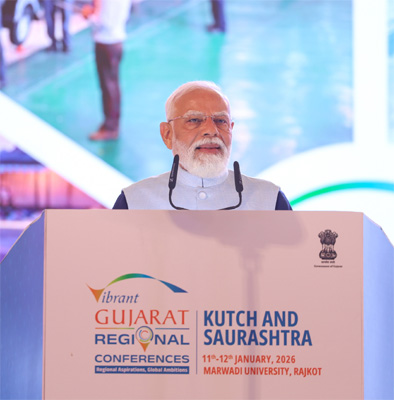
- Modi spotlights drug-free India, digital safety and cultural pride
- Shares moving account of a Delhi youth who battled drug addiction, homelessness and repeated relapses to rebuild his life
- Calls drug abuse a major challenge to India’s youth and lauds growing momentum of Nasha Mukt Yuva Abhiyan
- Sanchar Saathi recovers over 14 lakh lost mobile phones; more than ₹5,000 crore in potential cyber fraud losses prevented
- iGOT Karmayogi records over 3.25 crore course completions in AI and emerging technologies
- Hails Vadnagar Museum’s international design honour and Bihar Museum’s global ranking; India Pavilion voted best at Venice Art Biennale
NE NEWS SERVICE
NEW DELHI, NOV 29
Can a young person who has lost his family, home and future to drug addiction reclaim his life? Can a simple citizen’s complaint prevent cyber fraud worth thousands of crores? And can India’s traditional art, heritage and indigenous food products find recognition on the global stage? Prime Minister Narendra Modi brought these diverse stories of individual courage, technological empowerment and India’s cultural achievements together in the 140th episode of Mann Ki Baat on Sunday, placing the spotlight on a drug-free younger generation, digital vigilance, continuous learning and the country’s growing global footprint.
Opening the monthly radio programme with an impassioned appeal against drug abuse, Modi described addiction as a major challenge to the aspirations of India’s youth and highlighted inspiring examples of young people overcoming substance dependence through determination, institutional support and social intervention.
A youth’s battle against addiction becomes a national message
In an emotionally charged conversation, the Prime Minister spoke to a young man from Delhi who recounted how he slipped into drug addiction during his school years after being exposed to substance abuse in his neighbourhood and among older students.
What began as experimentation gradually turned into dependence, with the youngster deceiving his family to obtain money for drugs. The death of his father during childhood, followed by the loss of his mother and maternal grandmother, left him without a stable support system. He eventually found himself homeless, sleeping on the streets, surviving on food served at community kitchens and becoming increasingly vulnerable to addiction and associated illicit activities.
His attempts to quit were repeatedly disrupted by relapses. He approached the Society for the Promotion of Youth and Masses (SPYM), a rehabilitation organisation based in Delhi, and underwent treatment three times. However, the absence of a home and support system repeatedly drew him back into his earlier surroundings.
Recalling his turning point, the young man said he eventually decided that he could no longer allow addiction to destroy his life. Despite losing the support of people he had depended on, he sought treatment and resolved to rebuild his future.
Sharing his message with young people still struggling with addiction, he said: “These things are very enjoyable in the beginning… but the consequences that follow are suffered not just by us, but by our families as well. There is absolutely no benefit in this- nothing but harm, harm and only harm… nothing else.”
He added: “Our lives are very beautiful and really good. If we live life the right way, we can enjoy everything life has to offer.”
Congratulating him on overcoming addiction, Modi said his journey demonstrated that determination could help achieve even the most difficult goals.
“You have shown that when one possesses the willpower, no goal is impossible,” the Prime Minister said, expressing confidence that his story would inspire other young people to break free from substance abuse.
He stressed that keeping the younger generation free from drugs was vital not only for families but also for the nation, and highlighted the growing public participation in the Nasha Mukt Yuva Abhiyan.
iGOT Karmayogi drives continuous learning in government
Turning to the importance of lifelong learning, Modi highlighted the enthusiasm of government employees who, despite having served for 20 to 25 years, were continuing to upgrade their skills through the digital learning platform iGOT Karmayogi.
The platform offers more than 7,000 courses in 17 Indian languages, enabling government personnel to acquire knowledge in emerging technologies, including Artificial Intelligence, as well as Indian Sign Language.
More than 3.25 crore course completions have been recorded across over 200 courses relating to AI and emerging technologies.
The Prime Minister noted that the initiative had extended beyond Central Government employees to personnel working in States and Union Territories, including ASHA workers, Anganwadi workers, teachers, police personnel, healthcare workers and sanitation staff.
Describing the spirit of public service as the foundation of Mission Karmayogi, he reiterated its guiding principle: “Nagarik Devo Bhava”.
He said the enthusiasm for learning among government employees would prove a significant strength in India’s journey towards Viksit Bharat.
Sanchar Saathi recovers 14 lakh lost phones; cyber fraud worth ₹5,000 crore prevented
Highlighting how technology could directly protect citizens, Modi drew attention to the Government’s Sanchar Saathi platform, which helps people trace and recover lost mobile phones and report suspected fraudulent communications.
The portal has recorded more than 30 crore visits, while its mobile application has been downloaded approximately three crore times.
Explaining its functioning, the Prime Minister said the platform uses the unique International Mobile Equipment Identity (IMEI) number of a mobile phone. After filing a police complaint, users can submit the IMEI number and other necessary details through the portal to get the device blocked.
Even if another SIM card is inserted, the blocked handset cannot be used on mobile networks, while subsequent attempts to connect can help the police trace the device.
More than 14 lakh lost mobile phones have been recovered across the country and returned to their owners through the system.
Modi also urged citizens to report suspicious calls and fraudulent mobile numbers rather than merely disconnecting such calls, pointing out that another unsuspecting person could fall victim to the same fraudster.
He cited the examples of Himanshu Singh of Pune, who reported more than 300 suspicious numbers, contributing to the cancellation of approximately 18,000 mobile connections over the past year, and Vivek Alhari of Nellore in Andhra Pradesh, whose reporting of more than 900 fraudulent numbers helped disconnect approximately 17,000 mobile connections.
More than 1,600 institutions, including banks, payment applications, telecom companies and police agencies, are connected to Sanchar Saathi.
The platform has helped prevent potential financial losses exceeding ₹5,000 crore, Modi said, urging people to spread awareness about the facility, which is available in 23 languages.
Vadnagar Museum wins global design honour; Bihar Museum ranks ninth worldwide
Turning to India’s cultural and archaeological achievements, the Prime Minister urged citizens to make museums an integral part of their travel itineraries and take children along to explore the country’s rich heritage.
He highlighted the Bihar Museum in Patna, which secured the ninth position among the world’s 100 best museums and ranked first in Asia, according to the list cited by him.
He also drew attention to the Anant Anadi Vadnagar Archaeological Museum in Gujarat, developed at the site of archaeological excavations that have revealed evidence of different historical periods.
The museum features a specially constructed pathway allowing visitors to observe excavations several metres below ground level and showcases more than 5,000 ancient artefacts.
In a significant international recognition, the Vadnagar Museum received the prestigious Red Dot: Best of the Best Award in Berlin this month, becoming the first museum in India to receive the distinction.
Reflecting on Vadnagar’s historical continuity, Modi described it as a city that had remained vibrant for thousands of years, much like Kashi. He recalled that he was born in Vadnagar and represents Kashi in Parliament.
He also referred to the recent visit of the Shankaracharya of Kanchi Kamakoti Peetha, who had given Vadnagar the identity of the ‘Kashi of Gujarat’.
India Pavilion wins global acclaim at Venice Art Biennale
Modi also celebrated India’s achievement at the prestigious Venice Art Biennale in Italy, often described as the Olympics of the art world.
Approximately 4.5 lakh people visited India’s pavilion, which was voted the best by visitors from across the globe.
He said the achievement demonstrated the international appeal of Indian traditional art forms when presented through contemporary interpretations.
Announcing another major cultural initiative, the Prime Minister said the India Biennale would commence in Delhi during the first week of December and continue for 108 days.
Historical monuments, museums and art galleries across the country will participate in the celebration of art, architecture and design.
He encouraged families to visit the event and introduce children to India’s cultural and artistic heritage.
Erode palmyra jaggery enters Europe; Kutch camel milk powers chocolate innovation
Highlighting the growing international reach of India’s traditional food products, Modi announced that organic palmyra jaggery from Erode in Tamil Nadu had reached Europe for the first time.
He said the product combined traditional taste with quality and represented fresh opportunities for local producers.
The Prime Minister also pointed to the expanding global market for Indian chocolate and cocoa-based products, whose exports grew by nearly 25 per cent in the previous year.
He highlighted the role of startups and entrepreneurs in developing innovative chocolate flavours using locally sourced ingredients, creating opportunities for farmers, women and young business owners.
Drawing attention to Gujarat’s Kutch region, Modi spoke about the distinctive connection between camel milk and chocolate production.
He said Amul was using milk supplied by local camel herders to produce chocolate, saffron-flavoured milk and Rajbhog ice cream.
The daily collection of camel milk at Sarhad Dairy had increased from 1,300 litres to 5,500 litres, representing more than a fourfold rise compared with 2017–18.
Camel milk is now available in long-shelf-life packaging and is also being processed into powder, making it accessible to consumers beyond Kutch.
He also mentioned Surat-based Schmitten chocolates as an emerging Indian fine-chocolate brand making its presence felt internationally.
‘Sundays on Cycle’ completes 100 editions; India celebrates sporting milestones
On the fitness front, Modi announced that the Sundays on Cycle initiative under the Fit India Movement had completed 100 editions.
Launched in December 2024, the initiative has been organised every Sunday, attracting more than 37 lakh participants across over 30,000 locations.
He also highlighted Pune’s selection to host the 2032 UCI Road World Championship.
Congratulating Indian sporting achievers, he referred to the national football team’s record 10th SAFF Championship title, Lakshya Sen’s consecutive Super 500 triumphs in Germany and Japan, including his historic Kumamoto Masters victory, and P.V. Sindhu’s success at the Hylo Open.
He also announced that the eighth Khelo India Youth Games would be held across six cities in Telangana from December 11 to 22.
With winter setting in, Modi urged citizens to maintain their fitness routines, exercise regularly and reduce oil consumption in their diets by 10 per cent. He cautioned against rising obesity and its associated health risks.
Indian diaspora’s spirit of service reaches Canada
The Prime Minister also acknowledged the humanitarian initiatives undertaken by members of the Indian diaspora overseas.
He highlighted the Sai Dham Food Bank in Canada, which provides assistance to approximately 60,000 people every month across the Greater Toronto and Hamilton areas, including elderly people and persons with disabilities.
He also praised Kulwinder Sanghera, associated with Red FM in Canada, for using community radio to connect people and promote service-oriented activities inspired by the teachings of Guru Nanak Dev and the Sikh tradition of selfless service.
Pays tribute to artist Sobha Singh and Constitution-maker B.N. Rau
Concluding the programme’s reflections on India’s cultural and constitutional heritage, Modi paid tribute to eminent artist Sobha Singh on his 125th birth anniversary, observed on November 29.
Recalling his contribution to the iconic portraits of Sikh Gurus, the Prime Minister noted that Sobha Singh had also served as a draftsman in the Army and had worked in Baghdad.
He welcomed the release of a commemorative coin in the artist’s honour, describing it as a moment of joy for the Sikh community.
Modi also paid tribute to B.N. Rau, whose contribution to the drafting of the Indian Constitution was recalled in the wake of Constitution Day celebrations on November 26. Rau’s death anniversary falls on November 30.
The Prime Minister concluded by thanking listeners for sharing inspiring initiatives from across the country and urged them to continue sending their experiences, suggestions and ideas for future editions of Mann Ki Baat.