- Ahmedabad surgeons deploy customised 3D-printed pelvic cage to repair life-threatening hip implant migration
- Complex two-stage revision surgery restores mobility to international patient who arrived unable to walk
- Advanced 3D-printing technology bridges massive pelvic bone loss and protects critical blood vessels
- Medical experts say personalised implants are transforming complex orthopedic reconstruction worldwide
- Breakthrough underscores India’s growing leadership in high-end medical innovation and global medical tourism
By R MANICKAVASAGAM
AHMEDABAD, MAR 6
In a landmark orthopedic feat showcasing the transformative power of medical technology, doctors at Marengo CIMS Hospital have successfully performed a rare 3D-printed revision hip reconstruction on an international patient from Nigeria, restoring her ability to walk after a life-threatening complication from a previous surgery abroad.
The patient, Basirath, had undergone a complex revision hip replacement surgery in Africa four months earlier. However, complications arose when the acetabular socket migrated deep into the pelvic cavity, causing severe pain and leaving her completely immobile.
Seeking advanced treatment, she travelled to India and consulted Pranav Shah, Director of Orthopedic Trauma and Hip Replacement at Marengo CIMS Hospital.
Detailed evaluation revealed a critical complication: the displaced implant had moved deep into the pelvis and was compressing major vascular structures, including a principal artery and the external iliac vein — a condition that carried serious surgical risk.
A carefully planned two-stage surgical strategy
To address the complex situation, the medical team adopted a two-stage surgical approach.
In the first stage, surgeons removed the migrated implant through an abdominal route to safely access the pelvis and protect surrounding blood vessels.
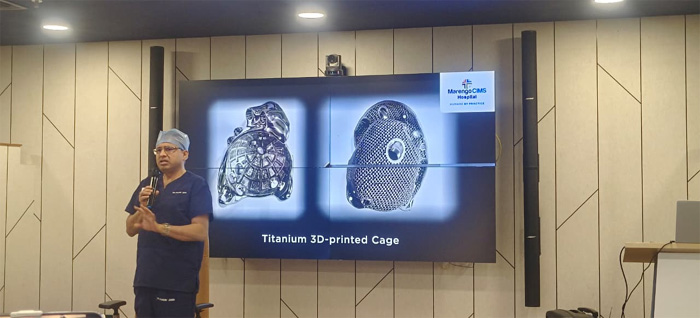
In the second stage, doctors reconstructed the extensive pelvic bone defect using a custom-designed 3D-printed pelvic cage, an advanced implant engineered specifically for the patient’s anatomy.
The implant was designed to bridge areas where natural bone support had been lost. A cemented hip replacement was then fixed over the cage to restore joint stability and mobility.
This marks the first time such a customised 3D-printed cage construct has been used at the hospital, representing a major advancement in treating complex revision hip surgeries.
Remarkably, Basirath began assisted walking within three to four days after surgery, signalling a successful outcome.
Surgeons highlight breakthrough potential
Dr Pranav Shah described the case as one of the most technically demanding procedures performed at the hospital.
“This was an extremely challenging and high-risk case because the implant had migrated into the pelvis and was compressing major blood vessels. A staged surgical plan allowed us to first safely remove the implant and then reconstruct the defect using customized 3D-printing technology. Such advanced solutions are redefining outcomes in complex revision hip surgery,” he said.
Hospital leadership said the surgery reflects the institution’s commitment to advanced technology and multidisciplinary expertise.
Keyur Parikh, Chairman and Senior Interventional Cardiologist at Marengo CIMS Hospital, added: “At Marengo CIMS, our commitment is to combine expertise, advanced infrastructure and cutting-edge technology to manage even the most complicated medical challenges. This successful surgery reflects our multidisciplinary strength and dedication to delivering world-class care.”
Patient regains hope and mobility
Expressing gratitude after the surgery, the patient said the procedure had given her a new lease on life.
“Before coming to India, I could not walk at all and the pain was unbearable. The doctors here explained everything clearly and gave me hope. After the surgery, I am already standing and walking with support. It feels like my life has started again,” Basirath said.
Why 3D printing is transforming healthcare
Medical experts say 3D-printing technology is rapidly revolutionising orthopedic surgery and other medical fields by enabling customised implants tailored to a patient’s anatomy.
According to research in the field of Orthopedic Surgery, 3D-printed implants provide several advantages over conventional implants.
Key benefits include:
- Personalised fit: Implants are designed using CT scans to match a patient’s anatomy precisely.
• Better bone integration: Porous structures encourage natural bone growth into the implant.
• Shorter surgery time: Custom implants reduce intra-operative modifications.
• Improved outcomes in complex cases: Especially beneficial where bone loss or deformity exists.
• Lower risk of revision surgeries due to better implant stability.
The porous architecture used in Basirath’s implant is expected to allow gradual bone ingrowth, strengthening long-term stability and enabling progressive weight-bearing.
India emerging as hub for advanced orthopedic care
With increasing adoption of 3D-printing technologies, India is rapidly emerging as a destination for advanced orthopedic reconstruction and medical tourism, attracting patients from Africa, the Middle East and Southeast Asia.
Experts say such personalised solutions could soon become standard practice in complex reconstructive surgeries, particularly in cases where traditional implants cannot provide adequate structural support.
For Basirath, however, the technology has already delivered a life-changing result — helping her stand and walk again after months of immobility.