NE NEWS SERVICE
CHENNAI, DEC 18
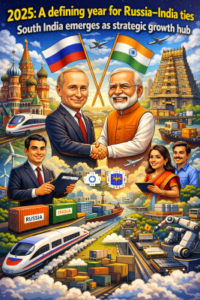
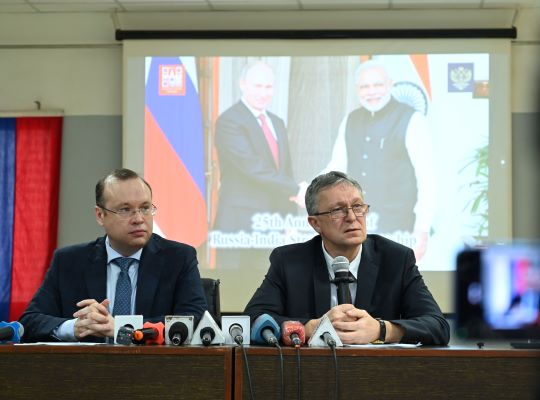
Marking the 25th anniversary of the Russia–India bilateral strategic partnership, 2025 has emerged as a landmark year, with ties continuing to strengthen despite global geopolitical and geoeconomic challenges, delivering significant outcomes across multiple sectors and deepening engagement with South Indian States, said Valerii Khodzhaev, Consul General of the Russian Federation in Chennai.
Addressing a press meet organised by the Consulate General of the Russian Federation and the Russian House to brief the media on developments in Russian–Indian cooperation over the past year, Mr. Khodzhaev said the partnership—elevated to a Special and Privileged Strategic Partnership 15 years ago—remains longstanding, time-tested and resilient, calling it “an invaluable asset that provides a strong foundation for future cooperation, resilient to changing political situations and expediencies.”
- 25 Years of Strategic Partnership Deliver Tangible Gains Across Energy, Railways and Education
- Kudankulam, Rail Modernisation and Regional Projects Deepen Russia–South India Engagement
- Focus Shifts to AI, Quantum, Fintech, Pharma Tech and Agritech for Next Phase of Cooperation
Political Momentum and Institutional Push
Highlighting the state visit of Russian President Vladimir Putin to New Delhi on December 4–5 as a major milestone, the Consul General said political engagements in 2025 have given a strong impetus to bilateral relations. He noted that the agreements and understandings reached at the summit are expected to further strengthen the institutionalised cooperation framework, adding momentum to trade and economic ties, scientific and technological collaboration, defence and security, as well as cultural and academic exchanges.
South India at the Centre of Cooperation
Khodzhaev underlined that recent agreements also hold special significance for regional cooperation, particularly with Southern India. He pointed to steady progress in several major projects, including the Kudankulam Nuclear Power Plant in Tamil Nadu, modernisation of the Indian Railways network, and joint development of natural resource deposits, reflecting the tangible benefits of the partnership for the region.
Business Ties Move Up the Value Chain
On the economic front, the Consul General said India–Russia business cooperation is becoming increasingly diversified, with a clear shift towards high-end and future-facing sectors such as artificial intelligence, quantum computing, fintech, pharma tech and agritech. To bridge awareness gaps among entrepreneurs, several Russian business delegations visited Tamil Nadu, Telangana, Karnataka, Andhra Pradesh and Kerala, while the first South India business mission from Tamil Nadu to Russia was organised recently, further strengthening two-way engagement.
Academic Collaboration and Student Mobility
Speaking at the event, lexander Dodonov, Director of the Russian House in Chennai, highlighted the vast potential for academic and university collaboration, noting the high standards of institutions in Tamil Nadu, Karnataka and Telangana and their ability to train skilled and semi-skilled manpower. He said this has gained added relevance following the mobility agreements signed at the recent summit.
With Russia’s higher education system reaching top global standards over the past decades, Mr. Dodonov said Russian universities have expanded opportunities for Indian students in 2025, reinforcing education as a key pillar of the evolving Russia–India strategic partnership.