
- Chennai medical team successfully reconstructs child’s massively enlarged aortic arch using a prosthetic graft
- Body cooled to a remarkable 16°C and blood circulation stopped for 40 minutes to enable life-saving surgery
- Youngest patient in the hospital team’s nearly four-decade experience with paediatric aortic aneurysm surgery
- Takayasu arteritis posed extraordinary surgical risks, necessitating specialised pre-operative treatment
- Child recovers without damage to vital organs and is discharged on the ninth day
- SIMS Hospital credits multidisciplinary expertise for landmark cardiothoracic surgical achievement
R ARIVANANTHAM
CHENNAI, NOV 18
Forty minutes without blood circulation. A body cooled to just 16 degrees Celsius. A life-threatening enlargement of the body’s largest artery. And a 10-year-old child who walked out of hospital nine days later. In a remarkable feat of paediatric cardiothoracic surgery, SIMS Hospital, Chennai, has successfully operated on an exceptionally large aortic arch aneurysm in a child suffering from the rare inflammatory condition Takayasu arteritis, achieving what the hospital describes as an Asia-first milestone.
The high-risk operation involved temporarily stopping blood circulation throughout the child’s body while surgeons removed the diseased portion of the aorta and reconstructed it using a prosthetic Dacron graft. To protect the brain and other vital organs during the procedure, the medical team cooled the child’s body to approximately 16°C using a heart-lung machine, allowing the delicate reconstruction to be completed during a 40-minute period of circulatory arrest.
The child, weighing just around 18 kg, was referred to SIMS Hospital in a critical condition with severe breathing difficulty, palpitations and an inability to lie down and sleep comfortably. The aneurysm had enlarged so dramatically that pulsations were visible through the chest wall.
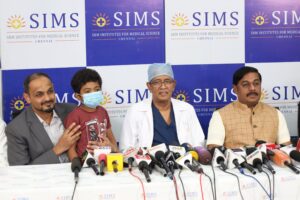
Explaining the extraordinary clinical challenge at a media interaction in Chennai on Tuesday, Dr Bashi V. Velayudhan, Director and Senior Consultant, Cardiothoracic Surgery, said the child required semi-emergency intervention because a rupture of the aneurysm could have proved fatal.
Investigations revealed a massive thoracic aortic aneurysm associated with aortoarteritis, also known as Takayasu arteritis, a rare inflammatory disease affecting the major blood vessels.
A race against a life-threatening aortic rupture
The child’s condition presented several layers of surgical complexity. Takayasu arteritis causes inflammation and thickening of blood vessel walls and can result in abnormal narrowing or aneurysmal enlargement.
Operating while the inflammation remains active carries a substantial risk of bleeding and other complications. The medical team therefore involved the rheumatology department to control the disease and prepare the child for surgery before undertaking the high-risk intervention.
Dr Velayudhan said this was the youngest patient with an aortic aneurysm operated upon by the team in its nearly 40 years of experience.
The location of the aneurysm added another formidable challenge. Since the enlarged portion of the aorta was situated very close to the breastbone, opening the chest through the conventional approach could have caused catastrophic injury to the already compromised blood vessel.
The surgeons therefore devised an alternative strategy to establish cardiopulmonary bypass before proceeding with the chest operation.
16°C: When surgery demanded a controlled shutdown of circulation
The operation required extraordinary precision.
The surgical team first connected the child to a heart-lung machine through blood vessels in the groin, using specially selected small tubes to accommodate the child’s body weight of approximately 18 kg.
The medical team then gradually cooled the body to around 16°C, a specialised technique known as deep hypothermic circulatory arrest.
After administering medicines to stop the heart, the surgeons temporarily stopped blood circulation throughout the body for approximately 40 minutes.
During this critical window, they opened the aorta, removed the diseased aneurysmal section and reconstructed the vessel using a Dacron graft — a specially designed prosthetic fabric tube.
Once the reconstruction was completed, circulation was carefully restored. The heart-lung machine gradually rewarmed the child to normal body temperature before the patient was taken off bypass and shifted to the intensive care unit.
Explaining the science behind this extraordinary procedure, Dr Velayudhan said:
“We are happy that we could successfully save this child, who presented with this extremely rare and life-threatening condition. Replacing the ascending aorta and aortic arch in a child is highly challenging – as one of the most critical aspects of the operation was temporarily stopping blood circulation to allow us to remove the diseased portions of the aorta and replace them with a graft. To protect vital organs such as the brain, kidneys, intestines and spinal cord during this period, we cooled the child’s body to 16°C using a cardiopulmonary bypass machine. This significantly reduces the body’s metabolic activity and, consequently, its oxygen requirement, allowing vital organs to withstand the temporary interruption of blood supply. Blood circulation was temporarily stopped for about 40 minutes while we performed the aortic reconstruction, after which circulation was carefully restored”.
No damage to vital organs; child back on his feet
The outcome was particularly encouraging given the complexity of the operation and the patient’s young age.
The child recovered well in the postoperative period and was discharged on the ninth day. Follow-up assessments showed that he could walk normally, sleep comfortably and breathe without difficulty.
Dr Mohammed Idhrees, Senior Consultant, Cardiothoracic Surgery, SIMS Hospital, described the achievement as a significant moment for the speciality and a reflection of the team’s collective expertise.
“This is a proud moment for cardiothoracic surgery and a testament to the surgical expertise of our team. What the team has achieved is no small feat. Blood circulation was stopped for about 40 minutes while the surgeon performed the delicate aortic reconstruction, following which circulation was carefully restored. It is somewhat like having to shut off the water supply to an entire house to repair a major plumbing problem. In this case, we had to temporarily stop the body’s blood supply while ensuring that the vital organs were adequately protected throughout the procedure. Post-surgical tests have confirmed that there was no damage to vital organs, including the brain, kidneys, intestines and spinal cord, during this period. The reconstructed aorta and its branches are also functioning well. Considering the complexity of the procedure and the child’s young age, this is an exceptional outcome,” he said.
The child, however, will require continued medication and medical monitoring to control the underlying inflammatory disease and prevent its progression or the development of aneurysms in other sections of the aorta.
Anaesthesia and teamwork behind the high-risk operation
The success of the procedure depended not only on surgical precision but also on managing the complex anaesthetic challenges associated with a critically ill child.
Dr Arun Kumar, Senior Consultant, Anaesthesiology, said:
“Anaesthetising the child posed additional challenges. His blood pressure was significantly elevated and difficult to control before induction of anaesthesia, increasing the complexity of the process. Furthermore, given his small body size and the possibility of steroid-related tissue changes following preoperative treatment, securing the airway and endotracheal intubation could also be technically challenging”.
The operation was performed by a team led by Dr Bashi V. Velayudhan, Cardiothoracic Surgeon, along with Dr Mohammed Idhrees, Senior Consultant, Cardiothoracic Surgery.
The anaesthesia team comprised Dr Aju Jacob and Dr Arun Kumar, Senior Consultants, Anaesthesiology.
Scrub nurses, perfusionists responsible for operating the heart-lung machine and operation theatre technicians also played crucial roles in executing the complex procedure.
SIMS Chairman hails a landmark in advanced medical care
Describing the achievement as a defining milestone for the institution, Dr Ravi Pachamuthu, Chairman of SRM Group, said:
“We are extremely happy and proud to have achieved this significant surgical milestone. This achievement reflects SIMS Hospital’s commitment to advancing the boundaries of medical care and bringing highly specialised, complex treatments within reach of patients who need them. Successfully performing this rare and complex procedure in a child, and achieving a first for Asia, is a testament to the expertise, dedication and collaborative efforts of our medical teams. We remain committed to pushing the frontiers of medical science and delivering the best possible outcomes for our patients, particularly in cases where treatment options are limited.”
The operation underscores the importance of multidisciplinary expertise in managing rare and life-threatening paediatric vascular conditions, where surgical intervention, rheumatological management, anaesthesia and intensive care must work in close coordination.
For the young patient and his family, however, the most meaningful measure of this extraordinary medical achievement is much simpler: a child who once struggled to breathe and sleep is back on his feet, with a renewed opportunity to lead a normal childhood.