- First-year findings of three-year WII-led study throw fresh light on turtle movements, habitat use and nesting along Odisha coast
- Satellite telemetry tracks 10 Olive Ridleys over 1,748 days, revealing strikingly different male and female movement patterns
- One female travelled 6,719 km over 271 days, reaching waters east of Sri Lanka
- Boat surveys record 1,390 turtles and 67 mating pairs, with most sightings within two kilometres of coastline
- Odisha Government, WII, Dhamra Port and Adani Foundation join hands to strengthen science-based conservation planning
NE WILDLIFE & ENVIRONMENT BUREAU
BHUBANESWAR, OCT 4
An Olive Ridley turtle travelling 6,719 km across the Bay of Bengal over 271 days has offered scientists a remarkable glimpse into the little-understood oceanic journeys of one of Odisha’s most iconic species, as the first-year findings of a three-year research initiative were released here on Sunday.
The findings, generated through satellite telemetry, boat-based surveys and shoreline analysis, are providing fresh scientific insights into the movements, habitat use, migration and nesting behaviour of Olive Ridley turtles along the Odisha coast—and could help shape the next generation of evidence-based conservation strategies.
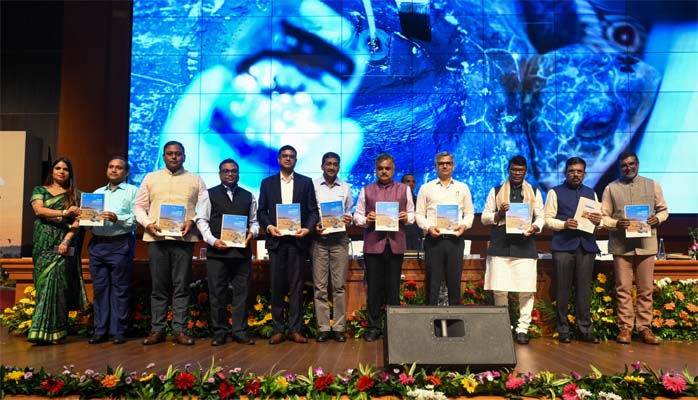
Ganesh Ram Singh Khuntia, Minister of State for Forest, Environment & Climate Change, Labour & ESI, Government of Odisha, released the first-year report of the study led by the Wildlife Institute of India (WII), Dehradun, in partnership with the Odisha Wildlife Organisation, Department of Forest, Environment & Climate Change, Dhamra Port Co. Ltd. (DPCL) and the Adani Foundation.
Dr Abhishek Lakhtakia, Chief Executive Officer, Adani Foundation, attended the event representing the social welfare and development arm of the Adani Group.
A turtle’s 6,719-km ocean odyssey
The satellite-tagging component tracked 10 Olive Ridleys for a cumulative 1,748 days, revealing distinct movement patterns between males and females.
Male turtles were found to begin their offshore migration earlier, while females remained in nearshore waters for longer periods. The telemetry data also indicated possible foraging stopovers along the continental shelf and across the Bay of Bengal.
The most striking journey was recorded by one female turtle, which travelled 6,719 km in 271 days, reaching waters east of Sri Lanka.
Another turtle travelled nearly 200 km from Gahirmatha to Rushikulya and back, highlighting the extent to which Olive Ridleys move between different parts of Odisha’s coastline.
The findings underscore the need to view conservation not merely through the lens of nesting beaches but across the much larger marine landscape used by the turtles during migration and feeding.
Science returns to Odisha’s turtle waters
Dr R. Suresh Kumar, Senior Scientist, Department of Endangered Species Management, WII, said the study marks an important revival of satellite tracking of Olive Ridleys in Odisha after nearly 15 years.
“This study marks the renewal of satellite tracking of Olive Ridley turtles in Odisha after nearly 15 years.”
He said the partnership between the Odisha Forest Department, Dhamra Port and Adani Foundation had enabled researchers to generate new insights into turtle movement and habitat use.
“The findings provide a scientific foundation for evidence-based conservation planning. We will continue tracking more turtles to build a stronger dataset that can support management strategies and long-term conservation.”
The continuation of telemetry tracking is expected to provide a larger dataset capable of helping conservation managers understand marine corridors, potential feeding areas and the relationship between offshore movements and nesting activity.
1,390 turtles, 67 mating pairs in field surveys
The research was complemented by boat-based surveys conducted during the 2025–26 nesting season, which recorded 1,390 individual Olive Ridleys and 67 mating pairs.
Most turtle sightings were recorded within two kilometres of the coastline, reinforcing the importance of nearshore waters as a critical habitat during the breeding season.
The report called for sustained monitoring to understand how movement and habitat-use patterns may influence the conservation and management of nesting habitats.
Odisha is home to some of the world’s most important Olive Ridley nesting grounds, including Gahirmatha in Kendrapara district and Rushikulya in Ganjam district, where spectacular mass nesting events take place.
The species enjoys the highest level of legal protection in India, being listed under Schedule I of the Wildlife Protection Act, 1972.
‘Protecting it requires deeper understanding’
Dr Priti G Adani, Chairperson, Adani Foundation, described the Olive Ridley as an important part of Odisha’s natural heritage and stressed the importance of understanding the species’ complete journey.
“The Olive Ridley is an important part of Odisha’s natural heritage and protecting it requires a deeper understanding of its journey.”
She said the Foundation was pleased to support WII’s scientific work and contribute to conservation efforts.
Dr Priti Adani also welcomed the Odisha Government’s emphasis on sustainability and environmental conservation under Chief Minister Mohan Charan Majhi, saying it provided a strong foundation for such scientific initiatives.
The study is being undertaken in collaboration with DPCL, part of Adani Ports and Special Economic Zone Ltd (APSEZ), and the Adani Foundation. APSEZ operates the Dhamra and Gopalpur ports in Odisha.
Conservation beyond the nesting beach
The study’s importance extends beyond the spectacular annual nesting phenomenon. The telemetry findings suggest that Olive Ridley conservation must account for the turtles’ entire ecological journey—from nearshore breeding waters to distant offshore and transboundary marine habitats.
The research therefore brings together government conservation machinery, a premier wildlife research institution, industry and a philanthropic organisation in an effort to build a stronger scientific evidence base.
The initiative also complements the Adani Foundation’s broader environmental and community programmes in Odisha. The Foundation has been working in the State for nearly a decade, with programmes reaching 283 villages across seven districts, covering education and scholarships, healthcare, livelihoods, agriculture, women’s empowerment and community infrastructure.
The first-year findings ultimately point to a simple but powerful conservation lesson: to protect the Olive Ridley on Odisha’s beaches, scientists may first have to understand the vast ocean it calls home.