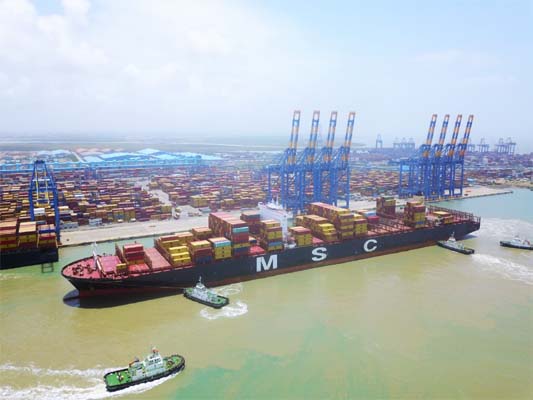
- With Gujarat handling over 580 MMT of cargo in FY24, government’s ₹69,725 crore incentive package aims to quadruple port capacity, attract shipbuilding investment and reduce logistics costs
- Under the Maritime India Vision 2030, the government envisages investment of ₹3-3.5 lakh crore across ports, shipping, and inland waterways sectors
- Ports such as Mundra reported 11-22% growth in certain cargo & container segments in recent months, reinforcing momentum
R MANICKAVASAGAM
GANDHINAGAR, SEPT 29
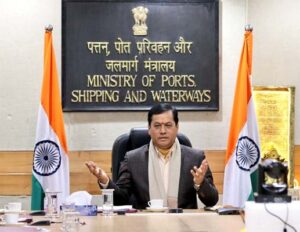
India’s maritime and shipping sector is gearing up for a transformational leap after the Union Cabinet approved a massive ₹69,725 crore package aimed at strengthening port infrastructure, promoting domestic shipbuilding, ship repair, ship breaking and boosting maritime trade.
Key Numbers & Gujarat’s Dominance
- In FY 2023-24, Gujarat’s ports (major + non-major) collectively handled 581.63 million metric tonnes (MMT) of cargo — the highest among all Indian states.
- Of this, non-major ports under Gujarat Maritime Board (GMB) handled ~449.26 MMT, up from 416.36 MMT in the previous year; private ports contributed ~55% of non-major port traffic.
- Cargo traffic at Gujarat’s non-major ports jumped by 8-10% year-on-year in FY 2023-24, driven especially by private ports such as Mundra, Pipavav, Dahej, and Hazira. Exports and imports via these ports rose 19% and 13% respectively.
- For the first three quarters of FY 2024-25 (Apr-Dec), GMB ports handled ~363.8 MMT, a 10% increase over ~330.8 MMT during the same period a year earlier. Private ports in Gujarat saw a ~13.5% jump.
Government’s Investment Plans & Policies
- Under the Maritime India Vision 2030, the government envisages investment of ₹3-3.5 lakh crore across ports, shipping, and inland waterways sectors.
- In addition, the broader Vision 2047 estimates ₹75-80 lakh crore required in investment, especially to increase port handling capacity by four times by 2047, develop maritime clusters, repair and shipbuilding infrastructure, and support bunkering, vessel spares and store hubs.
- Budget 2025 initiated a Maritime Development Fund of ₹25,000 crore, with 49% contribution from government, and rest from private sector / ports. This is meant to finance large maritime projects, infrastructure development, ship repair/shipyards etc.
- Shipbuilding reforms: the government has extended customs duty exemptions on raw materials for shipbuilding by 10 years, given “infrastructure status” to large vessels to facilitate financing, and introduced credit note policies for shipbreaking activities.
Minister & Official Quotes
Union Minister for Ports, Shipping & Waterways, Sarbananda Sonowal, said: “This incentive package is designed to turbocharge India’s maritime backbone. By supporting shipbuilding, expanding port capacity and reforms in financing, we aim to reduce logistics costs, boost exports, create lakhs of jobs and make ports like those in Gujarat global gateways.”
A senior official of Gujarat Maritime Board noted: “Gujarat’s ports already handle more than 40% of India’s maritime traffic. With record cargo volumes in Mundra, Dahej and others, the state is well-placed to leverage the new policies. But success will depend on faster clearances, better hinterland connectivity and operational efficiencies.”
Financial Implications & Challenges
- Job creation: Maritime India Vision 2030 projects over 20 lakh (2 million) new jobs (both direct and indirect) through investments in port infrastructure, shipyards, ancillary services.
- Revenue growth: The Vision also forecasts that enhanced performance could unlock ₹20,000 crore or more in annual revenues for major ports alone.
- Cost savings in trade: Improved port capacity, reduced vessel waiting time, better rail/road connectivity from ports like Mundra, Pipavav, Dahej could reduce transit & demurrage costs significantly for exporters/importers, improving competitiveness on global routes.
- Shipbuilding competitiveness: With infrastructure status, duty exemptions and financial assistance, Indian shipyards may attract more orders (both domestic & foreign), potentially reducing import dependency for equipment and vessels.
However, there are challenges:
- Financing & execution: Even with big packages, actual disbursement and project implementation need speed and transparency. Delays in land acquisition, environmental clearances or contract awards can stall gains.
- Infrastructure bottlenecks: Hinterland connectivity (rail, road), handling inefficiencies, labour and operational constraints remain. Gujarat ports are ahead but still face issues like congestion, container depot capacities etc.
- Global competition & regulation: India’s drive to become a hub comes with compliance challenges (IMO regulations, environmental norms, shipping emission controls etc.), which require additional cost and technology.
What This Means For Gujarat & National Shipping Sector
- Gujarat will likely benefit disproportionately due to existing scale: handling ~581.6 MMT vs many states far lower. That gives critical mass to absorb new investment and attract shipyards and auxiliary industries.
- Ports such as Mundra reported 11-22% growth in certain cargo & container segments in recent months, reinforcing momentum.
- The ₹70,000 crore package is effectively a signal to private players and foreign investors that India is open for investment in maritime infra not just in major ports but in non-major/private ports too.
Final Thoughts
India’s ₹69,725 crore maritime reform package, combined with its long‐term Vision 2030 & 2047, and the impressive cargo numbers from Gujarat ports, suggest a strong upward trajectory for the sector. For policymakers, the priorities will be fast execution, policy consistency, and ensuring that the benefits — lower logistics cost, job creation, export competitiveness — reach ground level.
If managed well, India could leapfrog several tiers to become a global maritime hub. Gujarat, with its coastline, existing port strength, and private sector presence, may well be the standard bearer in this transition.