NE HEALTH BUREAU
NEW DELHI/CHENNAI, OCT 29
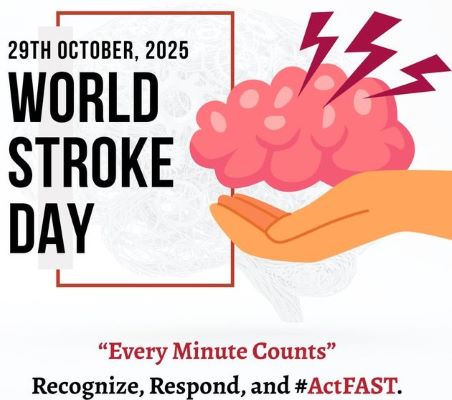
As the world observes World Stroke Day 2025, India is taking a holistic step forward in tackling one of the leading causes of death and disability — combining traditional wellness wisdom with modern medical innovation. The Ministry of Ayush and the Jawaharlal Institute of Postgraduate Medical Education and Research (JIPMER), Puducherry, have launched initiatives that strengthen both preventive and curative dimensions of stroke care, in alignment with the global theme: “Act Fast: Every Minute Counts.”
🧠 #WorldStrokeDay2025 observed at #JIPMER –Theme: “Act Fast: Every Minute Counts.”
CME, patient awareness sessions & launch of JIPMER Stroke Guidelines highlighted prevention & rapid treatment of stroke.
Early action saves lives!#ActFAST #StrokeAwareness #Healthcare #Neurology pic.twitter.com/xzcUWAG4R8— JIPMER – Official (@OfficialJipmer) October 29, 2025
- Ayush Ministry underscores holistic and preventive pathways
- JIPMER pioneers clinical innovations and awareness initiatives
- From traditional wellness to cutting-edge thrombectomy trials, India unites science and systems to reduce stroke burden
Ayush Ministry: Holistic Care for Prevention and Recovery
Highlighting the crucial role of integrative healthcare, Prataprao Jadhav, Union Minister of State (Independent Charge) for Ayush and Minister of State for Health & Family Welfare, said that Ayush systems can significantly complement conventional medicine through preventive, rehabilitative, and long-term recovery frameworks.
“The growing challenge of stroke underscores the need for comprehensive and integrative health strategies. Ayush systems, with their emphasis on preventive care and long-term rehabilitation, can reduce the national burden of stroke and improve quality of life,” said the Minister.
Read Also:
Apollo Hospitals Chennai expands citywide stroke network with 9 advanced labs
Vaidya Rajesh Kotecha, Secretary, Ministry of Ayush, added that Ayurveda, Yoga, Unani, Siddha, and Homoeopathy collectively offer a scientific, body–mind–environment framework for managing neurological conditions. “Ayush research collaborations aim to validate and expand the therapeutic potential of traditional medicine to strengthen stroke prevention and rehabilitation,” he said.
Ayush interventions — focusing on restoring Vata balance, improving nerve function, and enhancing circulation — are being studied as complementary therapies for post-stroke recovery. Meanwhile, Homoeopathy is showing promise as an adjuvant treatment to improve motor and neurological outcomes.
JIPMER: Advancing Precision and Accessibility in Stroke Care
At JIPMER, World Stroke Day 2025 was marked by a series of events, including a Continuing Medical Education (CME) session chaired by Dr. Vir Singh Negi, Director, JIPMER, and led by Dr. P. Vijaya, President of the Indian Stroke Association. The event also saw the release of the JIPMER Stroke Guidelines, edited by Dr. Sunil Narayan and his team, who achieved a reduction in “door-to-thrombolysis time” to under one hour, ensuring faster emergency response and treatment.
JIPMER has also made a significant stride in stroke technology innovation, completing a clinical trial on a novel thrombectomy device, “Supernova”, developed by Indian-origin engineers and interventional radiologists in collaboration with institutions in the USA and Hyderabad. The device, approved by the Drug Controller General of India (DCGI) in August 2024, was presented at the World Stroke Congress 2025 in Barcelona, where it was lauded for its safety, efficacy, and affordability.
Manufactured through a partnership between M/s Gravity (USA) and M/s Gurutva (Hyderabad), the Supernova device is expected to cost half to one-third of current international thrombectomy tools, potentially making advanced stroke care affordable and accessible in lower-income nations.
Nationwide Awareness and Integrative Pathways
Alongside clinical advances, JIPMER conducted a public awareness programme on early symptom recognition and risk reduction through hypertension, diabetes, and cholesterol control, echoing the Ministry of Ayush’s preventive message.
Together, these initiatives underline India’s comprehensive national strategy for stroke management — bridging modern medicine and traditional systems, innovation and accessibility, and awareness and action.
As both ministries emphasised, the message remains clear: every minute counts — and so does every method that can save a brain, a life, and a family.