NE FEATURES BUREAU
CHENNAI, NOV 20
India’s march toward mass electric mobility is no longer just an automotive shift — it is a technology-driven energy revolution. Charging infrastructure has transformed from isolated plugs into a smart, responsive, and renewable-ready ecosystem designed for speed, convenience, and national scalability. Five key innovations are now driving India’s next phase of EV charging excellence.
- Five breakthrough innovations accelerate the nation’s EV transformation
- Fast chargers, renewable-ready grids, and real-time intelligence redefine reliability
- Interoperability and app-led experiences put user convenience at the centre
- A connected, resilient, and scalable ecosystem powers India toward 2030 mobility goals
Fast Charging Innovation
Fast charging is emerging as the backbone of India’s EV expansion, shrinking charging times from hours to minutes and powering the future of intercity EV travel. High-power chargers are now being deployed nationwide, with innovators pushing the boundaries of speed, efficiency, and grid resilience.
Among the front-runners, Exicom’s Harmony Direct 2.0 stands out with ultra-fast charging capabilities reaching up to 400 kW, backed by predictive maintenance and a modular, scalable design. These systems enable simultaneous fast charging for multiple vehicles, ideal for both urban hubs and highway corridors.
Indian and global players alike are advancing modular, battery-backed fast chargers that strengthen grid stability and enhance user uptime — making high-speed EV charging a dependable new norm.
Grid-Resilient Charging: Renewables Integration and Dynamic Load Management
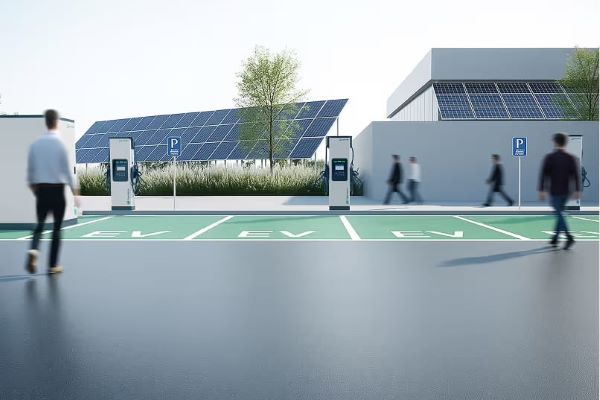
As EV demand surges, grid-resilient solutions are emerging to keep India’s charging backbone stable and sustainable. A new generation of stations is combining on-site solar generation with battery storage, reducing dependency on local grids while ensuring round-the-clock reliability.
A flagship example is India’s first solar-powered EV charging hub near Bengaluru Airport, powered by a 45 kWp rooftop solar array paired with a 100 kWh battery system. With 23 charging points, it enables 24/7 operations while easing stress on the grid.
Parallelly, smart charging networks are implementing dynamic load management that balances EV demand with available grid capacity in real time. Fortum Charge & Drive India’s New Delhi pilot showcases this innovation, modulating charging signals based on static utility supply.
Remote Monitoring Systems: Intelligence and Reliability at Scale
India’s EV charging networks are being supercharged by remote monitoring — an intelligence layer that keeps thousands of chargers operating smoothly.
Companies such as ChargeZone and Bolt.Earth use cloud-based dashboards and IoT-enabled systems to track charger health, uptime, energy flow, and diagnostics from anywhere.
With proactive fault detection, predictive maintenance, and remote troubleshooting, downtime drops dramatically. Remote monitoring has become the backbone of a smart, scalable, and user-friendly EV charging grid.
Smart Network Interoperability: Seamlessly Connected
Interoperability is eliminating the biggest pain point for EV users — incompatible chargers and fragmented apps. India is accelerating toward a unified, open-standard ecosystem where all networks speak the same language.
Platforms, including Tata Power EZ Charge, ChargeZone, Glida, and Bolt.Earth, are adopting global standards such as OCPP and ISO 15118, ensuring seamless roaming, universal payment options, and consistent user experience.
Collaboration between government, manufacturers, and operators is reshaping India’s fragmented landscape into a nationally connected, accessible, and future-ready charging network.
Connected Charging Experience: User-Centric Design
As EV adoption rises, digital platforms are becoming the command centre of the charging experience. Apps now solve real-world pain points — locating available chargers, confirming real-time functionality, enabling seamless payments, and integrating route planning.
Without such tools, EV users face non-functional chargers, payment hurdles, and navigation issues. Smart charging apps eliminate this friction.
JSW MG Motor India’s eHub app is a leading example, offering unified discovery, live status updates, navigation, and payments across 12,500+ fast chargers and 33 operators. Media reports indicate the app has crossed 1,00,000 downloads, underscoring strong demand for integrated EV charging solutions.
The Road Ahead
These five innovations represent a technological leap for India’s EV future — fast, reliable, intelligent, interconnected, and user-first. As the country targets 30% EV adoption by 2030, the charging revolution is not just progressing — it is setting global benchmarks for scalable, sustainable, and customer-centric mobility ecosystems.