- MadhuNetrAI enables early detection of diabetic eye disease at community level
- AFMS–AIIMS–MoHFW collaboration builds real-time national health intelligence
- Pilot rollout across seven diverse regions, from metros to remote areas
NE DEFENCE BUREAU
NEW DELHI, DEC 18
In a landmark advancement for preventive healthcare and defence-led medical innovation, the Armed Forces Medical Services (AFMS) has launched India’s first Artificial Intelligence–driven community screening programme for Diabetic Retinopathy (DR), strengthening early detection of diabetic eye disease and laying the foundation for a real-time national health intelligence framework.
The initiative was launched on December 16, 2025, in New Delhi in collaboration with the Dr Rajendra Prasad Centre for Ophthalmic Sciences (RPC), AIIMS, and the eHealth AI Unit of the Ministry of Health & Family Welfare. The programme was inaugurated at Army Hospital (Research & Referral), bringing together the clinical outreach of AFMS, academic leadership of AIIMS and digital innovation capabilities of the Ministry of Health.
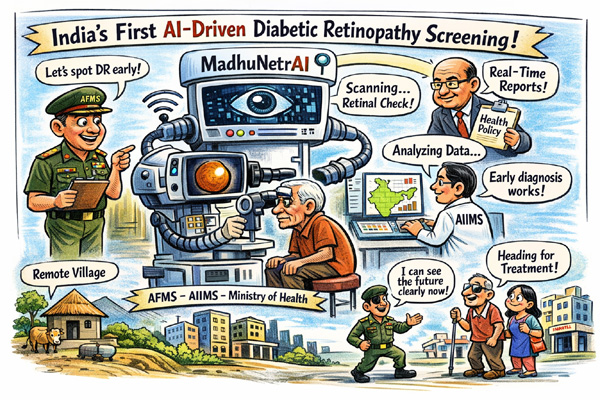
At the core of the programme is MadhuNetrAI, a web-based AI platform developed by RPC, AIIMS. The tool enables automated screening, grading and triaging of retinal images captured through handheld fundus cameras. Trained Medical Officers, nursing staff and healthcare assistants can conduct community-level screening, significantly expanding access to early diagnosis. The platform also generates real-time data on disease prevalence and geographic distribution, supporting evidence-based planning and policy formulation.
During the pilot phase, AFMS will implement the programme across seven locations—Pune, Mumbai, Bengaluru, Dharamshala, Gaya, Jorhat and Kochi—covering metropolitan, rural, hilly, coastal and remote regions. Personnel from each site will undergo intensive training at RPC, AIIMS, followed by large-scale community screening initiatives.
Patients diagnosed with Diabetic Retinopathy will be referred for appropriate diabetic management, while those with vision-threatening DR will be directed to vitreo-retina specialists at designated district hospitals. District Health Administrations will coordinate referrals and integrate DR care within existing non-communicable disease programmes to ensure continuity of treatment.
A detailed compendium outlining the programme’s methodology and operational guidelines was released at the launch. The role of the HOD and Consultant (Ophthalmology), Army Hospital (R&R), in facilitating the collaboration was also acknowledged. Designed as a scalable and replicable model, the initiative showcases how AI-enabled solutions can be seamlessly integrated into public health systems through coordinated efforts of AFMS, AIIMS and the Ministry of Health & Family Welfare.