- 74th National Town & Country Planners Conference to decode India’s next urban leap
- AI, GIS, bullet rail, BRTS and regional corridors anchor future-ready planning agenda
- Gujarat Model, TN & Maharashtra frameworks and Amaravati Capital take centrestage
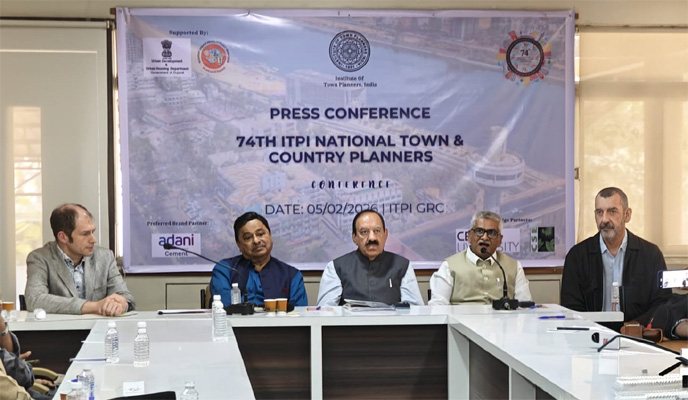
- German and Portugal experts flag global best practices at pre-event media interaction
- Women student awards, CEPT leadership, panels and 100 years of Gujarat TPS add depth
NE INFRASTRUCTURE BUREAU
Ahmedabad, February 5
After a gap of 13 years, Ahmedabad is set to reclaim the national spotlight in urban and regional planning as it hosts the 74th National Town & Country Planners Conference (NTCPC) from February 6 to 8, 2026, at the Karnavati Club, Ahmedabad–Gandhinagar. Organised by the Institute of Town Planners, India (ITPI) with support from the Gujarat Urban Development and Urban Housing Department, the three-day national meet will bring together over 500 town planners, policymakers, academicians, urban designers and infrastructure experts from across the country.
Anchored around the theme “Proactive Regional Planning and Development to Usher Viksit Bharat”, the conference comes at a defining moment for India’s urban journey, as cities grapple with scale, speed and sustainability. Deliberations will focus on Artificial Intelligence (AI), GIS-based planning tools, high-speed rail influence, rapid transit systems and data-driven governance to make regional planning more responsive and resilient.
Ahmedabad as a Living Laboratory
Ahmedabad’s evolution as a planning laboratory—from its globally referenced Bus Rapid Transit System (BRTS) to integrated mobility, land pooling and transit-oriented development—will be showcased as a replicable national model. Planning frameworks from Tamil Nadu and Maharashtra, alongside the Amaravati Capital Region’s land pooling and capital planning experiment, will also be examined for scalable adoption.
Sessions will spotlight flagship initiatives including Dholera Special Investment Region (SIR), GIFT City, Metro Rail expansion, DMIC connectivity, industrial clusters at Sanand and Becharaji, and Gujarat’s newly announced satellite town policy, positioning the state as a frontrunner in integrated regional development.
Global Voices at the Pre-Event Media Meet
At a pre-event media interaction in Ahmedabad, international planning experts from Germany and Portugal underscored the relevance of India’s planning discourse in a rapidly urbanising world.
Prof. Dr. Sabine Hoffmann (Germany), an expert in digital urban transformation and AI-driven spatial planning, said: “India is at a decisive moment where technology can redefine planning outcomes. AI must become a core planning instrument—not merely for efficiency, but for anticipating demographic, environmental and economic shifts.”
Highlighting Ahmedabad’s transport and data-led planning, she added that systems like BRTS demonstrate how scalable, tech-enabled mobility can shape inclusive cities.
Dr. Vítor Oliveira (Portugal), noted urban morphologist from the University of Porto, drew attention to India’s long planning legacy, stating: “Regions that succeed are those that respect urban form while allowing transformation. Gujarat’s century-old Town Planning Scheme shows how structure and flexibility can coexist.”
He observed that lessons from Gujarat’s TPS, when combined with European compact-city principles, offer valuable guidance for sustainable urban growth worldwide.
Policy, People and the Future of Planning
The conference gains further weight as India’s urban population is projected to touch 600 million by 2031, with 68 cities crossing the 10-lakh mark, intensifying the need for proactive regional strategies.
Pradeep Kapoor, President, ITPI, said: “As India advances towards Viksit Bharat by 2047, planning must move ahead of growth, not chase it. This conference is about aligning technology, governance and inclusivity to build balanced regions.”
NK Patel, Past President and Patron, ITPI, noted: “Discussions will focus on spatial equity, climate-resilient infrastructure, economic corridors, urban-rural continuum management and stronger institutional mechanisms such as Metropolitan Planning Committees and regional authorities.”
R.J. Rawal, Chairman, ITPI Gujarat Regional Chapter, said the conference would also commemorate 100 years of Town Planning Schemes in Gujarat, showcasing how the state’s planning framework continues to influence urban and peri-urban development across India.
Women, Academia and AI-Led Futures
Reinforcing inclusivity, ITPI will confer special awards to outstanding UG and PG, including a special women category, students in town planning, encouraging leadership diversity in the profession. CEPT University’s leadership and faculty will play a key role through technical sessions and panel discussions, particularly on AI deployment in town planning schemes, mobile GIS, and inclusive infrastructure planning for mega events such as the Commonwealth Games 2030 in Ahmedabad.
Panel discussions will also explore inter-state coordination, river basin planning, renewable-ready grids, and next-generation regional governance models, positioning the conference as one of the most comprehensive urban policy platforms in the country.