- Third edition of GSAC places water, sanitation and climate action at the heart of global development
- 300 delegates from 30 countries engage in cross-learning on inclusive, climate-resilient WASH
- Academia, policy and practice intersect to shape solutions for vulnerable communities
- Global South voices drive evidence-led pathways towards SDG 6 and SDG 13
NE ENVIRONMENT EDUCATION BUREAU
AHMEDABAD, FEB 10
The Global South Academic Conclave (GSAC) on WASH and Climate 2026, organised by the Centre for Water and Sanitation (CWAS) at the CEPT Research and Development Foundation (CRDF) in collaboration with the Faculty of Planning, CEPT University, was inaugurated at the CEPT University campus. The Conclave is supported by the Gates Foundation and the Viega Foundation.
Now in its third edition, GSAC 2026 has built on the momentum of its earlier cohorts, bringing together nearly 300 participants from 30 countries. Designed as a premier cross-learning and dialogue platform, the Conclave convenes academics, policymakers, sector professionals, implementers and researchers to examine the increasingly urgent and complex interlinkages between Water, Sanitation and Hygiene (WASH) and climate change, particularly across the Global South.
Welcoming the participants, Professors Emeriti and Senior Advisors at CWAS, Prof. Dinesh Mehta and Prof. Meera Mehta, underscored the Conclave’s growing relevance in an era of accelerating climate risks.
Prof. Dinesh Mehta said, “The need for more inclusive and climate-resilient communities is greater than ever. Through this Conclave, we aim to bring together diverse expertise and create a platform for knowledge exchange that helps build a cleaner and safer future for the coming generations.”
Prof. Meera Mehta added, “The Global South Academic Conclave bridges academia and practice, creating a global platform where experiences and learnings are not confined to practitioners alone but are equally shared with academics, who represent the next generation that will carry this work and its legacy forward.”
Setting the tone for the deliberations, CWAS Centre Heads Dhruv Bhavsar and Aasim Mansuri highlighted the immediacy of climate challenges facing the WASH sector.
Dhruv Bhavsar noted, “Climate risks are no longer distant concerns; they are immediate priorities, and platforms such as this Conclave are critical to advancing solutions through shared learning across the Global South.”
Aasim Mansuri added, “These challenges are further compounded by a rapidly shifting geopolitical order, where development assistance for climate action and WASH is coming under increasing pressure, making collaboration and knowledge exchange more important than ever.”
The two-day Conclave is structured around key thematic pillars, including:
• WASH Monitoring and Climate Resilience, focusing on systems, policies and strategies for tracking WASH outcomes under climate stress;
• Governance and Financing for Inclusive, Climate-Resilient WASH, examining political, administrative, economic and financial frameworks that enable equitable and resilient service delivery;
• Technology and Innovation in WASH Service Delivery, highlighting emerging tools, digital solutions and community-level innovations supporting climate-adaptive water and sanitation systems.
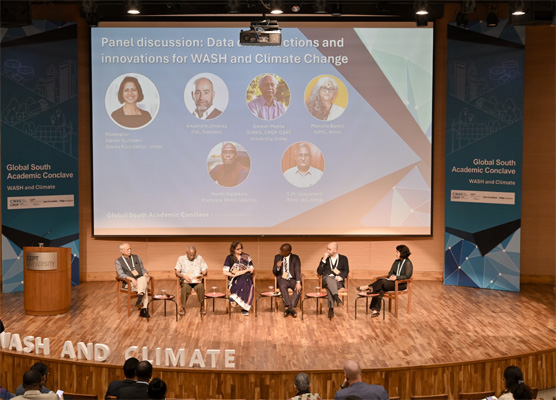
The first day featured keynote addresses by leading global WASH advocates, including Ms Neeta Pokhrel, Director, Water and Urban Development, Asian Development Bank; Mr Silver Mugisha, Managing Director, National Water and Sewerage Corporation, Uganda; and Mr Patrick Moriarty, CEO, IRC, Netherlands. The sessions included two panel discussions followed by technical presentations.
The second day will feature keynote addresses by Ms Aloka Majumdar, Managing Director and Global Head – Philanthropy and Sustainability, HSBC-India; Mr Osward Chanda, Former Director, African Development Bank; and Ms Kate Medlicott, Team Lead, Sanitation and Wastewater, WHO, along with panel discussions, thematic sessions and structured networking across disciplines and geographies.
GSAC continues to foster rigorous dialogue and exchange, positioning evidence, cross-sector research and practice-based insights at the centre of global WASH-climate discourse. Organisers envision GSAC 2026 as a catalyst for actionable knowledge, stronger regional networks and meaningful contributions to global commitments—particularly Sustainable Development Goal 6 (Clean Water and Sanitation) and Sustainable Development Goal 13 (Climate Action).