

R ARIVANANTHAM
CHENNAI, FEB 27
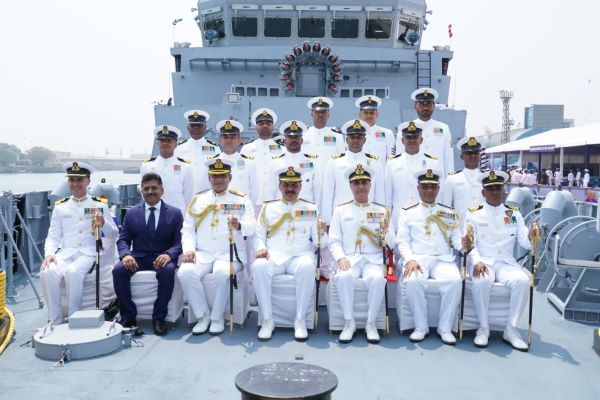
In a defining moment for India’s maritime power and indigenous defence capability, Chief of the Naval Staff Admiral Dinesh K Tripathi commissioned INS Anjadip, the Indian Navy’s fourth indigenously designed and built Anti-Submarine Warfare Shallow Water Craft (ASW-SWC), reinforcing the nation’s undersea combat readiness and coastal defence architecture.
#INSAnjadip
“अद्वितीय शत्रु विध्वंसक” – The Dolphin Hunter pic.twitter.com/tAjc80rOrf— SpokespersonNavy (@indiannavy) February 27, 2026
“It is a moment of immense pride for me to be present here as we commission INS Anjadip … the Indian Navy’s fourth indigenously designed and built Anti-Submarine Warfare Shallow Water Craft,” said Chief of the Naval Staff Admiral Dinesh K Tripathi at the commissioning ceremony on Chennai’s historic Coromandel Coast.
- Chief of Naval Staff Admiral Dinesh K Tripathi commissions fourth indigenous submarine hunter, boosting coastal warfare dominance
- Advanced Anti-Submarine Warfare craft embodies Aatmanirbharta and India’s rise as a decisive Indian Ocean power
- Named after historic Anjadip Island, warship carries legacy of naval courage and strategic resolve
- Part of Indian Navy’s ambitious 200-ship vision, strengthening maritime security amid global geopolitical tensions
Recalling India’s rich maritime legacy, Admiral Tripathi noted that over a thousand years ago, the great Chola seafarers sailed from these very shores across the Bay of Bengal, underscoring India’s enduring civilisational bond with the seas.
As Prime Minister Narendra Modi has articulated, “India has always been a maritime civilisation. Today our security and prosperity are linked to oceans.”
A Warship Rooted in Legacy, Built for Modern Maritime Warfare
INS Anjadip succeeds the illustrious Petya-class corvettes, which served the nation with distinction for over three decades from 1972 to 2003.
“Anjadip joins the Indian Navy today as a befitting successor to her illustrious predecessor, the last of the Petya-class corvettes, which served the nation with distinction across varied operational deployments,” Admiral Dinesh K Tripathi said.
Named after Anjadip Island, the warship commemorates decisive naval action during the 1961 liberation of Goa.
“That spirit — of resolve, valour, bold action and safeguarding national maritime interests at any cost — is the enduring legacy that this Anjadip carries forward,” Admiral Tripathi emphasised.
Guarding the World’s Most Critical Maritime Lifeline
Describing the Indian Ocean Region as the epicentre of the emerging Maritime Century, Admiral Dinesh K Tripathi highlighted its enormous strategic importance.
Nearly 2.9 billion people across 33 nations live along the Indian Ocean littoral, with over 1,20,000 ships transiting annually, carrying:
- Two-thirds of global oil shipments
- One-third of global bulk cargo
- Half of the world’s container traffic
“India’s journey to becoming Viksit Bharat 2047 will be shaped at, by, and from the seas — it is truly a maritime voyage,” Admiral Tripathi said.
He also pointed to recent global maritime disruptions, including the Red Sea crisis and tensions in the Strait of Hormuz, which demonstrated how even limited disruptions can trigger global economic consequences.
Since October 2023, Indian Navy deployments in the Red Sea have enabled the safe transit of nearly 400 merchant vessels carrying over 16.5 million metric tonnes of cargo valued at more than 7 billion US dollars bound for India.
“Our ships continue to operate alongside partner navies, strengthening maritime cooperation and ensuring security and stability in the region,” Admiral Tripathi added.
Cutting-Edge Indigenous Technology Strengthens India’s Undersea Warfare Edge
INS Anjadip represents a major technological leap in India’s anti-submarine warfare capability, particularly in shallow coastal waters.
The warship is equipped with:
- Advanced shallow-water sonar systems
- Lightweight torpedoes
- Anti-submarine rocket launchers
- Sophisticated Combat Management System
- High agility and rapid response capability
“Today’s commissioning marks a substantive strengthening of our under-sea warfare capability — particularly in the coastal and littoral waters,” Admiral Dinesh K Tripathi said.
The ship’s motto, “अद्वितीय शत्रु विध्वंसक” (Unmatched Destroyer of Enemies), reflects its lethal mission as a silent and decisive submarine hunter.
“I am confident that the ship’s motto will inspire you to remain vigilant in watch, silent in approach, and decisive in strike,” Admiral Tripathi told the commissioning crew.
Aatmanirbharta in Action: Indigenous Shipbuilding Powers Naval Transformation
INS Anjadip stands as a powerful symbol of India’s growing self-reliance in defence manufacturing.
As Defence Minister Rajnath Singh has stated, “Indigenisation in defence production enhances operational preparedness and strengthens national security.”
The warship was built through national industrial collaboration involving:
- Garden Reach Shipbuilders & Engineers
- Larsen & Toubro
- Bharat Electronics Limited
- MSMEs, start-ups, naval designers and industry partners across India
“The delivery of Anjadip within just seven months of Arnala is a strong affirmation of GRSE’s standing as a dependable partner in strengthening naval preparedness,” Admiral Dinesh K Tripathi said.
He emphasised that India’s self-reliance vision is evolving beyond “Make in India” to “Trust in India” — reflecting sovereign technological capability and operational independence.
Toward a 200-Ship Navy and Maritime Dominance
The commissioning of INS Anjadip comes amid unprecedented naval expansion.
During 2025 alone, the Indian Navy commissioned 12 warships and one submarine, with plans to induct approximately 15 more ships in 2026.
The Navy aims to build a 200+ ship force by 2035, with all 50 ships currently on order being constructed in Indian shipyards.
“Our operational footprint today extends across the Indian Ocean Region and beyond, reflecting sustained reach and credible operational depth,” Admiral Dinesh K Tripathi said.
He congratulated the shipbuilders, naval designers and crew, stating: “Your pride in workmanship and commitment to excellence have truly given life to steel and systems.”
INS Anjadip now joins the Eastern Naval Command, strengthening India’s ability to protect its maritime interests, secure vital sea lanes and uphold regional stability.