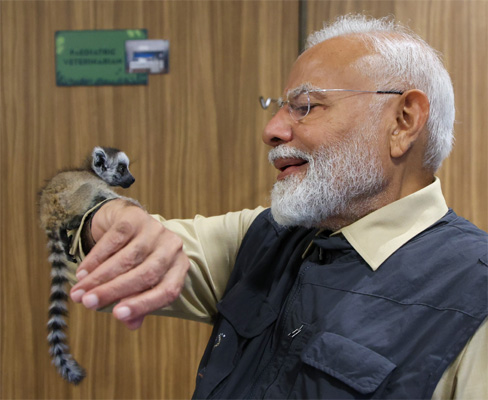
- One year after inauguration by Narendra Modi, Vantara reports measurable impact in wildlife rescue and rewilding
- Founded by Anant Ambani, the conservation initiative blends compassion with cutting-edge science
- Over 250 rescued elephants, thousands of crocodiles and diverse species rehabilitated
- National Referral Centre status strengthens India’s One Health and wildlife disease surveillance
- From Barda to Indonesia, rewilding efforts signal a second chance for endangered species
NE ENVIRONMENT BUREAU
JAMNAGAR (GUJARAT), MAR 3
One year after its inauguration by Prime Minister Narendra Modi, Vantara has emerged as one of India’s most ambitious, science-led wildlife conservation ecosystems — restoring thousands of animals to health and returning many to the wild.
On Vantara Foundation Day, the institution reflected on 12 months of measurable impact in wildlife rescue, advanced veterinary medicine, conservation research and rewilding. Founded by Anant Ambani, Vantara was envisioned as a global model rooted in compassion, welfare and scientific excellence.

In its first year, Anant Ambani received the prestigious Global Humane Award for his remarkable global contribution to wildlife care and conservation — recognition that underscores a commitment to compassionate, science-led conservation. Vantara has also earned memberships with EARAZA and SEAZA, Global Humane Conservation Certification, and the Prani Mitra Award 2025.
Beyond global recognition, the foundation has prioritised long-term capacity building — training hundreds of veterinarians in conservation medicine, hosting more than 50 national and international knowledge-sharing forums, and engaging thousands of children through outreach programmes designed to nurture future conservation stewards.
Rescue, Rehabilitation and Rewilding at Scale
Over the past year, Vantara has rescued animals from distressed and exploitative conditions and provided world-class veterinary care and specialised long-term support to more than 250 elephants saved from logging operations, circuses, rides and begging. Many of these elephants suffer from arthritis and age-related ailments, requiring sustained, expert medical intervention.
The foundation also continues to care for thousands of crocodiles rescued from overcrowded facilities, alongside big cats, primates, birds, reptiles and other mammals — reflecting a globally engaged conservation model grounded in welfare and science.
In a major milestone for ecosystem restoration, 53 spotted deer were released into the Barda Wildlife Sanctuary in partnership with the Gujarat Forest Department. Internationally, the snake-necked turtle rewilding initiative in Indonesia further demonstrated Vantara’s cross-border conservation commitment.
Each release represents not just rehabilitation but hope — a second chance at survival for endangered species.
Strengthening India’s One Health Ecosystem
Designated as the National Referral Centre for Wildlife (West Zone), Vantara has strengthened India’s One Health ecosystem by integrating wildlife health into broader disease surveillance and coordinated response frameworks.
Its scientific backbone comprises a central laboratory and 11 satellite laboratories, supported by over 70 specialists and processing more than 2,000 diagnostic samples daily. Capabilities include bio-banking, next-generation sequencing, molecular diagnostics, pathology, parasitology and toxicology — positioning Vantara at the forefront of wildlife disease research and climate-linked health surveillance.
Integrated Care Model: Nutrition, Logistics and Rapid Response
Supporting thousands of animals daily requires unprecedented logistical precision. Vantara produces 1,56,000 kg of high-quality nutrition through fully automated systems, transported via 50 temperature-controlled vehicles. Operations are managed by 200 qualified professionals and supported by more than 1,000 farmers cultivating fodder and feed.
A 200-member round-the-clock response team has supported over 50 international rescue operations and deployed 15 Wildlife Rapid Response and Rescue Teams — reinforcing India’s global footprint in conservation emergency response.
Beyond Wildlife: Humanitarian and Ecological Resilience
When devastating floods struck Punjab, Vantara extended support to affected communities, safeguarding thousands of animals and assisting over one million people. The intervention underscored the interdependence between ecological resilience and human wellbeing — reaffirming that protecting biodiversity also strengthens communities.
One year after its inauguration, Vantara stands as an integrated conservation ecosystem advancing rescue, research, rewilding and public engagement at scale. At its core lies a clear mission: to create measurable conservation impact that protects wildlife, empowers communities and contributes to a more sustainable future — in India and across the world.