R ARIVANANTHAM
CHENNAI, MAR 7
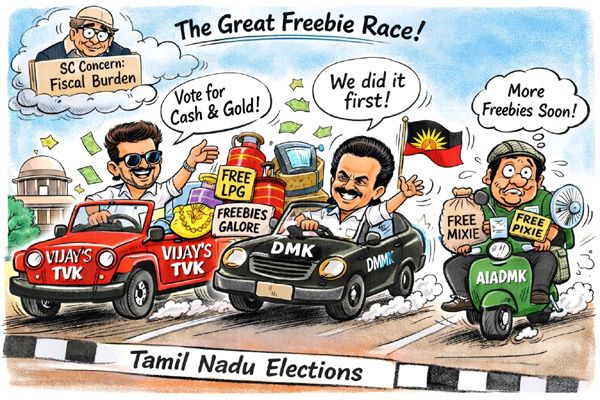
Ahead of International Women’s Day, actor-politician Vijay (actor) unveiled a sweeping set of welfare promises aimed at women voters, signalling that the upcoming Tamil Nadu Assembly election could see a renewed battle of freebies among political parties.
- Actor-politician Thalapathy Vijay unveils a basket of cash aid, gold and free LPG to woo women voters ahead of the Assembly polls
- From ₹2,500 monthly assistance to six free cylinders, TVK’s promises intensify Tamil Nadu’s long-running “freebie politics”
- Rivals question economic viability as the welfare race escalates between Dravidian parties and new challengers
- Supreme Court and economists warn of fiscal risks while parties defend schemes as social justice tools
- Why Dravidian politics has historically turned welfare benefits into a decisive electoral battleground
Addressing a gathering organised by his party Tamilaga Vettri Kazhagam (TVK) in Mamallapuram, Vijay promised that if elected to power, his government would roll out a series of schemes including ₹2,500 monthly financial assistance for women, six free LPG cylinders annually, and a sovereign of gold with a silk saree as a wedding gift for young women.
The actor, popularly known as “Thalapathy”, said the cash assistance would be provided to all women—except government employees—until the age of 60.
Among the key announcements were:
- ₹2,500 monthly financial support for women
- Six free LPG cylinders annually under the Annapurani Super Six Scheme
- One sovereign gold and silk saree as a marriage gift for women
- ₹15,000 annual support for mothers to prevent school dropouts under Kamarajar Kalvi Uruthi Thittam
- Free bus travel for women in state-run buses
- Interest-free loans up to ₹5 lakh for women Self-Help Groups
- Gold ring and baby care kit for every newborn under the proposed Ashirwad scheme
Vijay also promised panic buttons in buses, fast-track courts for crimes against women and a dedicated “Rani Velu Nachiyar” police unit for women’s safety.
Attacking the ruling Dravida Munnetra Kazhagam (DMK) led by M. K. Stalin, Vijay alleged large-scale corruption in the state’s finances.
He said, “A 30 per cent ‘Stalin sir tax’ of loot and corruption is happening in Tamil Nadu’s ₹4.39 lakh-crore budget. A graft-free super-good government can easily implement these schemes.”
Welfare race intensifies
Vijay’s announcements immediately reignited debate over Tamil Nadu’s long tradition of welfare-driven electoral politics.
The state has historically seen intense competition between the DMK and All India Anna Dravida Munnetra Kazhagam (AIADMK) over welfare schemes ranging from free televisions and laptops to subsidised food and bus travel.
Former AIADMK leader J. Jayalalithaa had once defended such promises by arguing they were meant to uplift poorer citizens.
She had said: “I do agree we have announced freebie schemes. It is because the AIADMK is always on the side of the poor… Such schemes are for uplifting the poor people and helping them stand on their own legs.”
However, critics say such announcements are often timed around elections.
Recently, G. K. Vasan of the Tamil Maanila Congress questioned the timing of welfare payouts by the DMK government, saying that large cash transfers announced before elections could mislead voters.
Economic viability debate
Economists and policy analysts have repeatedly raised concerns about the fiscal sustainability of large-scale welfare promises.
Tamil Nadu already carries a substantial public debt burden, and expanding subsidies—especially cash transfers and consumer benefits—could increase fiscal pressure if not matched by higher revenue.
The issue has also reached the Supreme Court of India, where debates over “freebie culture” have triggered calls for guidelines on election promises and fiscal responsibility.
The court has in the past observed that unlimited freebies could distort electoral competition and strain state finances, though it has also acknowledged that some welfare schemes are legitimate instruments of social policy.
Why Dravidian parties compete on welfare
Political analysts say Tamil Nadu’s welfare politics is rooted in the Dravidian movement’s emphasis on social justice and redistributive governance.
Since the late 1960s, governments led by the DMK and AIADMK have used welfare programmes to:
- Reduce social inequality
- Support lower-income households
- Expand education and health access
- Mobilise women voters and marginalised communities
Programmes like mid-day meals, subsidised food, free bus travel for women and financial assistance schemes have helped expand the state’s human development indicators.
At the same time, electoral competition has turned these schemes into a political arms race.
With Vijay’s entry through TVK, analysts say the welfare contest may intensify further as parties seek to capture the crucial women and youth vote bank.
A new challenger in a familiar battlefield
For Vijay, the Women’s Day announcement signals his attempt to position TVK within the core grammar of Tamil Nadu politics — welfare, social justice and pro-poor messaging.
Whether his promises translate into electoral traction remains uncertain.
But one thing is clear: in Tamil Nadu’s political theatre, freebies and welfare schemes remain one of the most powerful campaign scripts.