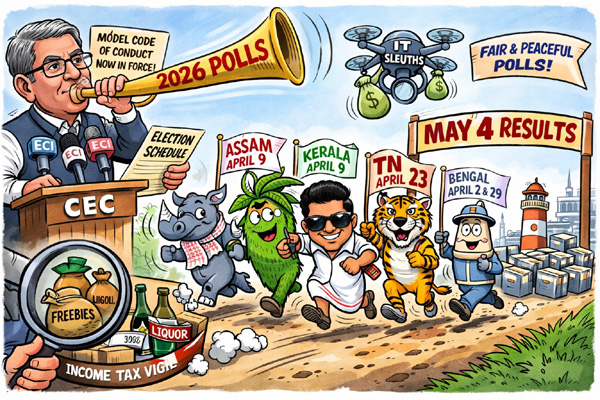
- Assam, Kerala & Puducherry to Vote on April 9; Tamil Nadu and West Bengal Polls on April 23
- Bengal Elections in Two Phases; Results for All States on May 4
- Model Code of Conduct Kicks In; Special Income-Tax Monitoring Wing Activated
- 4 Crore Voters, 2.19 Lakh Polling Stations, Nearly 25 Lakh Officials on Duty
- CEOs Assure Violence-Free, Transparent and Inducement-Free Elections
NE POLITICAL BUREAU
NEW DELHI, MAR 15
India’s election season formally began on Sunday as the Election Commission of India announced the schedule for the 2026 Assembly elections in Assam, Kerala, Tamil Nadu, West Bengal and the Union Territory of Puducherry, setting the stage for one of the largest democratic exercises in the country this year.
The counting of votes for all five legislatures will take place on May 4, determining the governments in politically crucial regions that collectively represent 17.4 crore voters across 824 constituencies.
The announcement was made at a press conference in New Delhi by Chief Election Commissioner Gyanesh Kumar, along with Election Commissioners Sukhbir Singh Sandhu and Vivek Joshi.
Phase-wise poll calendar
The elections will be conducted in a mix of single-phase and multi-phase formats across the five regions.
Assam (126 seats)
• Polling: April 9
• Counting: May 4
Kerala (140 seats)
• Polling: April 9
• Counting: May 4
Puducherry (30 seats)
• Polling: April 9
• Counting: May 4
Tamil Nadu (234 seats)
• Polling: April 23
• Counting: May 4
West Bengal (294 seats)
• Phase 1: April 23 (152 seats)
• Phase 2: April 29 (142 seats)
• Counting: May 4
Overall, the exercise will involve 2.19 lakh polling stations and nearly 25 lakh election officials, reflecting the scale of India’s democratic machinery.
Model Code of Conduct in force
With the announcement of the schedule, the Model Code of Conduct (MCC) has come into immediate effect in all five poll-bound regions.
The code bars governments and political parties from announcing new policy decisions, financial grants, or welfare schemes that may influence voters.
CEC’s Clarification
“The Model Code of Conduct becomes applicable only after the announcement of the election schedule. Actions taken before that remain within the prerogative of the government concerned,” said Chief Election Commissioner Gyanesh Kumar.
He reiterated that the Commission would monitor campaign speeches, political conduct and inducements strictly under MCC provisions.
Special Income-Tax Monitoring Wing Activated
To ensure money power does not influence voters, the Commission has activated a Special Income Tax Monitoring Wing to track suspicious financial transactions during the election period.
Officials said the unit will coordinate with enforcement agencies to detect cash movements, illegal inducements, and unaccounted political funding.
Election observers and flying squads will also be deployed across sensitive constituencies to check distribution of cash, liquor, gifts and freebies during campaigning.
CEOs assure transparent elections
Chief Electoral Officers (CEOs) of poll-bound states have assured the Commission that administrative and security preparations are in place.
Officials said the focus areas include:
• Deployment of central armed police forces in sensitive constituencies
• Strict monitoring of campaign expenditure
• Special arrangements for first-time voters and senior citizens
• Measures to curb misinformation, deepfakes and social media manipulation
A senior CEO stated that real-time coordination between district election officers, police authorities and observers will ensure free and fair polls.
Tackling violence, deepfakes and misinformation
The Commission also flagged the growing threat of deepfakes and digital misinformation during elections.
CEC Gyanesh Kumar warned that the poll panel will closely track digital platforms and campaign speeches to prevent misleading content from influencing voters.
“Elections in India are a festival of democracy. The Commission will ensure that the process remains peaceful, transparent and inducement-free,” he said.
Largest democratic exercise
The elections come at a politically significant moment as they will determine the governments in four major states and one Union Territory, each with distinct political dynamics.
Together, these regions account for a massive electorate of 17.4 crore voters, making the upcoming polls one of the largest democratic exercises in the world this year.
With the poll bugle now sounded, political parties across the five regions are expected to intensify candidate announcements, alliance negotiations and campaign strategies in the weeks ahead.
From the horse’s mouth
Chief Election Commissioner Gyanesh Kumar
“Elections in India are a festival of democracy. Every citizen is a stakeholder in this process.”
“The Commission will ensure peaceful, violence-free and inducement-free elections.”
Election Commission Officials
“Strict monitoring mechanisms, including the Income Tax surveillance wing, have been activated to curb illegal campaign financing.”
State Chief Electoral Officers
“Administrative machinery and security forces are fully prepared to ensure free, fair and transparent polls.”