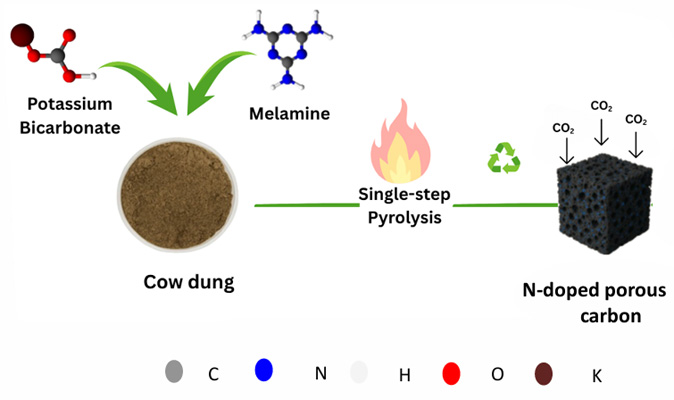
- Low-cost, scalable innovation targets CO₂ at source using abundant biomass
- Nitrogen-doped porous carbon delivers 58% higher performance than conventional material
- Green chemistry meets climate action with minimal waste and maximum efficiency
- Breakthrough works at low temperatures, boosting real-world deployment potential
- Aligned with global climate goals and India’s net-zero 2070 vision
NE SCIENCE & TECHNOLOGY BUREAU
GANDHINAGAR | MAR 18
In a remarkable stride towards affordable climate solutions, researchers at Indian Institute of Technology Gandhinagar (IITGN) have developed a low-cost, sustainable, and scalable carbon capture material derived from cow dung, transforming a widely available biomass into a powerful environmental tool.
Published in the journal Surfaces and Interfaces, the study introduces nitrogen-doped porous carbon (NDPC-1)—a high-performance material engineered to capture carbon dioxide (CO₂) efficiently. With a nitrogen content of 2.95% and an impressive surface area of 1153 m² per gram, the material demonstrated 58% higher performance than pristine carbon.
At a time when rising CO₂ levels are accelerating global warming, the innovation offers a clean, accessible alternative to conventional carbon capture technologies, which often rely on toxic chemicals and energy-intensive processes.
Explaining the process, researchers noted:
“To make it, we mixed cow dung with melamine (which provides nitrogen) and potassium bicarbonate. Nitrogen incorporated into carbon improves the material’s ability to attract CO₂, and potassium bicarbonate is a green, less corrosive, and effective activating agent to create a high surface area in the material,” said Ranjeet Kumar and Sree Harsha Bharadwaj H, PhD scholars at IITGN.
Highlighting the performance edge, Chinmay Ghoroi said: “The best-performing nitrogen-doped porous carbon, NDPC-1, performed 58% better than pristine carbon, which is pyrolysed cow dung without any activation. NDPC-1 also exhibited excellent cyclic stability, which is the ability of the porous carbon to maintain its initial CO₂ capture capacity after 10 adsorption-desorption cycles.”
On the scientific depth behind the discovery, Raghavan Ranganathan explained: “Our work includes the combination of reactive molecular dynamics computational simulation and Grand Canonical Monte Carlo simulations with experiments to elucidate the structure-property relationship governing CO₂ adsorption. This framework provides a deeper mechanistic understanding of nitrogen functionality and pore architecture, among other features.”
What makes this breakthrough particularly significant is its real-world applicability. Unlike many existing carbon capture materials that function at high temperatures (400–700°C), NDPC-1 operates efficiently at near-ambient conditions (around 30°C)—a critical advantage for scalable deployment.
The process also generates minimal wastewater, aligning with principles of green chemistry and sustainable manufacturing. By integrating waste valorisation with advanced material science, the innovation paves the way for eco-friendly carbon capture technologies that are both practical and affordable.
The research aligns closely with global and national climate priorities, including the United Nations Sustainable Development Goal 13 (Climate Action) and India’s National Action Plan on Climate Change, which targets net-zero emissions by 2070.
The team acknowledged support from key institutions, including the Department of Scientific and Industrial Research–IITGN Hub, the Science and Engineering Research Board, and the Department of Science and Technology under the Mission Innovation (IC3) – CCUS initiative, along with IITGN’s advanced research facilities.