NE DEFENCE BUREAU
NEW DELHI, MAR 20
With drones rapidly redefining modern warfare, Rajnath Singh has made a strong pitch for India to emerge as a global hub for drone manufacturing within the next few years, calling for a mission-mode push to build a fully indigenous ecosystem.
Speaking at the National Defence Industries Conclave in New Delhi. https://t.co/se8uVDhQDp
— Rajnath Singh (@rajnathsingh) March 19, 2026
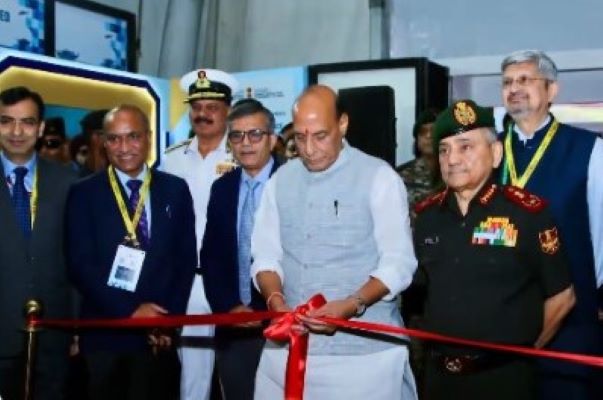
Addressing the National Defence Industries Conclave 2026 in New Delhi, the Defence Minister underlined that strategic autonomy and defence preparedness now hinge on self-reliance in drone technologies, especially in the backdrop of evolving geopolitical tensions.
Raksha Mantri Shri @rajnathsingh inaugurated the 2-day National Defence Industries Conclave in Delhi, launching DISC-14, ADITI challenges, and 101 innovation challenges from DPSUs. He stressed building a drone production ecosystem for strategic autonomy and Aatmanirbhar Bharat.… https://t.co/53bUJxnQXd
— PRO & Spokesperson, MoD, Jammu Region (@prodefencejammu) March 19, 2026
‘From parts to platforms’: Full-Stack indigenous capability
Defence Minister stressed that self-reliance must go beyond assembly: “From the drone’s molds to its software, engines, and batteries, everything must be manufactured in India. This is no easy task. In most countries where drones are manufactured, a significant number of critical components are currently imported from China.”
Highlighting global conflicts—from the Russia-Ukraine war to tensions in West Asia—he noted:
“Drones and counter-drone technologies are destined to play a pivotal role in future warfare.”
Policy push & industry power: A unified defence ecosystem
Calling for a collaborative approach, he said: “The creation of a strong defence industrial ecosystem depends on the combined efforts of large industries, MSMEs, start-ups, and innovators, supported by a clear policy push tailored to national requirements.”
He assured full government backing to transform India into a global drone manufacturing powerhouse.
Innovation engine fires up: iDEX, DISC & ADITI
At the conclave, Defence Minister launched:
- DISC-14 (Defence India Start-up Challenge)
- ADITI Challenges 4.0
A total of 107 problem statements (82 under DISC-14 and 25 under ADITI) were unveiled from the Defence Forces, Coast Guard, and Defence Space Agency.
Additionally, 101 innovation challenges from DPSUs were introduced to promote design-led innovation, offering mentorship, testing facilities, and supply-chain integration for start-ups.
Start-up surge: Numbers that signal momentum
Highlighting the impact of Innovations for Defence Excellence (iDEX), he said: “As of February 2026, approximately 676 start-ups, MSMEs, and individual innovators have joined the defence innovation ecosystem since the inception of iDEX in 2018. 548 contracts have been signed; and 566 challenges launched.”
He added: “Of these, 58 prototypes have received clearance for procurement, valued at around ₹3,853 crore. Furthermore, 45 procurement contracts have already been signed, worth nearly ₹2,326 crore. These figures demonstrate that innovation is gradually materialising into tangible products & technologies.”
Future tech mandate: AI, Robotics & Digital Twins
Emphasising next-generation technologies, he said: “Innovations such as Automation, Artificial Intelligence, Robotics, and Additive Manufacturing are reshaping the global manufacturing sector.”
On emerging tools, he explained: “A ‘Digital Twin’ essentially involves creating a virtual model of a real-world system. Such technologies empower us to better comprehend complex systems and facilitate more informed decision-making.”
MSMEs at the core: Growth, integration & scale
Defence Minister highlighted the critical role of MSMEs: “MSMEs are today actively engaged in fields such as Artificial Intelligence, Robotics, Automation, and Advanced Manufacturing, representing a monumental and positive transformation.”
He stressed integration as key: “Horizontal integration enables MSMEs to collaborate across sectors, while vertical integration connects them with large industries and emerging technologies. Together, they create a robust innovation ecosystem.”
Policy backbone: Enabling ‘Champion MSMEs’
Referring to government support, he said: “A three-pronged approach providing Equity, Liquidity, and Professional support has been introduced to help MSMEs emerge as ‘Champion MSMEs’.”
He added that the number of MSMEs has grown significantly—from 4.67 crore in 2012-13 to nearly 8 crore today—reflecting rising entrepreneurial momentum.
Vision ahead: From start-ups to global leaders
Encouraging innovators, the Defence Minister said: “We see start-ups serving as catalysts for social change through their unique ideas, while others achieve ‘Unicorn’ status in a short span. Many more will emerge in the near future with consistent effort and dedication.”
He urged stakeholders to push forward: “Innovate, embrace new technologies, and realise the vision of self-reliant and developed India.”
Industry & Policy Converge at Conclave
Sanjeev Kumar said: “The conclave aims to promote advanced manufacturing technologies and integrate MSMEs across the entire value chain—from design to development and manufacturing.”
He added: “The 200 problem statements will provide opportunities for industries, start-ups, and innovators to design state-of-the-art products and enhance their capabilities.”