- Tata Group’s global battery arm locks in a major construction milestone in Gujarat’s Sanand
- Massive steel framework signals rapid march towards India’s clean energy ambitions
- 20 GWh capacity plant to power EV revolution and grid-scale storage demand
- 2,500+ workforce, 24,000 tonnes steel underline scale of execution and local sourcing push
- Project to fuel jobs, skills, and India’s Net Zero 2070 roadmap
NE BUSINESS BUREAU
AHMEDABAD, APR 2
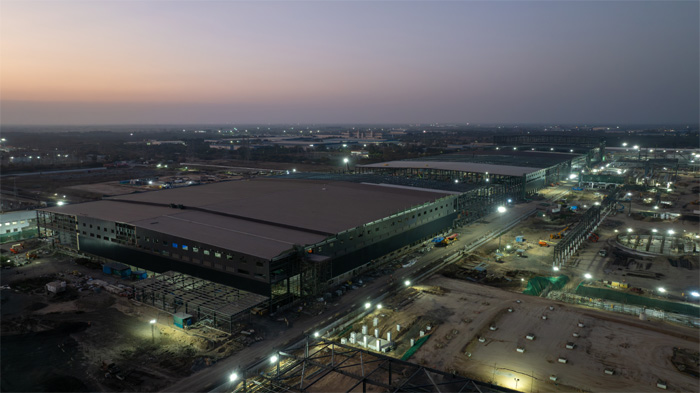
In a decisive leap towards India’s clean energy future, Agratas, the Tata group’s global battery business, has achieved a critical construction milestone at its Sanand facility in Gujarat, with the completion of its massive steel framework—paving the way for production rollout in 2027.
Scale, speed & structural might
The newly completed steel structure stretches an impressive 700 metres in length, 150 metres in width, and towers up to 34 metres, encompassing a built-up area of 105,000 square metres.
Over 24,000 tonnes of steel have been deployed, marking the project as one of the most ambitious industrial builds in the region. At peak construction, more than 2,500 skilled workers operated simultaneously on-site, reflecting the scale and intensity of execution.
The project is being executed by Tata Projects Limited in collaboration with Tata Consulting Engineers (TCE) and multiple steel contractors, with a strong emphasis on domestic sourcing, strengthening India’s industrial backbone and reducing import dependency.
Quality & sustainability at the core
Agratas has embedded stringent quality benchmarks and regulatory compliance into every phase of construction, ensuring a robust foundation for long-term operational excellence.
Sustainability remains central to the project’s DNA, with environmentally responsible design and construction practices guiding development—aligning with global standards and India’s green transition goals.
Voices from the ground
Sharing his perspective, Sudhir Ghalsasi, Vice President – Capital Delivery, Agratas, said: “This milestone reflects the scale, complexity, and pace of execution at Sanand. In a dynamic and evolving environment, translating detailed designs into on-ground reality comes with its own set of challenges. What began as a vision is now taking shape through strong collaboration, disciplined execution, and a shared commitment across teams. Together with our partners, we’ve turned our plans into tangible progress, building a future-ready facility that will deliver long-term value.”
Deepak Khare, Vice President – Manufacturing Operations, Agratas, added: “Completing the steel frame at Sanand marks an important step in our journey towards operational readiness. As we move forward, our focus is on building the systems, processes and capabilities required to deliver reliable, world-class batteries made in India for the world, while developing a highly skilled workforce to support safe and high-quality manufacturing.”
Powering India’s net zero ambitions
With India targeting Net Zero emissions by 2070 and aiming for 500 GW of non-fossil fuel capacity by 2030, the need for advanced battery manufacturing has never been more urgent.
Agratas’ Sanand facility, with an initial annual capacity of 20 GWh, is poised to play a pivotal role in powering electric vehicles and grid-scale energy storage, accelerating the nation’s shift away from fossil fuels.
Jobs, skills & a future-ready ecosystem
Beyond infrastructure, the project is expected to generate significant employment across production, engineering, maintenance, and quality functions.
Agratas is also investing in local workforce development, building a skilled talent pipeline to support India’s rapidly expanding battery manufacturing ecosystem.
A strategic boost to India’s global battery play
As Agratas advances its industrialisation phase, the Sanand plant is set to emerge as a cornerstone of India’s battery value chain—strengthening the country’s position in sustainable mobility and clean energy leadership on the global stage.