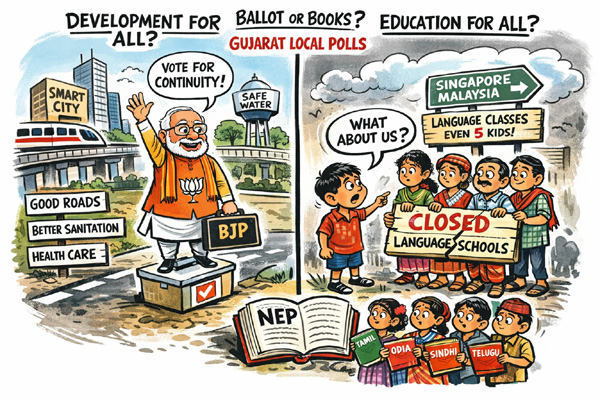
- BJP retains upper hand in civic polls, but education gaps among migrant communities raise policy questions
- NEP push vs ground reality: closure of language schools for Tamils, Odiyas, Sindhis, Marathis, Telugus sparks concern
- Global models like Singapore and Malaysia show how even small student groups can sustain linguistic diversity
- As new municipal corporations emerge, voters weigh continuity against inclusive governance and cultural rights
R MANICKAVASAGAM
AHMEDABAD, APR 13
Gujarat’s local body elections have evolved into more than a contest for civic control—they are now a referendum on whether governance under the Bharatiya Janata Party can expand beyond infrastructure and efficiency to embrace inclusivity, particularly in education for migrant communities.
While the BJP remains the clear frontrunner—owing to its entrenched urban network, organisational strength, and fragmented opposition from the Indian National Congress and Aam Aadmi Party—a deeper undercurrent is shaping voter discourse: access to education and cultural identity for migrants.
Upper Hand BJP, But New Questions Emerging
The BJP’s dominance in Gujarat’s urban landscape is undeniable. Its governance plank—roads, sanitation, water supply—continues to resonate with a large section of voters, including migrants seeking stability and economic opportunity.
Yet, beneath this dominance lies a subtle but growing concern: whether development without cultural accommodation is sustainable in an increasingly diverse urban society.
NEP Vision vs Ground Reality in Cities
India’s National Education Policy 2020 strongly advocates:
- Multilingual education
- Mother tongue-based learning in early years
- Preservation of linguistic diversity
However, in several major cities—including parts of Gujarat—civic-run schools offering instruction in languages like Tamil, Odia, Sindhi, Marathi and Telugu have been shut down due to “low student strength.”
This has created a paradox:
- Policy promotes inclusion and multilingualism
- Ground implementation leans towards consolidation and cost-efficiency
For migrant families, this often translates into loss of linguistic identity and limited access to culturally relevant education for their children.
Migrant Vote: Silent but Sensitive
Migrants—from Tamil, Odia, Sindhi, Marathi and Telugu communities—form a significant portion of the urban electorate in cities like Ahmedabad and Surat.
Traditionally, they have leaned towards the BJP due to:
- Economic stability
- Infrastructure growth
- Ease of doing business
But education is emerging as a second-generation issue:
- Parents prioritise jobs and stability
- Children’s education and cultural roots are becoming key concerns
This shift may not immediately alter electoral outcomes—but it is reshaping expectations from governance.
Global Lessons: Why Not Gujarat?
Countries like Singapore and Malaysia offer compelling models:
- They actively support mother tongue education for migrant communities
- Classes continue even with fewer than 10 students
- Language is treated as a cultural asset, not a logistical burden
In Singapore, Tamil is an official language despite a minority population. In Malaysia, vernacular schools continue with state support, preserving linguistic heritage alongside national integration.
👉 The key takeaway: Inclusivity is a policy choice, not a demographic constraint.
Can Gujarat Replicate This Model?
Gujarat is often projected as a “model state” for governance and economic growth. Replicating such inclusive education models would require:
- Policy alignment between NEP and urban local bodies
- Flexible norms for minimum student strength
- Hybrid models (weekend classes, digital learning, community partnerships)
- Budget prioritisation for cultural education
With the expansion of new municipal corporations, there is an opportunity to:
- Decentralise education policy
- Introduce pilot multilingual programs
- Build inclusive urban identities
Politics of Continuity vs Demand for Inclusion
Why BJP Still Leads:
- Strong governance perception
- Fragmented opposition (Congress vs AAP)
- Migrant preference for stability
Where Opposition Can Intervene:
- Raise issues of education equity and cultural rights
- Highlight gaps between NEP promises and local implementation
- Build coalitions among migrant communities
However, unless Congress and AAP present a coherent, credible alternative, BJP’s dominance is unlikely to be seriously challenged.
Do Voters Want Change?
The answer is nuanced.
- No strong appetite for regime change
- Yes, rising demand for better, more inclusive governance
Voters appear to favour a model of:
“Continuity in power, but change in priorities.”
Final Word: A Broader Mandate for Governance
Gujarat’s civic polls may once again reinforce the political supremacy of the Bharatiya Janata Party, but they also carry a quieter message—development must evolve beyond physical infrastructure to include educational access, linguistic diversity, and cultural dignity.
For voters, the question is no longer just who governs, but how inclusive that governance truly is.
For policymakers, the challenge is clear:
If global cities like Singapore and Malaysia can preserve every voice, why can’t Gujarat?