R ARIVANANTHAM
CHENNAI, APR 19
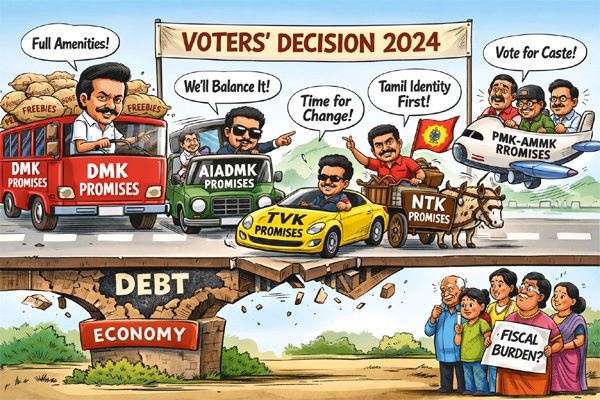
With Tamil Nadu heading into a decisive electoral contest, manifestos have become high-voltage political instruments—blending welfare, infrastructure, identity and fiscal ambition. From the ruling Dravida Munnetra Kazhagam’s governance pitch to the counter-narratives of All India Anna Dravida Munnetra Kazhagam, Tamilaga Vettri Kazhagam, Naam Tamilar Katchi and the PMK–AMMK axis, the core question before voters is sharper than ever: who promises best—and who can deliver without pushing the State’s finances to the brink?
- DMK’s ‘Chennai Super-6’: Governance pitch with tech-driven urban transformation
- AIADMK flags fiscal discipline; TVK, NTK, PMK push alternative and identity narratives
- BJP vs Congress: Growth model versus rights-based welfare debate intensifies
- 8th Pay Commission shadow: Salary, pension burden vs political compulsion
- Experts, celebrities caution on freebies vs sustainable growth
- Debt dilemma: Can Tamil Nadu balance welfare expansion with fiscal prudence?
- DMK: Delivery-backed promises with urban focus
Launching the ‘Chennai Super-6’, M K Stalin said, “This is about improving everyday life—from mobility to modern infrastructure.”
With AI-enabled transport, 1,000 mini-buses, stormwater upgrades and a global tech hub, DMK is blending governance with future-ready urban planning.
Party leaders assert, “People can judge us by our delivery record, not just promises.”
Execution highlights so far:
- Women-centric welfare schemes
- Strengthened public healthcare and education
- Urban infrastructure upgrades
- Social justice-driven policies
AIADMK: Welfare with caution on debt
The All India Anna Dravida Munnetra Kazhagam has sharpened its attack on fiscal management.
“Tamil Nadu cannot afford unchecked expansion of schemes without revenue backing,” leaders argue, positioning themselves as proponents of administrative efficiency and fiscal restraint.
TVK, NTK & PMK axis: Disruption, identity and micro-targeting
Vijay’s Tamilaga Vettri Kazhagam continues to ride a grassroots, anti-establishment wave:
“This is a people’s movement,” he maintains.
The Naam Tamilar Katchi stresses Tamil identity and ecological balance, while S Ramadoss’s bloc focuses on caste arithmetic and rural welfare.
National political lens: BJP vs Congress
From the BJP, Narendra Modi has emphasised, “Development must be transparent, inclusive and corruption-free.”
Amit Shah has said, “Double-engine governance accelerates growth and welfare delivery.”
State BJP leaders add, “Freebie politics without fiscal backing will hurt long-term growth.”
On the other side, Rahul Gandhi has maintained, “Welfare is not a freebie—it is a right that empowers citizens.”
Congress voices argue, “Social justice and economic inclusion must remain central to governance.”
8th Pay Commission effect: A silent fiscal disruptor
Even as parties expand promises, economists warn of a looming fiscal wave if an 8th Pay Commission revision is implemented:
- Government employees: Likely salary hikes could boost consumption but increase revenue expenditure
- Pensioners: Higher pension outgo could significantly strain state finances
- Fiscal impact: Combined burden may run into tens of thousands of crores annually
Experts caution: “Pay revisions, combined with new welfare schemes, could sharply widen fiscal deficits unless matched by strong revenue growth.”
Voices of caution: Celebrities and experts
- Kamal Haasan: “Governance must move beyond freebies to sustainable models.”
- R Sarathkumar: “People want delivery, not just declarations.”
- Sathyaraj: “Voters today are more aware—they compare promises with performance.”
- Policy experts add: “Tamil Nadu needs fiscal pruning, rationalisation of subsidies and a clear roadmap to manage rising debt.”
The big question: Who has the edge?
- Most structured manifesto: DMK (delivery + targeted innovation)
- Strong challenger: AIADMK (anti-incumbency + fiscal caution)
- Wildcard: TVK (youth surge, anti-system appeal)
- Influence players: NTK, PMK (identity and caste blocs)
Reality check: The election may not just be about promises—but about credibility, sustainability and fiscal responsibility.