NE DEFENCE BUREAU
NEW DELHI, APR 28
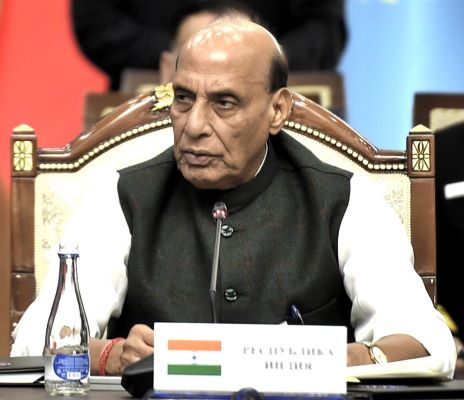
India sent a strong and unambiguous message on global security as Defence Minister Rajnath Singh declared that “Operation Sindoor demonstrated India’s firm resolve that terrorism epicentres are no longer immune to justifiable punishment,” while addressing the Defence Ministers’ Meeting of the Shanghai Cooperation Organisation in Bishkek on April 28, 2026.
#WATCH | Defence Minister Rajnath Singh in Kyrgyzstan for SCO meet
Defence Minister Rajnath Singh received a warm welcome from the Indian diaspora in Bishkek ahead of the Shanghai Cooperation Organisation defence ministers’ meeting.
He will focus on regional security,… pic.twitter.com/AdfCks0AIl
— DD India (@DDIndialive) April 27, 2026
Calling for a united global front, he urged SCO member nations to tackle “the evils of terrorism, separatism and extremism by eliminating safe havens and rejecting any political exceptions,” asserting that state-sponsored cross-border terrorism must be confronted without hesitation or double standards.
- Rajnath Singh cites ‘Operation Sindoor’ as proof of decisive action against terror epicentres
- Calls on Shanghai Cooperation Organisation to act firmly against state-sponsored terrorism
- India pushes for zero tolerance, rejects double standards in global counter-terror framework
- ‘Terrorism has no nationality, no theology’—collective resolve urged amid global uncertainties
- Vision for world order rooted in coexistence, compassion, and rule-based stability
“SCO should not hesitate in seeking appropriate action against those who abet, shelter & provide safe havens to terrorists,” said Rajnath Singh. “By tackling terrorism, separatism, and extremism without exception, we transform regional security from a challenge into a cornerstone for peace and prosperity.”
Reinforcing India’s long-standing position, he stated: “Terrorism has no nationality and no theology. Nations must take a firm & collective stance against terrorism,” highlighting that consistency in action remains the true test of global credibility.
Referring to the Tianjin Declaration, the Raksha Mantri described it as a testament to India’s zero-tolerance approach. He also underscored the role of SCO’s Regional Anti-Terrorist Structure in countering radicalisation and strengthening cooperative security frameworks.
Amid rising global uncertainty, Rajnath Singh raised a larger philosophical question: “Do we need a new world order or a world which is more orderly?”
“We must focus on a global consensus where co-existence, co-habitation and compassion take precedence over chaos, competition and conflict,” he said, cautioning against fragmentation of the rule-based international order.
Emphasising peace through strength and restraint, he added: “We should continue to follow the path of dialogue and diplomacy and not of unrelenting force… The real test of power is not in using it against the poor and the weak, but to use it in the interest of those who are unable to defend themselves.”
Invoking the philosophy of Vasudhaiva Kutumbakam, he reiterated India’s commitment to global harmony and constructive engagement within the SCO framework.
The meeting, attended by defence leaders of member nations, also reflected on the organisation’s growing relevance as it marks 25 years since its founding, amid increasing geopolitical volatility and security challenges.