NE SPIRITUAL BUREAU
SOMNATH (GUJARAT), MAY 11
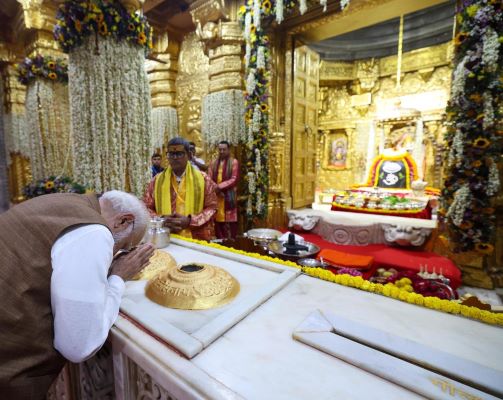
Standing before the majestic shores of the Arabian Sea where faith has defied destruction for centuries, Prime Minister Narendra Modi on Monday visited the sacred Somnath Temple and described the 75th anniversary of its reconstruction as a defining moment in Bharat’s timeless civilisational journey.
- Prime Minister Narendra Modi visits Somnath Temple during 75th anniversary celebrations of its reconstruction
- PM calls the reopening of the rebuilt shrine a defining milestone in Bharat’s civilisational journey
- Somnath Temple, one of the 12 Jyotirlingas, has been rebuilt multiple times after repeated invasions
- Historic reconstruction after Independence was spearheaded by Sardar Vallabhbhai Patel
- Devotional fervour, spiritual energy and national pride mark Somnath Amrut Mahotsav celebrations
The Prime Minister, visibly moved by the spiritual atmosphere surrounding the Somnath Amrut Mahotsav celebrations, said the experience transported him back to the historic moment when India’s first President Rajendra Prasad inaugurated the rebuilt temple in 1951 after Independence.
Jai Somnath! Feeling blessed to be here, when we are marking 75 years since the rebuilt Temple opened its doors for devotees. pic.twitter.com/gFumT80Qva
— Narendra Modi (@narendramodi) May 11, 2026
“Jai Somnath! Feeling blessed to be here, when we are marking 75 years since the rebuilt Temple opened its doors for devotees,” Modi posted on social media platform X.
Speaking at the Somnath Amrut Mahotsav. The Somnath Temple stands as a beacon of unwavering faith, divinity and a sacred symbol of India’s eternal soul. https://t.co/otO2YOCCUL
— Narendra Modi (@narendramodi) May 11, 2026
A Temple That Refused to Fall
Revered as one of the holiest shrines dedicated to Lord Shiva and counted among the sacred 12 Jyotirlingas, the Somnath Temple occupies a unique place in India’s spiritual and historical consciousness.
Located in Prabhas Patan on Gujarat’s western coast, the temple is believed to have ancient origins dating back thousands of years and is deeply rooted in Hindu mythology and scriptures.
Historians and spiritual scholars describe Somnath not merely as a temple, but as a symbol of India’s enduring civilisational strength.
Over centuries, the shrine faced repeated invasions and destruction, most notably by Mahmud of Ghazni in 1025 CE. Yet every time it was demolished, devotees and rulers rebuilt it — turning Somnath into a living metaphor for resilience, revival and unwavering faith.
Sardar Patel’s Dream of National Reawakening
The modern reconstruction of Somnath after India’s Independence became one of the earliest symbols of cultural restoration in free India.
India’s Iron Man Sardar Vallabhbhai Patel played a pivotal role in initiating the rebuilding of the temple soon after Independence, viewing it as an act of national self-respect and civilisational revival.
Though Patel passed away before the temple’s completion, the reconstructed shrine was formally inaugurated in 1951 by President Rajendra Prasad despite political controversies of the time.
That historic reopening, Modi said, marked a turning point in independent India’s spiritual and cultural resurgence.
‘Bhakti in Every Corner’
Describing the overwhelming atmosphere at the temple town, the Prime Minister said Somnath was radiating devotion from every direction.
“At Somnath, one can experience Bhakti in every corner. Countless people have come together to mark 75 years since the rebuilt Temple opened its doors to devotees. That day was indeed a milestone in the civilisational journey of Bharat,” he wrote.
Modi also recalled the emotional energy witnessed along the temple route, saying the enthusiasm of devotees had deeply touched him.
He said the spiritual aura surrounding the celebrations was infusing “amazing energy” into the entire region.
Symbol of India’s Spiritual Continuity
As chants of “Har Har Mahadev” echoed through the temple corridors and thousands of devotees thronged the shrine during the Amrut Mahotsav celebrations, Somnath once again emerged not merely as a place of worship — but as a beacon of India’s spiritual continuity.
From mythology and medieval resistance to post-Independence reconstruction and modern-day devotion, Somnath continues to embody the soul of Bharat — wounded many times, but never defeated.