NE NEWS BUREAU
CHENNAI, MAY 11
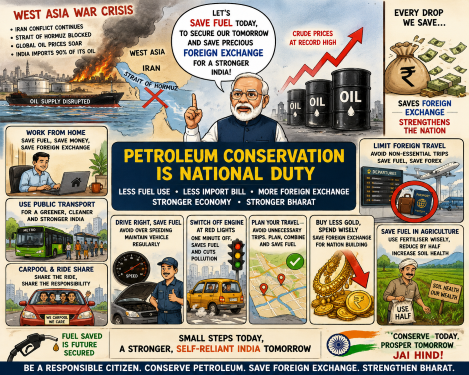
In one of the strongest public austerity appeals since the Covid-19 pandemic, Prime Minister Narendra Modi has urged Indians to embrace work-from-home practices, reduce unnecessary foreign travel, conserve fuel and cut non-essential spending as the escalating Iran conflict sends shockwaves through global energy markets and threatens India’s petroleum security.
భారతదేశం అభివృద్ధిలో కొత్త శిఖరాలను అధిరోహిస్తూనే ఉంది. అయితే అదే సమయంలో మనం అధిగమించాల్సిన ఎన్నో సవాళ్లు కూడా ఉన్నాయి.
ఈ సందర్భంగా తోటి భారతీయులకు ఇదే నా విజ్ఞప్తి. pic.twitter.com/tggpC1i6OB
— Narendra Modi (@narendramodi) May 10, 2026
Addressing a public gathering in Hyderabad on Sunday, Modi warned that the prolonged disruption in global crude supplies due to the continuing US-Israel-Iran conflict and the closure of the strategically vital Strait of Hormuz had created an extraordinary economic challenge for India.
- Prime Minister Narendra Modi urges Indians to work from home, reduce foreign travel and conserve fuel
- India’s crude oil import bill surges sharply as Strait of Hormuz remains blocked for over two months
- Government closely monitoring strategic petroleum reserves amid fears of prolonged supply disruption
- Sensex tumbles over 1,000 points as markets react to energy crisis and economic uncertainty
- Opposition attacks Centre over preparedness as industries, transport and agriculture face mounting stress
“Patriotism is not only about sacrificing one’s life at the border. In these times, it is also about living responsibly and fulfilling our duties in daily life,” Modi said while appealing for collective national discipline to reduce fuel consumption and save foreign exchange.
India’s Petroleum Stocks Under Pressure
India, which imports nearly 90 per cent of its crude oil requirements, is now confronting one of its toughest energy crises in decades as international crude prices continue to soar.
Government sources and energy analysts indicate that India’s Strategic Petroleum Reserves (SPR) — located at Vishakhapatnam, Mangaluru and Padur — are being closely monitored to cushion any major supply shock.
India currently maintains emergency crude reserves estimated to cover roughly 9 to 10 days of national demand, while oil marketing companies and refineries together hold additional commercial inventories capable of sustaining supplies for several weeks.
However, analysts warn that a prolonged blockade of the Strait of Hormuz — through which nearly one-fifth of the world’s oil supply passes — could significantly tighten India’s petroleum availability and sharply escalate import costs.
The country’s crude import bill has already witnessed a multi-billion-dollar surge since the outbreak of the conflict, intensifying pressure on the rupee, inflation and government finances.
Fuel Conservation Measures Likely
Modi’s remarks are being viewed within policy circles as a precursor to possible nationwide energy conservation measures.
The Prime Minister urged citizens to use public transportation, including metro rail systems, adopt carpooling and minimise fuel wastage wherever possible.
In a move that stunned many economists and political observers, Modi also appealed to citizens to “buy less gold” and prioritise saving foreign exchange reserves during the ongoing geopolitical crisis.
He additionally urged farmers to reduce fertiliser usage by half, reflecting growing concerns over fertiliser supply chains linked to rising global energy prices.
Analysts described the Prime Minister’s appeal as the “most drastic public advisory” issued by the Centre since the pandemic era.
Markets Reel, Rupee Weakens
The economic tremors were immediately visible across financial markets on Monday.
Benchmark indices witnessed a sharp sell-off, with the BSE Sensex plunging more than 1,000 points in early trade amid fears of prolonged global supply disruptions and rising inflationary risks.
The Indian rupee has also slipped to record lows in recent weeks, increasing the cost of imports and fuelling broader inflation concerns.
Despite mounting global crude prices, the government has so far refrained from increasing domestic petrol and diesel prices — a move that has intensified financial pressure on state-run oil marketing companies.
Industry bodies warn that sectors dependent on energy-intensive manufacturing — including glass, plastic, ceramic tiles and fertilisers — are already witnessing operational stress and potential job risks.
Global Crisis Triggers Emergency Measures Worldwide
The oil shock triggered by the Iran conflict has forced multiple nations to adopt emergency economic measures.
China has reportedly directed refiners to halt fuel exports temporarily, while airlines in several countries have reduced operations due to soaring aviation fuel costs.
Australia has introduced subsidised public transport schemes in certain states to discourage private vehicle usage.
The Philippines declared a national emergency earlier this year, implementing transport subsidies, ferry service reductions and a four-day work week for government employees.
Neighbouring Sri Lanka has reintroduced fuel rationing and temporary four-day work weeks, including partial shutdowns of schools and government offices.
The International Energy Agency has termed the current disruption as the “largest supply shock in modern energy history.”
Opposition Targets Centre
Meanwhile, opposition leaders intensified attacks on the Centre over its handling of the emerging crisis.
Rahul Gandhi accused the government of shifting the burden of economic management onto ordinary citizens.
“These are not sermons. They are proofs of failure,” Gandhi wrote in a post on X.
Political observers believe the Centre may soon unveil a calibrated national energy management strategy, including possible fuel-use advisories, industrial restrictions and eventual petroleum price revisions if the geopolitical crisis deepens further.
With oil markets remaining volatile and India’s energy dependence exposed once again, the coming weeks could prove decisive for the country’s economic stability and fuel security architecture.