- Groundbreaking green research transforms jamun, neem, tulsi, guava and curry leaves into multifunctional carbon nanoparticles without using hazardous chemicals
- Eco-friendly nanomaterials demonstrate exceptional ability to detect heavy metals while offering antioxidant and biomedical potential
- Microwave-assisted innovation opens new frontiers in environmental monitoring, diagnostics and sustainable healthcare technologies
- Study aligns with Atmanirbhar Bharat, Mission LiFE and global sustainability goals by harnessing nature for next-generation scientific solutions
NE SCIENCE & TECHNOLOGY BUREAU
GANDHINAGAR, JUNE 9
What do iron, lead, and nickel have in common? These heavy metals are an indispensable part of many, many industries. However, they also share a dark reality. They are serious environmental and public health threats. Every day, they find their way into the atmosphere and water bodies through industrial activities, mining, and urban waste. Heavy metals are highly toxic, do not break down naturally, and tend to build up in the tissues of living organisms over time. A recent story on the website of Harvard T. H. Chan School of Public Health highlighted that their emission from power plants could have severe health impacts, such as inflammation, airway constriction, blood clotting, and cardiac stress. Detecting these contaminants, which is essential for tackling them effectively, often requires sophisticated equipment and expensive testing procedures.
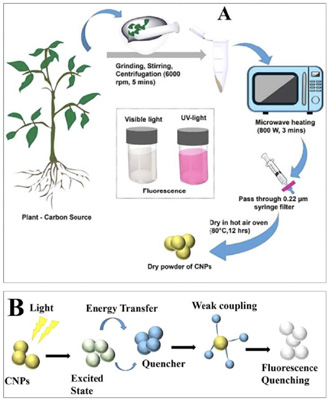
What if one promising solution starts with common medicinal plants that are very familiar in Indian homes and have been valued for generations? Researchers from the Indian Institute of Technology Gandhinagar (IITGN) used jamun (Syzygium cumini), tulsi (Ocimum sanctum), neem (Azadirachta indica), guava (Psidium guajava), and curry leaf tree (Bergera koenigii) and presented a simple and time-efficient approach to developing highly sensitive, eco-friendly carbon nanoparticles (CNPs). Their study was published in Nano Express. These plants were selected based on features like antioxidant and anti-cancer properties.
What are CNPs? They are promising materials with applications in fields like metal ion detection, bio-imaging, and antimicrobial activity, among others. CNPs contain nanosized carbon elements, with generally excellent ability to safely interact with living tissue (biocompatibility) and low toxicity. Due to the increasing emphasis on green approaches in recent times, natural and renewable sources such as fruits, vegetables, and plant leaves are being employed to generate CNPs. It is an effort to minimise costs, energy-intensive processing, and the use of hazardous chemicals. Towards this objective, the team used a rapid microwave-assisted method to generate CNPs with enhanced sensitivity and performance.
All five types of CNPs turned bright red (fluorescence) under UV light. Upon interacting with these CNPs, specific heavy metal ions acted as quenchers and decreased the intensity of fluorescence emitted by them. This feature is an effective tool to detect pollutants. The researchers found that guava-derived CNPs showed sensitivity toward nickel ions, and neem-derived and jamun-derived ones toward iron ions (ferrous ions for the former and ferric ions for the latter). Tulsi-derived CNPs were capable of detecting iron (ferrous ions) and lead ions. “Fascinatingly, the decrease in fluorescence intensity became more pronounced with increasing heavy metal ion concentration! The curry-leaf-derived CNPs did not show this behaviour, which could be attributed to factors such as their non-selectivity toward the metal ions used in this study,” remarked Parul Singh, a final-year PhD student in the Department of Electrical Engineering at IIT Gandhinagar.
Beyond sensing, the plant-derived CNPs also exhibited strong antioxidant activity, following the order of jamun being better than tulsi, followed by guava, neem, and curry leaf, respectively. Antioxidants help neutralise unstable molecules known as free radicals, which are associated with conditions like cellular damage, ageing, and several diseases. The researchers used two free radicals and found that their violet and blue-green colour turned to a light yellow colour upon exposure to the CNPs, indicating the presence of antioxidant behaviour. Further, biocompatibility assessments revealed minimal toxicity of these CNPs to a type of cell line at low concentrations, with tulsi-derived CNPs being the most compatible. These findings suggest their potential for diagnostic and therapeutic applications.
According to Dr Jhuma Saha, “Our work shows that components from medicinal plants can serve as building blocks for nanomaterials with optical, sensing, and biomedical capabilities. Future research is needed to explore the scalability of our synthesis technique and the practical use of our CNPs in environmental remediation and biological applications.” Dr Saha is an Assistant Professor in the Department of Electrical Engineering at IIT Gandhinagar. The team also included Prof Dhiraj Bhatia, Prof Mukesh Danka, Ms Hitasha Vithalani, Mr Aniruddha Dan, and Mr Nihal Singh from the Department of Biological Sciences and Engineering, and Ms Padma Priya Kannan from the Department of Materials Science and Engineering.
As we observe World Environment Day and World Oceans Day in the month of June, such studies highlight how sustainable innovations can contribute to cleaner ecosystems. This research aligns with the Government of India’s Mission on Nano Science and Technology (developing nanotechnology-based applications) and Mission LiFE (protecting the environment). Developing CNPs from commonly available plants mirrors the vision of Atmanirbhar Bharat, which emphasises home-grown solutions. The study also resonates with the United Nations’ Sustainable Development Goal 6 (sustainable management of clean water and sanitation) and Goal 9 (Industry, Innovation and Infrastructure).