
- Only Indian company in Wood Mackenzie’s global top 10 rises to sixth position
- Integrated manufacturing model and technology strength propel Gujarat-based solar giant upward
- Recognition underscores India’s emergence as a global clean energy manufacturing powerhouse
- Rapid domestic capacity expansion positions India as the world’s second-fastest-growing solar market
NE BUSINESS BUREAU
NEW DELHI, JUNE 11
India’s renewable energy manufacturing ambitions received a significant global endorsement as Adani Solar, the solar manufacturing arm of Adani New Industries Ltd (ANIL), climbed to sixth position in Wood Mackenzie’s Global Solar Photovoltaic (PV) Module Manufacturer Rankings 2026, emerging as the highest-ranked Indian company in the prestigious annual assessment.
The latest ranking marks an improvement from the company’s eighth position last year, making it the only Indian solar manufacturer to feature among the world’s top 10 module producers.
The comprehensive 2026 assessment evaluated 48 global solar module manufacturers across multiple parameters, including capacity utilisation, technology maturity, financial performance, supply chain resilience and operational excellence.
Wood Mackenzie awarded Adani Solar a coveted Grade A classification, recognising its strong performance across manufacturing capabilities, technological advancement, financial robustness, supply chain resilience and operational metrics.
The achievement comes at a time when India is aggressively strengthening domestic solar manufacturing to reduce import dependence and build a self-reliant clean energy ecosystem.
India’s solar module manufacturing capacity has witnessed an extraordinary leap—from less than 2.5 gigawatts (GW) in 2014 to over 170 GW in 2026—while domestic solar cell manufacturing capacity has expanded to 27 GW, reflecting the country’s rapid industrial transformation.
Chinese manufacturers continue to dominate the global rankings, occupying the top positions led by LONGi Green Energy, followed by Jinko Solar, JA Solar and Trinasolar. Yet Adani Solar’s steady climb signals India’s growing competitiveness in the international renewable energy manufacturing landscape.
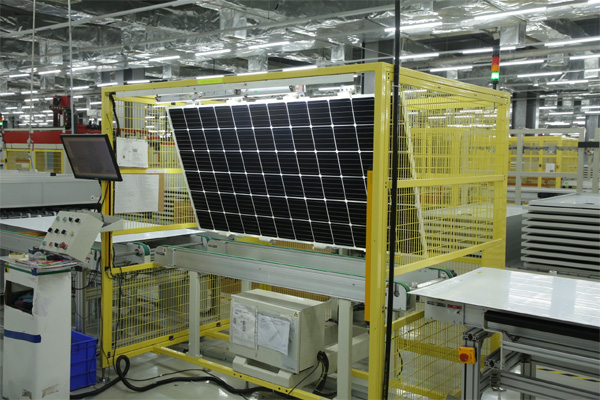
The company is currently in the advanced stages of expanding its integrated manufacturing complex at Mundra, Gujarat, to an annual capacity of 10 GW. At present, it operates 2 GW of ingot and wafer manufacturing capacity along with 4 GW each of solar cell and module production capacity.
Unlike many global manufacturers that specialise in a single segment of the value chain, Adani Solar has built an end-to-end integrated manufacturing ecosystem spanning ingots, wafers, solar cells and finished solar modules, enhancing quality control and supply chain efficiency.
Further strengthening its global credentials, the company was recognised as a BloombergNEF Tier-1 manufacturer in the second quarter of 2026 and has consistently earned top performer ratings in independent solar module reliability assessments conducted by Kiwa PVEL.
Wood Mackenzie noted that while Chinese firms continue to lead the sector, manufacturers from India, South Korea and Singapore are increasingly contributing to a more geographically diversified global solar manufacturing ecosystem.
India’s solar growth story has gathered unprecedented momentum. The country surpassed the United States in annual solar capacity additions during 2025, becoming the world’s second-largest solar growth market. Installed solar capacity has now crossed 155 GW, supporting India’s goal of achieving 50 per cent non-fossil fuel power capacity while enabling it to fulfil its Nationally Determined Contributions (NDCs) ahead of schedule.
The number of domestic solar module manufacturers has also surged from 21 companies in 2021 to nearly 100 today, underscoring the remarkable pace of expansion and positioning India as an increasingly influential player in the global clean energy value chain.