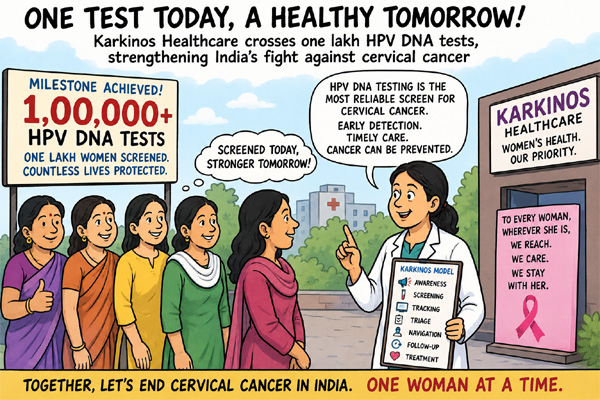
- Reliance-owned Karkinos Healthcare crosses the one-lakh mark in HPV DNA testing, expanding access to one of the world’s most reliable cervical cancer screening tools
- Milestone assumes significance as India battles a largely preventable cancer that still claims thousands of lives because women are screened late or lost to follow-up
- Karkinos says its digitally enabled care pathway goes beyond testing to include awareness, tracking, triage, navigation and treatment linkage for women who test positive
- Experts say the real breakthrough lies not just in scale, but in taking high-quality screening and follow-up care beyond metros into districts, small towns and underserved communities
- With public-health partnerships, self-sampling models and technology-backed outreach, the programme is being positioned as a scalable blueprint for India’s cervical cancer elimination drive
NE HEALTH BUREAU
MUMBAI, JUNE 25
In a significant boost to India’s fight against cervical cancer, Reliance-owned Karkinos Healthcare has completed HPV DNA screening for more than one lakh women across the country, a milestone that strengthens efforts to expand access to early detection of one of the most preventable yet still deadly cancers affecting women.
Karkinos Healthcare, a 100% step-down subsidiary of Reliance Industries Limited, said the achievement marks an important step in widening access not just to high-quality cervical cancer screening, but also to the follow-up care that is often the missing link in women’s cancer prevention in India.
What makes the milestone especially important is that cervical cancer prevention is frequently hindered not only by limited access to screening, but by the fact that many women who test positive are lost to follow-up before diagnosis or treatment can begin. Karkinos says its model seeks to tackle both gaps simultaneously through World Health Organization-recommended HPV DNA testing and a digitally enabled continuum of care that combines awareness, screening, tracking, triage, navigation and follow-up.
Commenting on the milestone, Dr Neerja Bhatla, Consultant, Early Detection and Women Wellness, Karkinos Healthcare, and Padma Shri awardee, said, “The evidence has been clear for some time that HPV DNA testing is the most reliable primary screen we have for cervical cancer. What matters now is not testing at scale alone but also ensuring that every woman who tests positive is carried through to diagnosis and treatment across the care continuum. A program that can demonstrate that linkage at this volume, and well beyond the big cities, is exactly the direction India’s cervical cancer elimination effort needs.”
Underlining the larger public-health challenge, Dr Goura Kishore Rath, Senior Oncology Advisor, Karkinos Healthcare, who has also served as Head, NCI-India, and Chief, DRBRAIRCH-AIIMS, said, “For decades, the obstacle in this country has not been our understanding of cervical cancer; it has been the reach. Bringing a high-quality test to women in districts and small towns and then carrying them through the system rather than leaving them with only a result, is how a public-health gain is actually made. This is the model that has to scale.”
For Karkinos, the one-lakh mark is being positioned not merely as a number, but as a measure of whether women remain connected to care all the way from screening to treatment when needed.
Ms Sripriya Rao, Chief Growth Officer – Women Wellness, and Head of Distributed Cancer Care Network (DCCN), Karkinos Healthcare, said, “Every one of these one lakh tests represents a woman who was met where she was. The measure of this work is not how many women we reached, but how many we did not lose along the way, and whether we did it with dignity, and sustainably, for women who have historically been the last to be served. That is the standard we hold ourselves to.”
She added, “At Karkinos, we dedicate this milestone to the late Dr R. Sankaranarayanan, fondly known to us as ‘Shankar Sir’, whose scientific leadership and unwavering conviction in early detection laid the foundation for this work. Shankar Sir believed that no woman should die of a cancer we already know how to prevent. Backed by the belief, conviction, and unflinching support of Reliance, we are confident of carrying this journey forward to one million tests next, and to one hundred million responsibly, sustainably, and without ever letting a single woman fall through the pathway. We also acknowledge the continued guidance of Dr Partha Basu of the International Agency for Research on Cancer (IARC) in the science of cancer prevention.”
Why the milestone matters
Cervical cancer remains one of the most preventable cancers in women, yet it continues to pose a major health burden because many cases are detected late. Medical experts have long stressed that timely screening, early diagnosis and proper follow-up care can prevent the vast majority of cervical cancer deaths.
Karkinos said the one-lakh milestone was achieved through multiple implementation models across diverse geographies, including public-health programmes, public-private partnerships, CSR-backed initiatives, nurse-assisted and self-sampling models, district-level screening drives, and focused outreach among underserved and high-risk communities. A substantial proportion of the women screened, it said, were those who might otherwise never have had access to organised cervical cancer screening because of distance, social barriers or lack of healthcare access.
The company said the scale and spread of the programme demonstrate that high-quality HPV DNA testing can be delivered at scale in India through technology-driven care pathways, and that the systems and learnings built through the initiative could help support broader organised screening efforts in the country.
At a time when women’s health outcomes continue to be shaped by delayed diagnosis and unequal access to care, Karkinos’ one-lakh-test milestone is being seen as a reminder of a simple but powerful public-health truth: cervical cancer need not be a death sentence if screening reaches women in time — and if the healthcare system stays with them after the test.