NE NEWS SERVICE
CHENNAI, JULY 1
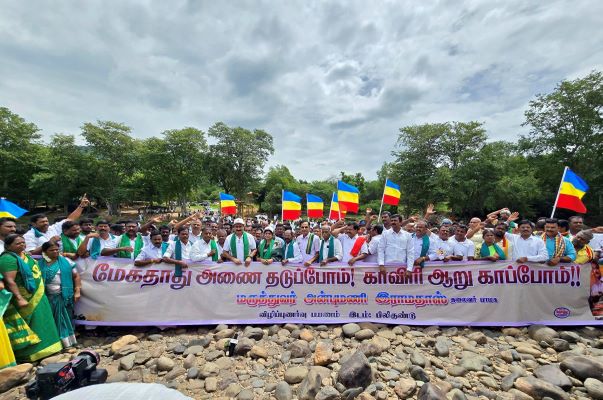
The politically sensitive Cauvery water dispute gathered fresh momentum on Wednesday after PMK President Anbumani Ramadoss launched a statewide public awareness march from Biligundlu in Dharmapuri district to the ancient port town of Poompuhar, seeking to rally public opinion against Karnataka’s proposed Mekedatu balancing reservoir project.
- PMK chief launches 300-km awareness march from Biligundlu to Poompuhar, calling Mekedatu a threat to Tamil Nadu’s water future
- Tamil Nadu government, opposition parties and farmers remain united in opposing Karnataka’s proposed balancing reservoir
- Karnataka insists the project is vital for Bengaluru’s drinking water security and flood management, promising no reduction in Tamil Nadu’s allocated share
- Environmental concerns over forest submergence add another dimension to the decades-old inter-state river dispute
- The Centre, statutory authorities and the Supreme Court remain pivotal to the project’s future amid intensifying political and legal battles
The campaign comes at a time when the Mekedatu issue has once again emerged as one of the few subjects that has united almost the entire political spectrum in Tamil Nadu, even as Karnataka continues to maintain that the project is essential for securing drinking water for Bengaluru and adjoining regions.
Launching the march, Anbumani termed the proposed reservoir “a grave threat” to Tamil Nadu’s water security, agriculture and ecology, urging the State government to intensify its legal battle to prevent the project from receiving statutory clearances.
“The objective of this campaign is to create awareness among the people about the dangers posed by the Mekedatu project and to protect the lifeline of Tamil Nadu,” he said.
Describing the Cauvery as the State’s lifeline, Anbumani said over five crore people depend directly or indirectly on the river for drinking water, agriculture and industry.
He alleged that construction of the proposed 70 TMC reservoir would enable Karnataka to retain more water upstream, thereby affecting downstream releases to Tamil Nadu.
Rejecting Karnataka’s contention that the project is intended primarily for Bengaluru’s drinking water needs, Anbumani said the city’s requirement could be met with a much smaller storage facility.
“The proposed reservoir may ultimately be used for irrigation purposes, reducing water availability for Tamil Nadu,” he alleged.
The PMK leader also highlighted ecological concerns, claiming that nearly 12,500 acres of dense forest, home to elephants, tigers and several endangered species, would be submerged if the project is implemented.
He pointed out that several environmental activists in Karnataka have also expressed reservations over the ecological impact of the project.
Accusing successive Karnataka governments of violating the spirit of the Cauvery water-sharing arrangement, Anbumani urged the Tamil Nadu government to exhaust every available legal remedy to stall the project.
He reiterated his opposition to constituting a fresh Cauvery tribunal, maintaining that the existing legal framework remains sufficient.
Appealing to the youth, Anbumani called for a statewide people’s movement on the lines of the Jallikattu protests.
“I appeal to the youth of Tamil Nadu to unite to save Cauvery, just as they united for Jallikattu,” he said.
He also urged Congress leader Rahul Gandhi to prevail upon the Congress government in Karnataka to withdraw the Mekedatu proposal.
Tamil Nadu Government’s Position
The march comes barely days after the Tamil Nadu Assembly unanimously adopted a resolution opposing the Mekedatu project and urged the Union Government not to grant technical, environmental or statutory approvals.
Chief Minister C. Joseph Vijay has maintained that Karnataka’s proposal violates both the Cauvery Water Disputes Tribunal Award and the Supreme Court’s 2018 judgment, arguing that the Cauvery basin is already fully allocated and no upstream project should proceed without the concurrence of the lower riparian State.
State ministers have repeatedly asserted that Tamil Nadu will pursue every available legal remedy to prevent construction of the dam and safeguard farmers’ interests.
Karnataka’s Stand
Karnataka, however, has consistently defended the Mekedatu project as a balancing reservoir designed primarily to provide drinking water to the rapidly expanding Bengaluru metropolitan region while generating hydroelectric power and improving water regulation.
Chief Minister D.K. Shivakumar recently directed officials to eliminate every technical deficiency in the project’s Detailed Project Report so that Tamil Nadu does not gain any legal advantage during future court proceedings.
He has emphasised that the project will not reduce Tamil Nadu’s legally allocated share of Cauvery water and has instructed officials to prepare a robust technical and legal defence before the Supreme Court.
Environmental and Regulatory Questions
Apart from the political and legal contest, environmental concerns continue to occupy centre stage.
The proposed reservoir is expected to submerge substantial stretches of the Cauvery Wildlife Sanctuary, prompting conservationists to question its ecological impact.
At the regulatory level, the project still requires multiple statutory approvals, including environmental and forest clearances, besides scrutiny by the Central Water Commission before any construction can commence. Earlier, the Chairperson of the Cauvery Water Management Authority observed that the project’s techno-commercial feasibility is yet to be conclusively established. (The Times of India)
What’s Next
With Tamil Nadu intensifying both political mobilisation and legal resistance, Karnataka strengthening its technical preparations, and the Union Government yet to take a final call on statutory clearances, the Mekedatu issue appears set for another prolonged phase of political, legal and administrative contest.
For now, Anbumani’s march has ensured that the Cauvery remains at the centre of Tamil Nadu’s political discourse, even as both States continue to defend what they describe as their legitimate water rights.