- India’s largest renewable energy company becomes the nation’s first to cross the 20 GW operational milestone through predominantly greenfield development
- Annual clean power generation now exceeds 52 billion units—enough to illuminate New York City for a year or power almost the entire Mumbai and New Delhi combined
- Record capacity addition, world-leading battery storage deployment and the colossal Khavda renewable energy park propel AGEL’s next growth chapter
- Milestone strengthens India’s energy security while accelerating the country’s transition towards reliable, round-the-clock green electricity
- Company targets 50 GW renewable capacity by 2030, with battery storage emerging as the backbone of India’s clean energy revolution
NE BUSINESS BUREAU
AHMEDABAD, JULY 1
Adani Green Energy Limited (AGEL) has scripted a landmark chapter in India’s clean energy journey by becoming the country’s first renewable energy company to surpass 20 gigawatts (GW) of operational renewable energy capacity, achieved predominantly through greenfield development.
The milestone firmly establishes AGEL as India’s largest renewable energy company while reinforcing the nation’s accelerating transition towards sustainable and energy-secure growth.
Today, AGEL generates more than 52 billion units of clean electricity annually, accounting for nearly 3 per cent of India’s total electricity consumption—enough to power New York City for an entire year or almost the combined annual electricity requirement of Mumbai and New Delhi.
The achievement comes less than a decade after AGEL commissioned its maiden renewable energy project at Kamuthi, Tamil Nadu, in 2016, making it the fastest and largest greenfield renewable energy capacity expansion undertaken by any company in India.
In FY26 alone, AGEL added 5,051 MW of renewable energy capacity—the highest annual capacity addition by any renewable energy company outside China.
The company’s operational portfolio now comprises approximately 14.2 GW of solar energy, 2.7 GW of wind power, and 3.3 GW of wind-solar hybrid projects, representing nearly 14 per cent of India’s utility-scale solar installations and around 12 per cent of the country’s combined utility-scale solar and wind capacity.
Commenting on the achievement, Sagar Adani, Executive Director, AGEL, said: “Surpassing 20 GW demonstrates what disciplined execution and long-term vision can achieve. Today, AGEL, along with our efficient team and longstanding partners, delivers renewable electricity almost equivalent to annual power requirement of Mumbai and New Delhi combined, reinforcing the country’s energy security while accelerating its clean energy transition.”
The milestone follows Sagar Adani’s address at the inaugural Adani Green Energy Dialogue during London Climate Action Week, where he underlined the need to accelerate electrification by integrating renewable energy with utility-scale battery storage to ensure reliable, affordable and round-the-clock clean power.
AGEL has simultaneously emerged as a global leader in energy storage by commissioning 3.55 GWh of Battery Energy Storage Systems (BESS)—the world’s largest operational deployment outside China and among the fastest executed anywhere.
Highlighting the growing significance of storage technologies, Sagar Adani added:
“As renewable energy assumes a larger share of India’s power mix, battery storage is becoming central to delivering reliable, dispatchable clean power.”
Building on this momentum, AGEL plans to commission 10 GWh of battery storage during FY27 and expand its storage portfolio to 50 GWh over the next five years, supporting its ambitious target of achieving 50 GW of renewable energy capacity by 2030.
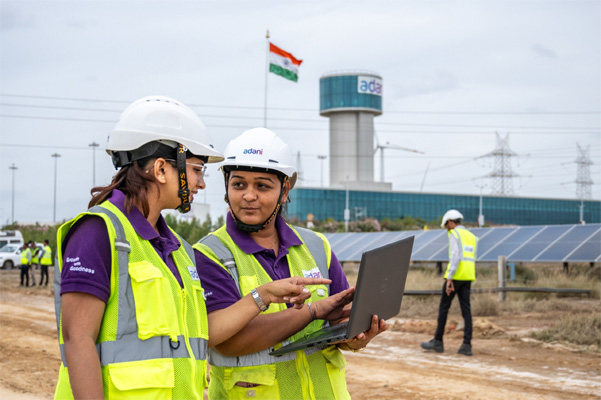
At the heart of AGEL’s next growth phase is Khavda in Gujarat’s Kutch district, where the company is developing the world’s largest renewable energy plant.
Spread across 538 square kilometres of barren land—an area nearly five times the size of Paris and almost as large as Mumbai—the mega project is designed to deliver 30 GW of renewable energy capacity.
AGEL has already commissioned 9.5 GW of solar capacity at Khavda, accounting for more than 30 per cent of the project’s planned capacity, making the site one of the world’s most significant symbols of large-scale clean energy transformation.
As India intensifies its pursuit of net-zero ambitions and energy independence, AGEL’s latest milestone underscores the increasing role of utility-scale renewable energy and battery storage in powering sustainable economic growth while reducing dependence on fossil fuels.
India’s utility-scale solar and utility-scale solar & wind data are as of May 31, 2026.