R ARIVANANTHAM
CHENNAI, JULY 7
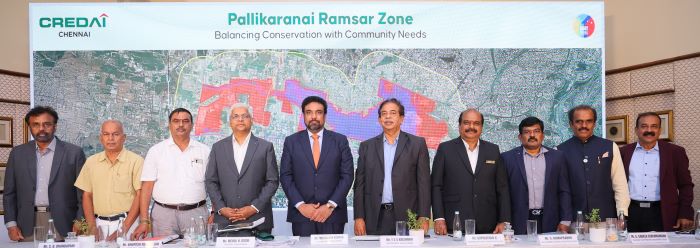
Calling for an approach that places environmental conservation and sustainable urban development on equal footing, the real estate industry has urged the Tamil Nadu Government to adopt a scientific, transparent and consultative framework for implementing regulations around the Pallikaranai Ramsar Site, arguing that ecological protection should proceed alongside legal clarity and socio-economic stability.
- Industry backs wetland conservation but urges transparent demarcation, scientific planning and stakeholder consultation before enforcing development restrictions
- Developers say over one lakh patta holders, housing projects, public infrastructure and investments face prolonged uncertainty
- Calls for completion of statutory ground-truthing, hydrological studies and Integrated Management Plan before finalising Ramsar influence zone
- Industry estimates ₹71,500 crore in business and economic activity affected by current regulatory ambiguity in and around Old Mahabalipuram Road (Rajiv Gandhi Expressway @ IT Expressway).
While reaffirming that the Pallikaranai Marsh remains one of India’s most ecologically significant urban wetlands deserving the highest level of protection, industry representatives said the present implementation of restrictions has created widespread uncertainty for landowners, homebuyers, businesses and public infrastructure because of unresolved questions over the exact extent of the notified Ramsar area and the subsequent 1-km development freeze.
According to the industry, more than one lakh patta landowners have been affected following the inclusion of an additional 550 hectares within the notified Ramsar area, which, they contend, has yet to undergo complete scientific identification and statutory notification under the Wetlands (Conservation and Management) Rules. They estimate that nearly ₹51,735.88 crore worth of business value and an additional ₹19,790.48 crore in direct and indirect economic activity are currently under stress, taking the overall estimated impact to more than ₹71,500 crore. The ripple effects, they said, extend well beyond the real estate sector to construction workers, MSMEs, transporters, suppliers, professionals and numerous ancillary industries.
Support for Conservation, Appeal for Scientific Implementation
Industry representatives stressed that they are not questioning the need to conserve the Pallikaranai wetland, but are requesting that implementation strictly follow the procedures prescribed under environmental law.
They pointed out that the 698-hectare Pallikaranai Swamp Reserve Forest, notified in 2007, already enjoys statutory protection and remains undisputed.
The present concern, they said, relates to the additional 550 hectares included when the site was designated a Ramsar Wetland in 2022.
According to the industry, even four years after the Ramsar declaration, the process of ground-truthing, survey-number demarcation, public consultation and final notification envisaged under the Wetlands (Conservation and Management) Rules remains incomplete.
The industry has therefore urged the Government to expedite scientific surveys, publish authenticated maps, invite public objections and complete the statutory notification process so that the precise boundaries of the Ramsar site are established beyond ambiguity.
‘One-Kilometre Rule Should Be Science-Based’
The second major concern relates to the blanket 1-km Zone of Influence imposed around the wetland.
Industry representatives argue that the Wetlands (Conservation and Management) Rules do not prescribe a uniform buffer for every wetland. Instead, the influence zone is intended to be determined through site-specific scientific parameters, including hydrology, drainage networks, topography, adjoining land use and field verification.
They further cited the Integrated Management Plan (IMP) prepared by Care Earth Trust, which reportedly recommends that, given Pallikaranai’s highly urbanised surroundings, the influence zone should be delineated primarily based on inlet and outlet channels and associated satellite wetlands, rather than applying a uniform radial distance.
The industry also referred to the East Kolkata Wetlands, another Ramsar site located within a densely urbanised setting, where a zero-kilometre influence zone has reportedly been adopted as a planning precedent.
Adding to the uncertainty, they said a response obtained under the Right to Information Act indicated that the Care Earth Trust’s Integrated Management Plan remains at the draft stage and is still under scrutiny by the National Centre for Sustainable Coastal Management (NCSCM) before approval by the Tamil Nadu State Wetland Authority.
“Applying a blanket one-kilometre development freeze around a Ramsar boundary that itself has not been scientifically finalised is neither evidence-based nor consistent with the principles laid down under the Wetlands Rules,” industry representatives maintained.
Urban Infrastructure Also in the Affected Zone
The industry noted that the notified influence area encompasses an already developed urban landscape that includes residential neighbourhoods, educational institutions, hospitals, government offices, Metro Water facilities, electricity infrastructure, research institutions and civic amenities.
It also includes CMRL Phase II Metro stations, existing MRTS corridors, and the proposed Sholinganallur multimodal transit hub, raising concerns that prolonged planning uncertainty could affect future public infrastructure expansion.
Industry representatives said ordinary families possessing valid land titles are facing difficulties in obtaining building permissions, housing loans, redevelopment approvals and even land transactions, while developers report delays in project financing and regulatory clearances.
Industry’s Appeal to the Government
- Review the blanket 1-km development freeze until the wetland’s influence area is scientifically determined and officially notified.
- Complete comprehensive ground-truthing, hydrological assessment, drainage studies, adjoining land-use analysis and survey-number demarcation.
- Finalise and notify the Integrated Management Plan after statutory public consultation and stakeholder engagement.
- Continue processing planning permissions, renewals, No Objection Certificates, housing loans and ongoing developments in already urbanised areas so that citizens, businesses and infrastructure projects are not subjected to avoidable hardship during the regulatory transition.
Industry representatives said a balanced policy framework—one that combines ecological integrity, scientific evidence, legal transparency and public consultation—would not only strengthen the long-term conservation of the Pallikaranai Ramsar Wetland but also preserve public confidence, investment and sustainable urban growth.