- National workshop at RRU calls for a decisive shift from colonial policing to citizen-first, data-driven law enforcement anchored in ethics, empathy and public trust
- Former Uttar Pradesh DGP Vikram Singh urges police to replace the ‘danda’ culture with data, dignity and constitutional accountability
- Senior police leaders from across India showcase best practices in women’s safety, community engagement, predictive policing and technology-enabled crime prevention
- Experts stress that the true measure of policing lies not in force strength or publicity, but in public confidence, transparency and professional integrity
- RRU’s School of Internal Security and SMART Policing emerges as a national platform for shaping India’s policing vision under Viksit Bharat 2047
NE EDUCATION BUREAU
GANDHINAGAR, JULY 14
Can a police force truly command respect through authority alone, or is public trust the most powerful badge an officer can wear? As policing worldwide evolves from force-centric enforcement to service-oriented governance, Rashtriya Raksha University (RRU) on Tuesday brought together some of India’s finest policing minds to deliberate on a question that lies at the heart of modern law enforcement—how can the police become not just protectors of law, but trusted partners of society?
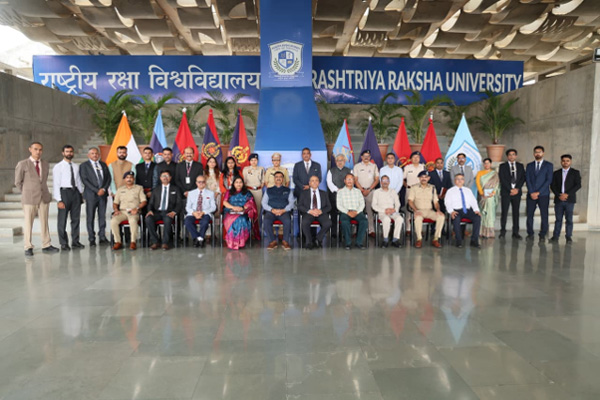
In a significant initiative aimed at redefining the future of Indian policing, the School of Internal Security and SMART Policing (SISSP) of Rashtriya Raksha University (RRU) organised a One-Day Workshop on “Police Image and Best Practices in Policing”, attracting senior police leadership, policymakers and security experts from across the country.
The workshop witnessed participation from Directors General of Police, Inspectors General, senior IPS officers and police officials representing Uttar Pradesh, Uttarakhand, Delhi, Meghalaya, Gujarat, West Bengal, Rajasthan, Daman & Diu and Dadra & Nagar Haveli, making it a vibrant national platform for exchanging ideas on citizen-centric policing.
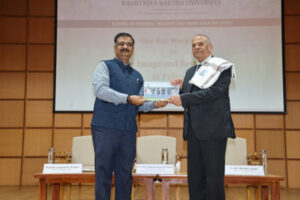
Delivering the Guest of Honour Address, Prof. (Dr.) Vikram Singh, IPS (Retd.), former Director General of Police, Uttar Pradesh and Chancellor of Noida International University, made a passionate call for transforming India’s policing philosophy by abandoning the colonial legacy embedded in the Police Act of 1861.
He urged police organisations to replace the feudal mindset with humane, accountable and people-centric policing, asserting that genuine public confidence cannot be manufactured through public relations campaigns or unauthorised media interactions.
“A positive police image is built not through publicity, but through consistent ethical conduct and genuine public service. Public trust is earned through action—not optics.”
Drawing attention to women’s safety, Prof. Singh highlighted the Kolkata Police’s “LISTEN” model and Uttarakhand Police’s safe-space reporting mechanism as exemplary initiatives that demonstrate empathy and accessibility.
He observed that police stations have historically functioned like a “boys’ club,” often discouraging women from reporting crimes, and called for creating a more inclusive policing environment.
Quoting eminent jurist Justice V.R. Krishna Iyer, he remarked:
“While murder destroys the body, rape destroys the soul.”
He urged police personnel to treat every victim with compassion and dignity.
“Treat victims of crime with the same reverence one would accord to God. Apply the law with complete impartiality, particularly in sensitive domestic disputes.”
Calling for a paradigm shift, he advocated moving “from the danda to the data-centric model of policing,” while encouraging graduating officers to serve the nation with knowledge, integrity and humanity.
Delivering the inaugural address, Prof. (Dr.) Kalpesh H. Wandra said Indian policing is undergoing one of its most profound transformations—from a reactive system that responds after crimes occur to a predictive policing model powered by technology and intelligence, in line with the Prime Minister’s vision of SMART Policing.
He noted that although India has one of the world’s largest policing systems—with nearly 20,000 police stations, 2.6 million personnel, serving more than 1.4 billion citizens—its effectiveness ultimately depends not on numbers but on public trust and active citizen participation.
Prof. Wandra observed that the workshop, featuring 54 expert lectures covering technology adoption, women’s safety and community engagement, reflected India’s growing commitment to creating a transparent, accountable and service-oriented police force aligned with the vision of Viksit Bharat 2047.
Earlier, Lt. (Dr.) Ruchika Singla, Director (I/C), SISSP, welcomed the delegates and outlined RRU’s mission of building a technology-driven, future-ready, efficient and citizen-centric police ecosystem.
She highlighted initiatives such as Mission Karmayogi, programmes promoting women in policing, and specialised capacity-building initiatives aimed at strengthening professional competencies across all ranks.
Dr. Singla noted that RRU’s monthly “Police Image” Lecture Series, conducted on the 22nd of every month, has successfully completed 54 lectures, reinforcing the university’s role in bridging academic research with field-level policing practices.
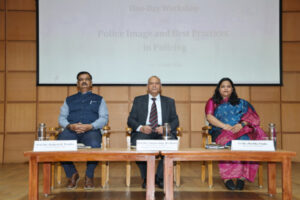
“RRU continues to advance the national vision of Smart Policing while remaining guided by its founding ethos—’National Security is Supreme.’ Our objective is to shape a responsive, technology-enabled and people-first policing framework for India.”
The workshop featured technical sessions by distinguished police leaders who shared innovative practices adopted by their respective organisations.
Among the key presentations were:
- Anant Takwale, IPS, Inspector General (Training), Uttarakhand Police, on community-oriented policing initiatives.
- Dev Ranjan Verma, IPS, Deputy Inspector General (Training), Uttar Pradesh Police, on Women Power Line 1090 and technology-enabled women’s safety.
- Neha Yadav, IPS, Additional Commissioner of Police, Delhi Police, on modern policing practices.
- Lakador Syiem, IPS, Meghalaya Police Academy, on community engagement models.
- Hardik N. Prajapati, Deputy Superintendent of Police, Gujarat Police, on best practices in Gujarat.
- Sujit Bhattacharjee, Inspector, Swami Vivekananda State Police Academy, West Bengal, on strengthening public trust through professional policing.
- Toniya Sharma, Company Commander, 4th RAC Battalion, Rajasthan, on innovative policing initiatives in Rajasthan.
Collectively, the deliberations highlighted how technology, community partnerships, gender-sensitive policing and ethical leadership are redefining the future of policing in India.
The workshop concluded with a vote of thanks by Vishal Katariya, I/C Coordinator, State and UT Police, SISSP, who acknowledged the contributions of the Guest of Honour, Vice Chancellor, distinguished speakers, delegates and the organising team for making the programme a meaningful national dialogue on the future of Indian policing.