NE SCIENCE & TECH BUREAU
BAIKONUR (KAZAKHSTAN), JULY 15
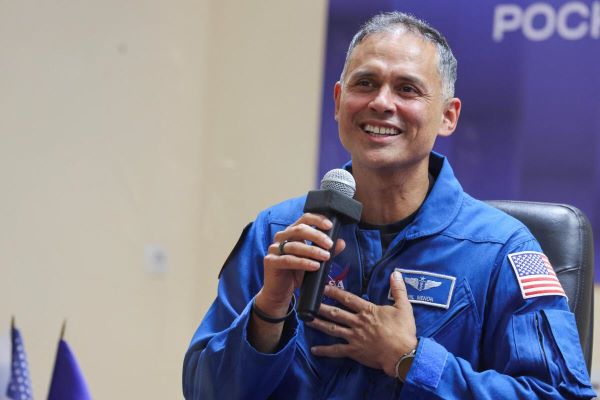
In a proud moment for the global Indian scientific community, Indian-origin NASA astronaut Anil Menon has embarked on his maiden journey to the International Space Station (ISS), marking the beginning of an ambitious eight-month mission dedicated to scientific research and next-generation technology demonstrations.
Menon lifted off aboard Russia’s Soyuz MS-29 spacecraft from the historic Baikonur Cosmodrome in Kazakhstan at 8:17 PM (IST) on Tuesday. The successful launch underscores the continued international cooperation in human spaceflight and shines a spotlight on the growing contributions of scientists and astronauts of Indian origin to global space exploration.
- Indian-origin NASA astronaut Anil Menon successfully launches aboard Russia’s Soyuz MS-29 for his maiden mission to the International Space Station.
- Eight-month expedition will focus on cutting-edge scientific research, technology demonstrations and space medicine experiments.
- Mission highlights the growing global influence of the Indian scientific diaspora in advanced space exploration.
- Soyuz spacecraft completes a flawless launch and automated docking with the ISS within three hours of liftoff.
- Menon will remain aboard the orbiting laboratory until April 2027, contributing to international scientific collaboration and future deep-space missions.
The Soyuz spacecraft carried Menon alongside Roscosmos cosmonauts Pyotr Dubrov and Anna Kikina. Following a smooth ascent into orbit, the spacecraft completed an automated rendezvous and docked with the ISS’s Prichal module after a rapid two-orbit journey lasting approximately three hours.
According to NASA, the newly arrived crew will spend nearly eight months aboard the orbital laboratory, conducting a broad range of scientific investigations, technology demonstrations and operational experiments aimed at advancing human knowledge in space science, engineering and medicine.
The mission is expected to generate valuable insights that will support future long-duration human spaceflights, including planned missions to the Moon under the Artemis programme and eventually to Mars.
For India, Menon’s journey carries special significance as it reflects the rising prominence of the Indian diaspora in the global space ecosystem. His mission comes at a time when India is rapidly expanding its own human spaceflight ambitions through ISRO’s Gaganyaan programme, reinforcing the country’s growing influence in international space science and technology.
Menon and his fellow crew members are scheduled to remain aboard the International Space Station until April 2027, continuing collaborative research that benefits humanity and pushes the frontiers of space exploration.