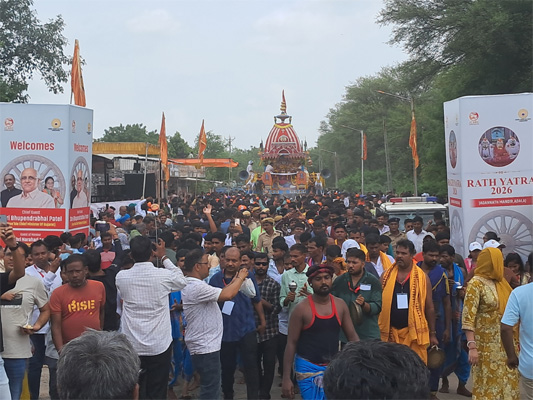

- Thousands of devotees immerse themselves in devotion as Odisha’s timeless Jagannath tradition blossoms vibrantly in Gujarat
- Chief Minister Bhupendra Patel performs the sacred ‘Chhera Pahanra’, reaffirming the eternal message of humility before the Almighty
- Adalaj’s 12th Rath Yatra transforms into a magnificent confluence of spirituality, cultural heritage and universal brotherhood
- Jagannath Cultural Academy and Orissa Socio-Cultural Association preserve Odisha’s living legacy through one of Gujarat’s most revered festivals
- Nearly 30,000 devotees witness the divine procession, while 20,000 receive Mahaprasad in a celebration of equality, compassion and harmony
PRASANTA KUMAR SAHOO
ADALAJ (GANDHINAGAR), JULY 16
More than 1,700 kilometres separate Puri from Gujarat, yet on the sacred occasion of Ashadi Bij, the spiritual heartbeat of Odisha resonated powerfully in Adalaj. As chants of ‘Jai Jagannath’ reverberated through the temple town, thousands of devotees witnessed a living bridge between two culturally rich states, where Odisha’s centuries-old traditions found a vibrant and joyous home in Gujarat. Beyond the rolling chariot and devotional hymns, the festival celebrated India’s timeless civilisational ethos—where faith transcends geography, culture embraces diversity and devotion unites humanity.
A breathtaking spectacle of spirituality, devotion and cultural grandeur unfolded at the Jagannath Temple, Adalaj, as thousands of devotees converged for the 12th Rath Yatra, transforming the temple precincts into a sea of faith and festivity.
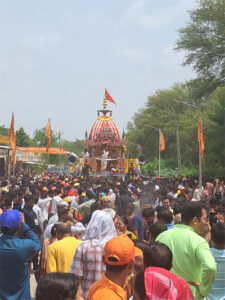
The annual chariot festival, jointly organised by the Jagannath Cultural Academy and Research Centre (JCARC) and the Orissa Socio-Cultural Association, Ahmedabad (OSCA), recreated the sacred traditions of Puri with remarkable authenticity, preserving Odisha’s cherished religious heritage while enriching Gujarat’s multicultural landscape.
The centrepiece of the celebrations was the revered ‘Chhera Pahanra’ ritual, performed by Chief Minister Bhupendra Patel, who ceremonially swept the chariot with a golden broom before the procession commenced.
Replicating the centuries-old tradition observed at the revered Jagannath Temple in Puri, where the Gajapati Maharaja performs the same sacred ritual, the ceremony symbolised the timeless values of humility, equality and selfless service before the Divine.
The ritual carries a profound spiritual message—that irrespective of authority, wealth or social stature, every individual remains an equal servant in the eyes of Lord Jagannath. It is this philosophy that has made the Rath Yatra one of India’s most inclusive spiritual celebrations.
Rajya Sabha MP Narhari Amin, Gandhinagar Mayor Miraben Patel and Vejalpur MLA Amit Thaker joined thousands of devotees in witnessing the sacred festivities.
As the magnificently decorated chariot carrying Lord Jagannath, Lord Balabhadra and Goddess Subhadra rolled through Adalaj amidst devotional chants, traditional music and showers of flowers, devotees pulled the sacred chariot with unwavering faith, believing the act brings divine blessings, spiritual purification and prosperity.
Celebrated on Ashadi Bij, the Rath Yatra commemorates the annual journey of the sibling deities from the Jagannath Temple to the Gundicha Temple, regarded in Odisha’s sacred tradition as the home of their maternal aunt.
Explaining the spiritual significance of the festival, Rabiranjan Panda, who heads the Puja and Rituals Committee of the Adalaj temple, said:
“This journey symbolises a divine family reunion. The deities stay at the Gundicha Temple for eight days before returning to their original abode on Bahuda Yatra on the ninth day.”
The festival also reflects Lord Jagannath’s universal appeal, as the deities leave the sanctum sanctorum to bless devotees from every walk of life, dissolving distinctions of caste, creed, community and social status.
Highlighting the larger cultural mission behind the celebrations, Maheswar Sahu, Chairman of JCARC, said:
“The Rath Yatra at Adalaj aims at serving twin objectives – we want to keep the Jagannath culture alive here and give the people of Gujarat a glimpse into the world-famous Rath Yatra of Puri. The festival is a symbol of universal brotherhood and communal harmony, and it is our humble endeavour to uphold this sacred tradition here.”
At Adalaj, the beautifully adorned chariot carrying the three sibling deities travelled nearly three kilometres from the Jagannath Temple to the Annapurna Temple on the Adalaj-Koba Road before returning after the ceremonial midday offering.

The scale of the celebrations reflected the growing popularity of the festival beyond Odisha’s traditional boundaries.
Sharing the overwhelming response from devotees, Ajay Kumar Das, Member-Secretary of JCARC, said:
“Arrangements were made to serve prasad to nearly 20,000 devotees at the temple, while around 30,000 people visited the shrine on the occasion.”
The Jagannath Temple at Adalaj, inaugurated on Rath Yatra Day in 2014, has celebrated the annual Rath Yatra every year since 2015. This year’s month-long festivities commenced with Devasnana Purnima on June 29 and will culminate with Niladri Bije on July 27, continuing to preserve Odisha’s sacred traditions while strengthening Gujarat’s rich tapestry of cultural inclusivity.
Far beyond a religious procession, the Adalaj Rath Yatra has evolved into a vibrant symbol of India’s unity in diversity—where the devotional soul of Odisha finds joyful expression in Gujarat, carrying forward an enduring message of compassion, equality, harmony and universal brotherhood.