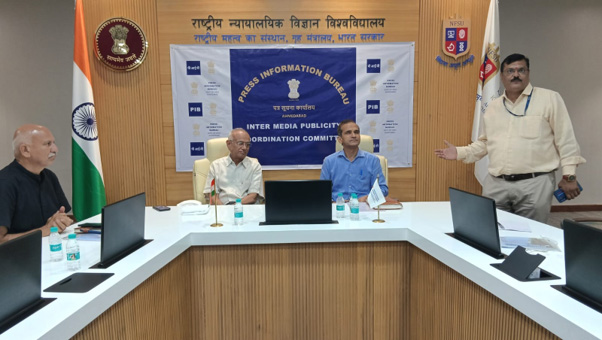
- NFSU Vice Chancellor urges journalists to embrace forensic journalism, scientific verification and rigorous fact-checking
- PIB Director General Prashant Pathrabe warns shrinking eight-second attention span demands instant credibility
- IMPCC meeting at NFSU charts roadmap for coordinated, trustworthy government communication
- Officials from key ministries and agencies deliberate on combating fake news and strengthening public trust
NE NEWS SERVICE
GANDHINAGAR, JULY 17
In an era where misinformation travels faster than verified facts, National Forensic Sciences University (NFSU) Vice Chancellor Dr J.M. Vyas delivered a compelling message to journalists: truth must be backed by evidence, not assumptions. Calling forensic journalism the next frontier of responsible reporting, he urged media professionals to make fact-checking and scientific verification their strongest defence against fake news, while PIB Director General Prashant Pathrabe cautioned that with the average human attention span shrinking to just eight seconds, credibility has become the media’s most valuable currency.
Addressing government communication officials during the Inter-Media Publicity Coordination Committee (IMPCC) meeting organised by the Press Information Bureau (PIB) at the National Forensic Sciences University, Gandhinagar, Dr Vyas highlighted the growing significance of forensic journalism in modern newsrooms.
“Journalists are often the first responders to reach the scene of an incident. Forensic journalism enables them to understand the evidence, facts and circumstances scientifically before presenting accurate and responsible reports to society,” he said.
Dr Vyas stressed that the digital revolution has dramatically intensified the challenges posed by fake news, misinformation and disinformation.
“In today’s digital age, journalists must place fact-checking at the heart of their profession, adopt a scientific approach and practise evidence-based reporting. Forensic journalism empowers the media to separate facts from speculation and deliver credible information that strengthens public trust,” he observed.
Illustrating the real-world application of forensic science, Dr Vyas referred to the crucial role played by NFSU following the Air India plane crash, where the university completed DNA profiling of all 270 victims within just ten days, ensuring timely and accurate identification of the deceased.
Speaking on the occasion, PIB Director General Prashant Pathrabe highlighted the communication challenges confronting institutions in the digital era.
“Today, the average human attention span is only about eight seconds. Every institution and communicator has an extremely limited opportunity to capture public attention and build trust. In an era dominated by fake news, misinformation and disinformation, credibility remains our greatest asset,” he said.
Pathrabe noted that while digital and social media have accelerated the flow of information, they have also amplified the spread of misleading content.
“Public trust can be strengthened only through factual, responsible and credible communication. Effective communication is not merely about conveying information—it is about building confidence among people and enhancing institutional credibility,” he added.
The meeting brought together representatives from several ministries, departments and public institutions, including NFSU, India Meteorological Department (IMD), Doordarshan, All India Radio (Akashvani), Employees’ Provident Fund Organisation (EPFO), Indian Oil Corporation Ltd (IOCL), National Highways Authority of India (NHAI), Defence PRO, ISRO, Gujarat State Information Department and the Department of Posts.
Participants reviewed awareness campaigns conducted under the nationwide “Ek Ped Maa Ke Naam” initiative and discussed upcoming outreach programmes aimed at expanding public awareness of Government of India welfare schemes.
The deliberations also focused on strengthening inter-departmental coordination, improving the credibility of government communication, addressing emerging public relations challenges and developing strategies to reinforce public confidence in the digital information ecosystem.
The IMPCC meeting concluded with a renewed commitment among participating organisations to promote accurate, transparent and coordinated communication while reinforcing the importance of fact-based public information in an increasingly complex media landscape.