- PIB’s five-day media immersion showcases Gujarat’s transformation through infrastructure, innovation, heritage and nation-building initiatives
- Delegation to explore Bullet Train project, GIFT City, National Maritime Heritage Complex, NFSU, Statue of Unity, Amul and semiconductor ecosystem
- Director General Prashant Pathrabe urges fact-based, development-oriented journalism to strengthen informed public discourse
- Tour aims to equip media professionals with first-hand insights into flagship national projects, technological advancements and India’s growth story
NE NEWS SERVICE
AHMEDABAD, JULY 20
As Gujarat continues to emerge as one of India’s foremost engines of economic growth, technological innovation and world-class infrastructure, a delegation of journalists from Chhattisgarh has embarked on a five-day immersive study tour to witness first-hand the development initiatives that are reshaping the nation’s future. The exposure visit is designed to deepen understanding of flagship national projects and promote informed, factual and balanced reporting on issues of public importance.
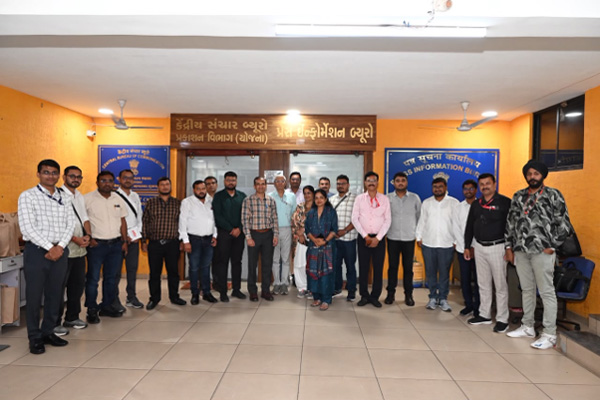
A 12-member delegation comprising journalists from print, electronic, digital and social media organisations in Raipur, accompanied by two officers from the Central Bureau of Communication (CEP), Raipur, arrived in Ahmedabad on Sunday under a media outreach programme organised by the Press Information Bureau (PIB), Raipur.
On the opening day of the tour, the visiting journalists paid a courtesy call on Prashant Pathrabe, Director General, PIB Ahmedabad, before visiting Kochrab Ashram, where they explored Mahatma Gandhi’s early experiments in nation-building and social transformation.
The study tour, scheduled from July 20 to 24, seeks to familiarise journalists with India’s major infrastructure projects, industrial achievements, technological institutions and nationally significant heritage sites, enabling them to disseminate authentic, fact-based information to the public.
During the visit, the delegation will undertake an in-depth study of the country’s flagship Mumbai-Ahmedabad High-Speed Rail (Bullet Train) Project and the Sabarmati Multimodal Transport Hub, gaining insights into India’s next-generation transportation infrastructure and integrated urban mobility initiatives.
The journalists will also travel to Lothal, the historic Indus Valley Civilisation port city, to understand the ongoing development of the National Maritime Heritage Complex, a landmark project showcasing India’s rich maritime legacy.
Industrial excellence will form another major component of the tour as the delegation visits a semiconductor manufacturing facility, Amul Dairy and the Indian Oil Corporation Limited (IOCL) Refinery, offering a closer look at India’s advances in manufacturing, cooperative success, energy security and refining technologies.
The itinerary further includes visits to the Statue of Unity and the Sardar Sarovar Dam, where participants will study water resource management, irrigation, hydroelectric power generation and tourism-led regional development centred around the world’s tallest statue.
In the final phase of the programme, the media team will explore the National Forensic Sciences University (NFSU) to understand emerging innovations in forensic science, cyber security and criminal investigation, before concluding the tour at GIFT City, India’s first International Financial Services Centre, to gain insights into the country’s rapidly expanding fintech ecosystem and global financial aspirations.
The PIB initiative aims to provide journalists with direct exposure to transformational projects that are shaping New India, enabling them to produce balanced, evidence-based and development-focused reportage that informs citizens and strengthens public understanding of national progress.
Read also