NE LEGAL BUREAU
NEW DELHI, JULY 20
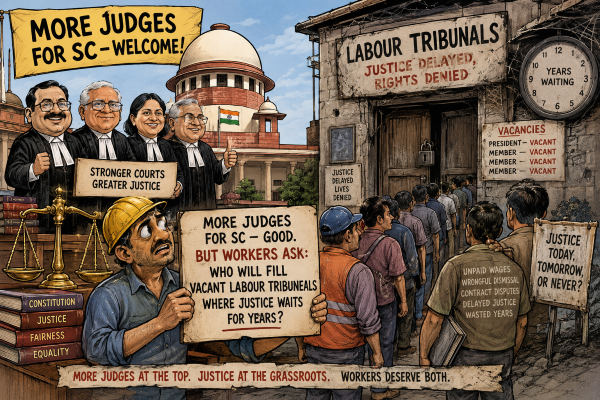
For millions of India’s working men and women, justice delayed is not merely justice denied—it is often justice buried with time. While the Union Government’s move to increase the sanctioned strength of the Supreme Court has been widely welcomed as a step towards reducing judicial backlog, trade unions and labour law experts have renewed an equally urgent demand: fill the long-vacant posts of Presiding Officers in Central Government Industrial Tribunals (CGITs), where workers battling illegal dismissals, wage disputes, gratuity, provident fund and retirement benefits continue to wait endlessly for justice.
- Government moves Bill to raise Supreme Court strength from 34 to 38 judges to tackle mounting pendency of over 92,000 cases
- Trade unions urge Centre to simultaneously fill long-vacant Presiding Officer posts in Central Government Industrial Tribunals (CGITs), saying delayed labour justice is denied justice
- Several CGITs continue to function without regular Presiding Officers, forcing additional-charge arrangements and prolonging industrial disputes, wage claims and retirement benefits
- Workers fear many litigants may never enjoy the fruits of favourable verdicts during their lifetime as cases drag on for years amid judicial vacancies
- Labour leaders call for a time-bound national mission to strengthen labour adjudication, saying speedy justice is the backbone of industrial peace and economic growth
- Legal experts welcome Supreme Court expansion but stress that judicial reforms must extend from the apex court to labour tribunals where India’s working class seeks its first line of justice
Law Minister Arjun Ram Meghwal on Monday introduced in the Lok Sabha a Bill to replace the ordinance increasing the sanctioned strength of the Supreme Court from 34 to 38 judges, asserting that enhancing judicial capacity is among the most effective ways to reduce the mounting pendency before the apex court.
According to the Statement of Objects and Reasons of the Bill, the Supreme Court had 92,101 pending cases as on January 1, 2026. During 2025, the Court received 75,410 fresh matters while disposing of 65,615 cases, highlighting the continuing gap between fresh filings and disposal.
The Government said increasing the strength of judges would enable the Chief Justice of India to constitute Constitution Benches more frequently and address long-pending matters more effectively.
However, the move has also brought renewed focus on the condition of Central Government Industrial Tribunals-cum-Labour Courts (CGITs), where vacancies of Presiding Officers continue to affect adjudication of industrial disputes.
Official data placed before Parliament earlier this year showed that eight of the country’s 22 CGITs were functioning without regular Presiding Officers, including tribunals at Chennai, Ernakulam, Mumbai-I and Ahmedabad, with additional charge arrangements being made in several places.
The Ministry of Labour’s own website continues to show several CGITs operating with vacant Presiding Officer posts, with neighbouring tribunals holding additional charge to keep proceedings alive.
For instance, the Ahmedabad CGIT has remained without a regular Presiding Officer since March 21, 2024, and the Government informed Parliament that the appointment process had to be restarted after the selected candidate declined the post.
Trade union leaders said this situation inflicts untold mental agony on thousands of workers and retirees.
“A worker approaching a labour tribunal is often fighting for livelihood, pension, gratuity, provident fund or reinstatement. Every vacant tribunal means another family pushed into uncertainty. Justice cannot become meaningful if a workman is unable to enjoy its fruits during his lifetime,” said senior trade union leaders while welcoming the move to strengthen the Supreme Court.
Another labour representative observed:
“The Government’s decision to strengthen the Supreme Court deserves appreciation. But judicial reforms must reach the last worker standing outside a labour court. Industrial peace depends as much on strong labour tribunals as on strong constitutional courts.”
Trade union leaders also urged the Centre to launch a time-bound recruitment drive to fill all vacancies in CGITs and provide adequate supporting staff and infrastructure.
Legal experts pointed out that while the Industrial Disputes framework envisages expeditious adjudication of labour disputes, prolonged vacancies often result in repeated adjournments and delayed hearings, particularly in complex wage, service and retirement benefit cases.
The Government has, in the past, stated that link officers, camp courts and advance recruitment processes are used to minimise disruption whenever vacancies arise.
The Bill introduced on Monday does not require a Constitutional amendment and can be passed by a simple majority in Parliament.
If enacted, the legislation will formally replace the ordinance under which the sanctioned strength of the Supreme Court has already been increased and five judges have subsequently been appointed.
While legal fraternity has broadly welcomed the expansion of the apex court, labour organisations insist that true judicial reform will be complete only when India’s workers—from factory floors to ports, railways, banks and public sector undertakings—receive timely justice through fully functional labour tribunals across the country.