NE NEWS SERVICE
CHENNAI, JULY 23
For millions, the roadside food stall is not merely a place to grab an affordable meal—it is a livelihood for one family and a daily source of food for thousands of others. The challenge before Tamil Nadu is therefore not to push street food away from public spaces, but to bring safety, dignity and scientific hygiene into every street kitchen.
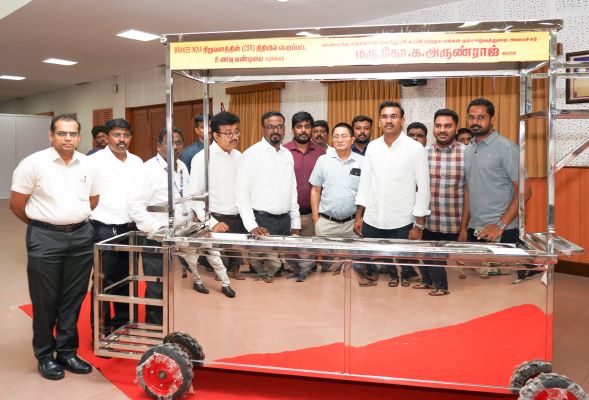
Taking a significant step in that direction, Tamil Nadu Health and Family Welfare Minister K.G. Arunraj on Thursday launched a special food-safety support initiative for street-food vendors, with more than 1,500 vendors from across Chennai participating in the programme.
- Health Minister K.G. Arunraj launches special food-safety vehicles for 1,500 street-food vendors in Chennai
- Stainless-steel cooking carts, food-safety training, hygiene kits and corporate support to transform street vending into safer micro-enterprises
- Six model ‘Healthy and Hygienic Food Streets’ planned in Chennai, Coimbatore, Madurai, Tiruchirappalli, Salem and Tiruppur
- Government sets sights on nearly 50,000 street-food vendors across Tamil Nadu through a statewide food-safety mission
- Minister calls for a new social contract between vendors and consumers: affordable food must also be safe and hygienic
The initiative seeks to transform street-food vending from an informal livelihood into a safer, more hygienic and better-supported micro-enterprise, combining food-safety awareness, improved cooking infrastructure, vendor training and corporate participation.
The programme was launched at Shri Ramachandra Medical College, where the Minister reviewed the special food-safety arrangements and interacted with street-food vendors.
The initiative is part of the State Government’s larger effort to improve food safety standards while protecting the livelihoods of street-food entrepreneurs.
A simple question with huge public-health consequences: Is the food safe?
The Minister stressed that food safety is not a luxury but a fundamental requirement for a healthy society.
He said the government’s approach was based on the principle that food must be safe, nutritious and hygienically prepared.
“Food is the basic necessity for the creation of a human being. No person can exist without food,” the Minister said, underlining the importance of ensuring that the food consumed by the public is safe.
He said the Government, under the leadership of Chief Minister Josph Vijay, was taking several measures to improve food safety and public health.
The Minister also noted that street-food vendors serve large sections of the public and should therefore be enabled to provide clean, hygienic and safe food while also expanding their businesses.
Tamil Nadu has around 50,000 street-food vendors, making the sector an important part of the State’s informal economy and urban food system.
From the cooking cart to the consumer: Safety at every step
The initiative seeks to ensure that food safety is maintained from the purchase of ingredients to preparation and sale.
The Minister emphasised that vendors must ensure that raw materials, cooking oils and other food ingredients are handled safely and hygienically.
He also called upon street-food vendors to take responsibility for their own health, pointing out that illness among food handlers could potentially affect the health of consumers.
The food-safety initiative includes:
- Food-safety awareness and training;
- Guidance on safe cooking and food handling;
- Support for hygienic food preparation;
- Awareness on the safe use of cooking oils;
- Promotion of stainless-steel cooking equipment;
- Food-safety kits for vendors;
- Medical and food-safety guidance; and
- Greater convergence between government agencies and private-sector partners.
The Minister said the objective was to establish a culture in which both vendors and consumers recognise that affordable food and safe food must go together.
Corporate partners join hands to equip street-food entrepreneurs
As part of the initiative, five street-food vendors were provided with food-related equipment and support by corporate partners, including Breaks India, Pan Oleo Energy Ltd, Udhayam Agro Foods and Grace Pvt Ltd.
The initiative also received support for the provision of stainless-steel food preparation vehicles, designed to facilitate more hygienic food preparation.
The Minister thanked the participating companies for extending support to street-food entrepreneurs.
The effort reflects a growing recognition that improving food safety requires a partnership involving:
- Government.
- Food-safety authorities.
- Local bodies.
- Street-food vendors.
- Consumers.
- And responsible private-sector partners.
- Six model food streets to set a new standard
Tamil Nadu is also moving towards the creation of Healthy and Hygienic Food Streets in six districts.
The model food streets are planned for:
- Chennai;
- Coimbatore;
- Madurai;
- Tiruchirappalli;
- Salem; and
- Tiruppur.
The objective is to create designated food zones where vendors can operate with better infrastructure and where consumers can access food prepared under improved hygiene standards.
The State Government’s broader plan envisages model food streets with standardised facilities and better support for vendors.
Officials have indicated that the initiative is intended to create examples of best practices in food safety and hygiene, while ensuring that street-food vendors are not excluded from the formal economy.
The pilot model is expected to be expanded across the State after assessing its implementation and impact.
The message to vendors: livelihood and responsibility must go together
The Minister said street-food vendors play an important role in society and should be able to grow their businesses while also ensuring food safety.
He called upon vendors and food handlers to pay attention to their own health and undergo periodic health checks.
The underlying concern is clear: a food handler’s health can have a direct bearing on public health.
The government is therefore seeking to build greater awareness among vendors on:
- Personal hygiene;
- Safe food handling;
- Clean cooking surfaces;
- Safe storage of ingredients;
- Use of approved food materials;
- Proper handling of cooking oils; and
- Prevention of food contamination.
The Minister also warned that strict action would be taken against the use of banned or unsafe food ingredients and against those who violate food-safety norms.
The bigger idea: Street food should not have to choose between affordability and safety
The Tamil Nadu initiative raises a larger question for India’s rapidly expanding cities:
Can street food remain affordable while becoming safer, cleaner and more professionally managed?
The answer may lie in the kind of collaborative model now being attempted in Tamil Nadu.
Street vendors need support, training and infrastructure.
Consumers need confidence.
The government needs effective monitoring.
And food businesses must accept that hygiene is not merely a regulatory obligation but a public responsibility.
With the State planning model food streets across six major districts and aiming to improve food-safety practices among its large street-vending community, Tamil Nadu is attempting to create a new template—one in which the humble roadside food stall becomes not a symbol of regulatory neglect but an example of inclusive urban enterprise with public-health responsibility.
The State’s food-safety authorities have also been emphasising stronger compliance and enforcement. The national regulatory framework has, meanwhile, increasingly moved towards combining simplified compliance for small food businesses with risk-based oversight and stronger food-safety enforcement.
The success of the initiative, however, will ultimately depend on sustained implementation.
Because the real test of a food-safety mission is not the launch of a programme.
It is whether every customer, at every street corner, can take the next bite with greater confidence.