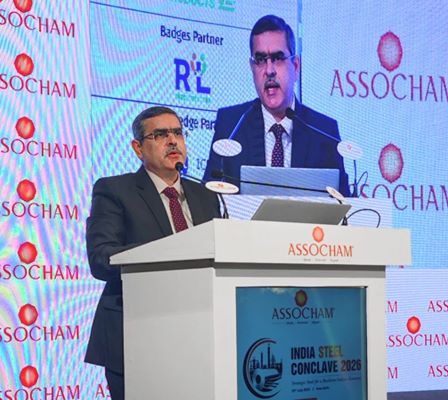
NE BUSINESS BUREAU
NEW DELHI, JULY 23
The age when steel could compete globally on price, volume and production capacity alone is rapidly coming to an end. The new contest will be fought on carbon intensity, technology, supply-chain resilience and access to markets—and Tushar Makkar’s message to the Indian steel industry is unmistakable: innovate, decarbonise, secure raw materials and look beyond traditional export destinations.
India’s steel future will be shaped by more than capacity. At the ASSOCHAM India Steel Conclave 2026, AM/NS India leaders discussed resource security, infrastructure connectivity, advanced manufacturing and the evolving global trade landscape. pic.twitter.com/YWthrKApgH
— ArcelorMittal Nippon Steel India (@AMNSIndia) July 23, 2026
As global trade becomes increasingly protectionist and carbon regulations begin influencing market access, the Indian steel industry must urgently reinvent its competitive strategy, Tushar Makkar, Head Corporate Communications, ArcelorMittal Nippon Steel India (AMNS India) has emphasised.
- AM/NS India’s Tushar Makkar flags raw-material security as a strategic imperative amid supply-chain disruptions, freight volatility and geopolitical risks
- Government urges Indian steelmakers to accelerate decarbonisation, strengthen technology and R&D and diversify export markets
- Carbon border measures and tariff actions are redrawing the global steel map, making low-carbon production increasingly critical to market access
- India’s steel industry must combine technology-led innovation with reliable raw-material supplies to support capacity expansion and global competitiveness
- The message from the India Steel Conclave 2026: the future belongs to steel that is greener, smarter, more resilient and capable of finding new markets
His call comes at a crucial juncture for the sector, with the global steel trade facing a rapidly changing landscape shaped by tariffs, carbon-border measures, geopolitical tensions and supply-chain vulnerabilities.
The broader message emerging from the ASSOCHAM India Steel Conclave 2026 is that Indian steelmakers must not wait for external pressures to force change.
They must get ahead of them.
‘The next competitive edge will be low-carbon steel’
The government has called upon the Indian steel industry to accelerate decarbonisation, strengthen technology and R&D and diversify export markets to remain globally competitive.
“Indian steel industry must accelerate decarbonisation, strengthen technology and R&D, and diversify its export markets to remain globally competitive amid a rapidly shifting trade landscape shaped by carbon border measures and tariff actions,” said Ashwini Kumar, Economic Advisor, Ministry of Steel, while addressing the conclave.
The warning carries particular significance as carbon intensity increasingly becomes a factor in international trade.
The European Union’s Carbon Border Adjustment Mechanism (CBAM) means that access to high-value markets will increasingly depend not only on the price and quality of steel, but also on the emissions associated with its production.
For India, this makes decarbonisation not merely an environmental objective.
It is becoming an export strategy.
Makkar: Raw-Material security is a strategic imperative
Makkar highlighted the equally critical challenge of ensuring reliable and uninterrupted access to raw materials.
“Raw material security continues to be a strategic concern. India remains dependent on imports for approximately 85 per cent of its coking coal requirements, exposing producers to supply-chain disruptions, freight volatility, geopolitical risks and raw-material price fluctuations. At the same time, ensuring predictable and long-term access to iron ore resources remains critical to supporting future capacity expansion,” he said.
The observation highlights the complex reality facing India’s steel sector.
A country may possess the ambition to become a global steel powerhouse, but its competitiveness can still be affected by the availability, cost and reliability of critical inputs.
Coking coal security, iron-ore access, freight costs and geopolitical disruptions are therefore no longer isolated procurement concerns.
They are strategic determinants of national industrial competitiveness.
From protectionism to carbon barriers: the global market is being redrawn
The global steel industry is facing an increasingly fragmented trade environment.
Countries are adopting protective measures to safeguard domestic industries, while carbon regulations are adding a new dimension to international competition.
The United States has invoked Section 232 measures, while the European Union has introduced CBAM, adding pressure on steel-producing nations to reduce the carbon intensity of production.
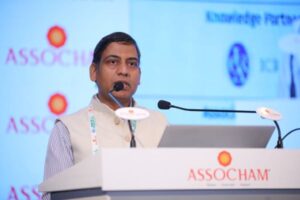
Ashwini Kumar, Economic Advisor, Ministry of Steel said the developments should not be viewed only as threats.
“I would like to look at it with a positive lens, an opportunity to modernise India’s steel industry, improve technology and production processes, significantly reduce emissions and, at the same time, strengthen its long-term global competitiveness. I am confident that with the right policy support, continuous innovation, investment in technology and close collaboration between government and industry, the Indian steel sector will not only overcome these challenges but emerge stronger and more globally competitive,” he said.
That opportunity, however, will require a fundamental transformation of the way steel is produced.
The new formula: technology + decarbonisation + new markets
For India’s steel industry, the next phase of growth will require a combination of multiple strategies.
Technology-led innovation will be critical to improve efficiency and reduce emissions.
Decarbonisation will determine access to increasingly climate-conscious markets.
Research and development will be needed to develop new production pathways and low-carbon technologies.
Export diversification will help reduce dependence on a limited number of markets.
And raw-material security will be essential to support the expansion of capacity.
The Ministry of Steel has itself identified low-carbon steel production, hydrogen-based steelmaking, carbon capture, utilisation and storage (CCUS), waste utilisation and resource efficiency among the important technology areas requiring attention.
The sector is therefore entering a phase where the ability to innovate could become as important as the ability to produce.
India needs to find the next market before the old one closes
The message on export diversification is particularly significant.
As traditional markets introduce tariff and carbon barriers, Indian steelmakers will need to identify new destinations while also moving towards higher-value and more specialised products.
The future of Indian steel exports could increasingly depend on:
- New geographical markets;
- Higher-value steel products;
- Specialised grades;
- Stronger customer partnerships;
- Lower-carbon production; and
- Greater flexibility in responding to shifting trade policies.
The strategy will have to move from simply asking “Where can India sell steel today?” to a more strategic question:
“Which markets will need Indian steel tomorrow—and what kind of steel will they demand?”
The decarbonisation race is now a competitiveness race
India’s steel sector is expanding rapidly, with the Ministry of Steel positioning the industry for significant capacity growth while simultaneously pursuing a transition towards lower-carbon production.
This creates a twin challenge.
India must produce significantly more steel to support infrastructure, manufacturing and economic growth.
At the same time, it must ensure that this growth does not lock the industry into production systems that become increasingly uncompetitive in a carbon-conscious global market.
The answer will require sustained investment in:
- Cleaner production technologies;
- Renewable energy;
- Energy efficiency;
- Green hydrogen;
- Scrap-based steelmaking;
- Carbon measurement and reporting;
- Digitalisation;
- Artificial intelligence and industrial automation; and
- Research and development.
The big message: India must not wait for the world to change
The combined message from the policy and industry voices at the conclave is powerful.
India’s steel industry has the scale, domestic demand and manufacturing potential to become a major global force.
But scale alone will not guarantee global competitiveness.
The industry must secure its raw materials.
It must develop cleaner technologies.
It must invest in R&D.
It must diversify export destinations.
And it must anticipate the future demands of global customers rather than merely respond to present-day trade pressures.
The choice before the industry is therefore stark: Remain a large producer competing primarily on volume—or become a technologically advanced, low-carbon and globally diversified steel powerhouse.
Tushar Makkar’s call makes the direction clear.
The future of Indian steel will be decided not merely in the furnace, but in laboratories, technology centres, supply chains, carbon ledgers and new markets across the world.