NE NEWS SERVICE
NEW DELHI, JULY 25
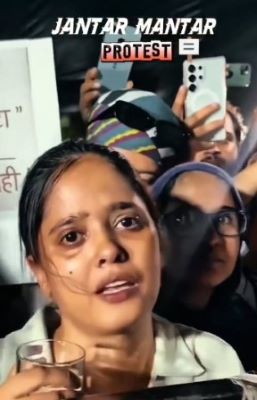
For 36 days, the streets spoke the language of students. On Saturday, the government answered with a resignation, assurances and a promise of reform. The Cockroach Janta Party (CJP) on Saturday called off its nationwide agitation over the NEET controversy after Union Education Minister Dharmendra Pradhan resigned, the government agreed to consider compensation for families of students who died by suicide in the aftermath of the examination crisis and assured withdrawal of FIRs and protection from retaliatory action against protesters.
मीडिया के नाम संदेश,
काफ़ी गंभीर विषय हैं। pic.twitter.com/2cCK9Cn8Bs
— Cockroach Janta Party (@CJP_for_India) July 26, 2026
The announcement brought an immediate end to the CJP’s 36-day protest at Jantar Mantar and other sites across India — but not to the larger national debate over the integrity, fairness and future of India’s high-stakes examination system.
The CJP said it was withdrawing the agitation “in good faith”, after government interlocutors JP Nadda and Jitendra Singh agreed to the key demands raised by the movement.
The two sides will meet again after four weeks to discuss broader reforms in the examination and education system.
‘We have won’ — but the fight for examination reform continues
CJP spokesperson Saurav Das said the organisation had decided to withdraw the agitation after the government accepted its demands.
“The CJP declares that we withdraw the agitation in good faith and understanding that the agreed-upon terms will be executed within the agreed-upon timeline,” Das said at a joint press conference with government interlocutors.
Another CJP spokesperson, Ashotosh Ranka, appealed to protesters across the country to return home peacefully.
“As the government accepted all our demands after 36 days of protests, we appeal to everyone to peacefully withdraw from protest sites and go home,” Ranka said.
The CJP said it had submitted a draft of its demands to the government and that a written guarantee would be provided by Tuesday.
Ranka said the CJP’s five-point charter of demands would remain central to the next round of discussions.
“We will meet again in four weeks with that demand charter so that we can work on broader reform,” he said.
The movement had demanded accountability over alleged irregularities in NEET-UG 2026, compensation for families of students who allegedly died by suicide in the aftermath of the examination crisis, withdrawal of cases filed against protesters and wider reforms in the conduct of competitive examinations.
Nadda’s assurance: No retaliation, FIRs to be withdrawn
Union Health Minister JP Nadda said the CJP representatives had come to the meeting with a written draft covering cases registered during the agitation and other demands.
“We discussed these issues in detail. After the discussion, the first point was that no action should be taken and no FIRs should be filed. If any FIRs have already been registered, whether by the Delhi Police or in BJP-ruled states, it will be withdrawn,” Nadda said.
He also said the government had agreed to provide “honourable compensation within the rules” to families of NEET-linked suicide victims.
Nadda said the government would provide the CJP copies of FIRs registered during the agitation.
The assurances followed weeks of mounting tension, including police action against protesters and a march towards Parliament that triggered a sharp confrontation between demonstrators and security forces.
The government’s commitment to no retaliatory action became one of the key conditions for the withdrawal of the agitation.
Pradhan: ‘This is not a matter of personal prestige’
The resignation of Dharmendra Pradhan became the defining moment of the protest.
In his message to students and the country, Pradhan said he had dedicated more than four decades to students, teachers and education reform.
“From day one, I took responsibility for this and never turned my back on the situation. My resolve was that we would not let any meritorious student’s prospects be ruined by the examination mafia, nor allow injustice to happen to any student,” he said.
In his resignation message, Pradhan said the decision was not driven by personal prestige.
“This is not a matter of personal prestige for me. India’s youth power is the true strength of this nation,” he said.
Explaining his decision, he said he wanted to ensure that the situation at Jantar Mantar and across the country was not exploited by anti-national forces, that national unity remained intact and that students’ futures did not become entangled in legal complexities.
“Considering all these factors, I have submitted my resignation to the Honorable Prime Minister,” Pradhan said.
His resignation came after the NEET-UG controversy had triggered nationwide protests, a CBI investigation, cancellation and re-conduct of the examination and a renewed national debate over examination security.
The Centre has also announced a move towards Computer-Based Testing (CBT) for NEET from next year, while reform proposals have included stronger digital security, tighter control over question-paper creation and a more robust institutional framework for examination management.
Stalin: ‘NEET MUST be at the heart of the students’ protest’
The political reverberations were particularly strong in Tamil Nadu, where opposition to NEET has remained a long-standing issue linked to social justice, rural access and the rights of government-school students.
Former Chief Minister of Tamil Nadu and DMK President M.K. Stalin has maintained that the examination itself must be abolished.
“More than any other demand, the abolition of NEET must be at the heart of students’ protests in New Delhi,” Stalin said.
He has also argued that Tamil Nadu had warned from the beginning about the risks associated with the examination and reiterated the State’s demand for its abolition.
“The Tamil Nadu Government has only one demand — the exam must be abolished,” he said.
The State’s position has been that a single high-stakes national examination can disadvantage students from rural, government-school and Tamil-medium backgrounds who lack access to expensive coaching.
The NEET controversy has therefore widened from a question of a compromised examination to a larger argument over social justice, federalism, coaching dependence and the future of medical admissions.
Kamal Haasan: ‘The nation failed its children’
Actor and politician Kamal Haasan also backed the student movement, framing the crisis as a failure of the education system to protect children and their aspirations.
His intervention came as the protests gathered support from prominent voices in Tamil Nadu’s political, social and cultural spheres.
Haasan’s message, that the nation had failed its children, captured the deep emotional dimension of the controversy — particularly for families who saw years of preparation, financial sacrifice and personal hope thrown into uncertainty by examination irregularities.
The debate, however, is now moving beyond outrage.
The central question confronting policymakers is whether the next generation of reforms can ensure that no student’s future depends on the strength of a leak network, the reach of a coaching ecosystem or the failure of a confidential examination chain.
Jyotika to Gen Z: ‘I stand with the students’
Actor Jyotika added her voice to the growing support for the protesters.
In a message backing the movement, she wrote:
“Step down Dharmendra Pradhan. Resign. I stand with the students and the future of our nation! I stand with accountability. I stand for a democratic India.”
The statement reflected the growing involvement of public figures in a debate that has increasingly moved beyond party politics.
The movement also received support from artists, filmmakers and civil society voices who argued that the credibility of an examination system must be measured by the confidence it inspires among students — not merely by the technical process through which it is conducted.
Vetrimaaran: ‘If students protest, it shows the failure of the government’
At a Chennai protest organised by the Neelam Students Movement, filmmaker Vetrimaaran strongly backed the student agitation.
“If students protest, it shows the failure of the government,” he said, referring to the impact of NEET on students and families.
The filmmaker said he had seen the impact of the examination through the experiences of friends’ children.
His intervention also revived a long-standing argument that a single national examination cannot adequately reflect the diverse educational, social and linguistic realities of India.
The Chennai protest saw participation from filmmaker Pa. Ranjith, Vetrimaaran and other artists and public figures, signalling the growing cultural and social dimensions of the NEET debate.
From anger to architecture: how India can plug the leaks
The end of the protest now places the spotlight firmly on the promised reforms.
The Government has already announced a shift towards Computer-Based Testing from next year, a move aimed at reducing vulnerabilities associated with the physical handling, transportation and storage of question papers.
But experts have cautioned that technology alone cannot repair a system unless the entire examination chain is redesigned.
Among the reform directions under discussion are:
- Computer-Based Testing to reduce physical question-paper vulnerabilities;
- Zero-trust examination architecture, in which no single individual or agency has complete knowledge of the final paper;
- Creation of a large, secure central question bank from which examination papers can be generated later;
- Stronger biometric and identity verification of candidates;
- Secure digital audit trails;
- Greater separation between question-setting, paper compilation and examination administration;
- Independent oversight and accountability mechanisms;
- Stronger protection for whistleblowers and complainants;
- Transparent protocols for handling suspected irregularities;
- Rapid communication with students when a crisis occurs.
One reform proposal discussed in the wake of the controversy envisaged question setters not knowing which examination their questions would ultimately be used for, with questions placed in a larger repository before the final paper is generated.
Education-reform experts have also stressed that examination security must be treated as a system rather than a single locked room. The process must be secure from question creation to final evaluation, with every stage independently auditable.
The students’ real demand: A fair chance
The 36-day agitation has left behind a message that cannot be reduced to the resignation of one minister.
For students, the central demand has been simple: the examination must be fair, the process must be transparent and accountability must be real.
The crisis has also highlighted the immense pressure built into India’s competitive examination ecosystem.
For many aspirants, a single examination determines years of preparation, family expenditure, emotional investment and career dreams.
When the system fails, the damage is not confined to a question paper.
It reaches homes.
It reaches classrooms.
It reaches the mental health of students.
And, in the most tragic cases, it reaches families that lose children who had once believed that education was their path to a better future.
That is why the government’s assurances on compensation, FIR withdrawal and reform will now face their most important test — implementation.
A protest ends. The examination of the system begins
The CJP’s decision to withdraw its agitation has brought a temporary calm to the streets.
But the four-week review meeting will be watched closely.
Will the promised written assurances be delivered?
Will FIRs be withdrawn?
Will families receive compensation?
Will the five-point reform charter become policy?
Will CBT truly eliminate the vulnerabilities that allowed the crisis to unfold?
And most importantly, will the next NEET restore the confidence of students who now approach India’s most important medical entrance examination with fear rather than faith?
The CJP has called the resignation its first major victory.
For the government, the next challenge is to ensure that the victory does not remain merely political.
For students, parents and educators, the real victory will come only when every deserving candidate can sit for an examination without asking whether the system itself is fair.
The protest may have ended at Jantar Mantar. But the nation’s examination system has just begun its most important test.