NE LAW & BUSINESS BUREAU
NEW DELHI, AUG 5
In an India that can detect a tax mismatch with an algorithm, track a transaction in seconds and identify a potential non-filer through technology, should a senior citizen who has paid more tax than legally due still have to navigate the maze of an Income Tax Return merely to get his or her own money back?
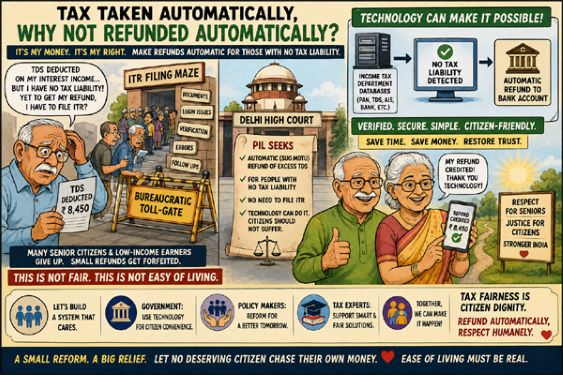
That uncomfortable question is now before the Delhi High Court, where a public interest litigation has sought an automatic or suo motu refund mechanism for excess Tax Deducted at Source (TDS) in cases where an individual has no tax liability and is otherwise not required to file an Income Tax Return (ITR).
A division bench of Chief Justice Devendra Kumar Upadhyaya and Justice Tejas Karia has sought responses from the Union government, Department of Revenue, Ministry of Finance and Central Board of Direct Taxes (CBDT). The matter is listed for further hearing on November 6.
The court has not adjudicated the merits of the petition, and the government’s response is awaited. The case therefore raises a policy and constitutional question rather than establishing any new right at this stage.
But its potential significance is enormous: can India’s increasingly sophisticated tax technology be used not merely to collect revenue efficiently, but also to return excess tax without imposing disproportionate compliance costs on those who owe nothing?
The ‘bureaucratic toll-gate’ before a legitimate refund
Petitioner-in-person Aakash Goel has contended that nearly two crore individuals, particularly senior citizens and low-income earners whose incomes fall below the taxable threshold, face difficulty recovering excess TDS because the present framework requires a return to be furnished for a refund claim.
The petition describes the requirement as a “bureaucratic toll-gate”, arguing that the financial and digital effort involved in filing a return can become disproportionate when the refund itself is modest.
It further describes the resulting situation as a “constitutional paradox”:
Technology is extensively deployed to identify tax-compliance gaps, but the same technological capabilities, according to the petitioner, have not been fully deployed to proactively identify and return excess TDS to persons whose records indicate no tax liability.
The plea argues that this can result in what it terms “procedural forfeiture”, disproportionately affecting senior citizens, blue-collar workers and low-income taxpayers.
These are, however, contentions of the petitioner and remain to be tested in court.
The law currently places the refund claim behind a return
The issue assumes added importance under the Income-tax Act, 2025.
The Income Tax Department’s official text of Section 433 states that every claim for refund under Chapter XX is to be made by furnishing a return under Section 263.
In ordinary circumstances, excess TDS is reconciled against the taxpayer’s final liability through the return process. Tax guidance currently available to taxpayers similarly explains that a TDS refund ordinarily arises when tax deducted exceeds the final liability and is claimed through the ITR.
The PIL, however, asks whether that process should be reconsidered for a narrow and objectively identifiable category—people whose tax records already establish that they have no tax liability and for whom the department possesses sufficient information to calculate the refund.
That distinction is crucial.
The proposal is not necessarily a call to dispense with tax verification. Rather, the larger question is whether verification can be performed digitally and the refund initiated automatically where the government’s own databases establish the taxpayer’s entitlement.
Why senior citizens could be the biggest beneficiaries
For senior citizens, the issue can be particularly sensitive.
Interest income from bank deposits and other sources can result in TDS even when a person’s ultimate tax liability is nil or lower than the amount deducted. Under the current system, the excess is generally recovered through the refund process after filing the return.
For a technologically confident taxpayer, filing an ITR may be relatively routine.
For an elderly person with modest income, however, the calculation can be very different: arranging documents, reconciling tax credits, obtaining professional assistance and navigating a digital portal can involve time, money and anxiety that may be disproportionate to a small refund.
That is the human dimension behind the legal question.
The petition has also cited official data to claim that about 2.35 crore individuals with TDS credits did not file returns despite having refundable amounts. The figure and its interpretation are part of the petitioner’s case and may be examined further as proceedings progress.
Can ‘Digital India’ complete the refund loop?
This is perhaps the most important policy question raised by the litigation.
The Income Tax Department already operates an increasingly integrated digital ecosystem involving PAN, TDS statements, AIS, tax-credit information and return processing. Its own TDS-compliance framework emphasises technology-enabled reporting and system-based compliance.
The petitioner’s argument essentially asks: if the system can know that tax has been deducted, can it also know that no tax is ultimately payable?
A possible future architecture could theoretically flag cases where:
TDS deducted > final estimated tax liability = potential refund
The taxpayer could then receive a digital notification:
“Our records indicate that excess tax of ₹X may have been deducted from you. Please verify your bank account and confirm the refund.”
After appropriate safeguards against fraud, identity theft and incorrect income data, the amount could potentially be credited without compelling a taxpayer who has no filing obligation to undertake a full return-filing exercise.
Whether such a system is legally permissible, administratively feasible and sufficiently protected against erroneous refunds is precisely the kind of question that policymakers and the court may have to consider.
Tax experts see both convenience and safeguards as essential
The case also needs to be viewed from the tax-administration perspective.
A refund cannot be based solely on the fact that TDS was deducted. The final liability may depend on total income, exemptions, deductions, income from other sources, tax credits, residency status and other factors.
That is why the present return-based mechanism provides a formal declaration and reconciliation point.
Tax professionals have also emphasised that taxpayers ordinarily claim refunds by reconciling their TDS with actual tax liability through the ITR process.
At the same time, the technological capability to make this process more seamless is increasingly evident.
The policy challenge, therefore, is not simply “ITR versus no ITR”. It is whether the government can create a risk-based, consent-driven automated refund mechanism for taxpayers whose entitlement can be established with a high degree of certainty.
Such a system could preserve safeguards while removing unnecessary procedural burdens from vulnerable taxpayers.
The larger ‘Ease of Living’ test
The petition invokes the government’s stated objective of “Ease of Living”, and this could become the most compelling policy lens through which the issue is viewed.
The Government has progressively digitised tax compliance. The next logical stage could be to digitise citizen entitlement with equal force.
Tax collection is designed to be seamless because revenue is the State’s legitimate entitlement.
But when the State has collected more than the citizen’s legal liability, returning the excess is not a concession—it is restoration of the citizen’s money.
The distinction is particularly important for pensioners and low-income individuals for whom even a few thousand rupees can carry real household value.
A reform that could begin with the smallest taxpayers
If eventually found legally and technically feasible, an automatic TDS-refund mechanism need not replace the existing ITR system.
Instead, it could operate as a parallel simplified route for a narrowly defined category:
- taxpayers below the applicable tax-liability threshold;
- senior citizens and other eligible low-income taxpayers;
- cases where TDS credits are fully visible in government records;
- cases where there are no significant unresolved tax mismatches;
- refunds that can be verified against AIS, TDS statements and other available data; and
- digitally authenticated bank accounts for direct credit.
For more complicated cases, the conventional ITR route could continue.
Such a risk-based architecture could potentially reduce administrative costs while allowing the tax department to focus scrutiny on cases where it is genuinely required.
The Supreme Court has already confronted the wider TDS debate
The present litigation is also not the first time the TDS regime has reached the Supreme Court.
In January 2025, the Supreme Court declined to entertain a PIL seeking abolition of the TDS system under the Income Tax Act. The bench headed by then Chief Justice of India Sanjiv Khanna dismissed the petition while giving liberty to the petitioner to approach the appropriate High Court.
That earlier litigation had challenged the TDS framework on broader constitutional grounds, including alleged compliance burdens.
The current Delhi High Court PIL is materially different in focus: it seeks reform of the refund mechanism rather than abolition of TDS itself.
The government’s response will be crucial
The Centre, Revenue Department and CBDT have yet to respond to the present PIL, and the Delhi High Court has not ruled on whether the proposed automatic-refund mechanism should be implemented.
The government could potentially raise concerns involving verification, fraudulent refund claims, data mismatches, privacy, bank-account authentication, multiple income sources and the legal requirement to furnish returns for refunds.
Those concerns deserve serious consideration.
Equally, the petition raises a legitimate public-policy question: if the State possesses enough verified information to establish that a citizen has no tax liability, should that citizen have to incur additional compliance costs simply to recover excess TDS?
The answer will require a careful balance between tax integrity and citizen convenience.
But the opportunity is unmistakable.
From ‘tax deducted at source’ to ‘refund returned at source’
India has already built much of the digital infrastructure required for a smarter tax ecosystem.
The next step could be to make the system work both ways—efficient in collecting what is due and equally efficient in returning what is not.
For millions of senior citizens and low-income taxpayers, that would turn digitalisation from merely a compliance tool into something far more meaningful: a technology-enabled promise that the government will not make a citizen chase his or her own money.