- IIT Gandhinagar studies reveal two dramatically different sediment stories—from landslide-driven surges in the Brahmaputra to dam-trapped sediments in the Godavari
- Fine particles from Himalayan mass-wasting events travel nearly 1,000 km downstream, while coarser sediments reshape the Brahmaputra within about 100 km
- Godavari’s sediment supply to its delta has weakened sharply as dams intercept the river’s natural cargo
- Researchers warn that sediment pathways must become part of flood-risk assessments, hydropower planning and river management
- Findings underline how both climate-linked extremes and human interventions can reshape river systems far beyond their immediate locations
NE ENVIRONMENT BUREAU
GANDHINAGAR, AUG 8
India’s rivers are carrying more than water—and changes in that invisible cargo could be redrawing the country’s landscapes in ways that are easy to overlook until the consequences become severe. Two studies involving researchers from IIT Gandhinagar reveal contrasting sediment journeys: massive landslides in the eastern Himalaya can send fine particles nearly 1,000 km downstream in the Brahmaputra basin, while dams in the Godavari basin are trapping sediment that once replenished its densely populated delta.
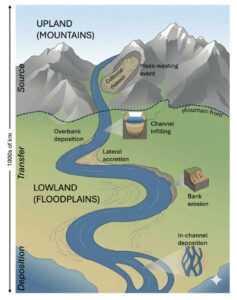
The studies offer a striking picture of how rivers function as giant natural conveyor belts, transporting sand, silt and clay from mountains towards the sea. That sediment sustains floodplains, helps create river islands and replenishes deltas and coastal landscapes. But when nature suddenly injects huge quantities of sediment—or when human infrastructure prevents sediment from moving downstream—the consequences can extend far beyond the original site.
The findings therefore point to an often-overlooked dimension of river management: understanding where sediment comes from, how far it travels and where it eventually settles may be as important as tracking the movement of water itself.
The two studies, conducted in contrasting landscapes—the Brahmaputra in the eastern Himalaya and the Godavari in peninsular India—highlight how sediment pathways can be altered by both extreme natural events and human interventions.
A Himalayan landslide sends a sediment wave downstream
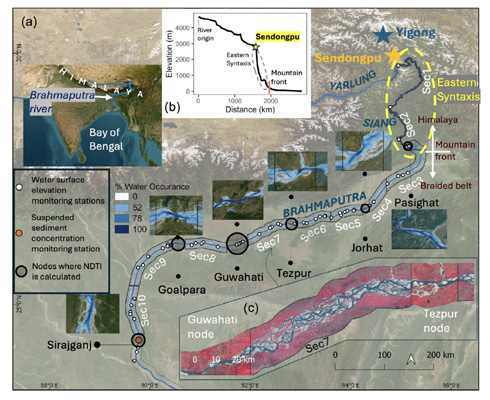
The first study, involving IIT Gandhinagar researchers in collaboration with the University of Leeds, UK, examined the Eastern Himalayan Syntaxis in the Brahmaputra basin, one of the regions experiencing some of the highest erosion rates in the Himalaya. The findings were published in Earth Surface Processes and Landforms.
The Brahmaputra is among the world’s great sediment-laden rivers, carrying an estimated 500 to 1,000 million tonnes of sediment every year. The scale is enormous—roughly comparable to the weight of 2.5 to 5 million blue whales.
The researchers examined the impact of major mass-wasting events, including the 2000 Yigong event and the 2017, 2018 and 2021 Sendongpu events, using years of satellite observations.
“We analysed years of satellite observations of the Brahmaputra following these events, tracking changes in water turbidity, water surface elevation, sandbar area and flood extent, at the finest temporal and spatial resolution available through Google Earth Engine’s database. The findings were remarkable. Fine sediments from the mass-wasting events could be traced up to approximately 1000 km downstream, reaching the delta,” said Dr Abhishek Dixit, postdoctoral fellow in the Department of Earth Sciences at IIT Gandhinagar and first author of the study.
The distance is comparable to a road journey from Ahmedabad to Bareilly or a flight from London to Venice.
But not all sediment travels equally far. Like sand and pebbles poured into a flowing stream, finer material can remain suspended and travel long distances, while coarser particles settle closer to the mountains.
The study found that coarser sediments accumulated within about 100 km of the mountain front, producing morphological changes that coincided with increased water-surface elevation and high flood inundation. The researchers also found that different mass-wasting events produced different river responses: the Yigong event generated a far-reaching but short-lived sediment response, while the Sendongpu events produced a more prolonged but less intense response, with sediment retained in valleys and gradually mobilised.
More sediment, less room for floodwater
These changes are not merely geological curiosities. Sediment accumulation can reduce the space available in a river channel for rising water, while newly formed sandbars can redirect flows into different channels.
Following the 2017 event, the stretch of the Brahmaputra immediately downstream of the mountains experienced a significant increase in flood extent. The study also recorded a 20% to 35% increase in sandbar area across a 100-km reach.
The findings underscore the need to incorporate sediment generated by mass-wasting events into flood-risk assessments and hydropower planning, particularly in landscapes facing growing natural and human pressures.
Godavari tells the opposite story
If the Brahmaputra demonstrates what happens when nature suddenly injects sediment into a river system, the Godavari illustrates what happens when human infrastructure interrupts its journey.
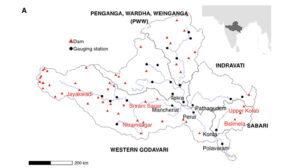
Stretching nearly 1,500 km across central and peninsular India, the Godavari has historically carried sediment from the Deccan Plateau to its delta. Seasonal sediment deposition replenished floodplains, supported farmland and helped sustain the delta.
That natural supply chain, however, has been substantially interrupted by the construction of more than 900 dams across the basin.
IIT Gandhinagar researchers examined sedimentation rates from 48 major dams and sediment-load data from 23 gauging stations. Their findings were published in Anthropocene.
The researchers acknowledge that dams provide crucial benefits, including water storage for irrigation, hydropower generation, drought resilience and drinking-water supplies. But they also alter the natural functioning of rivers by changing sediment pathways.
According to Dr Dixit, “Our findings revealed that between 1969 and 2013, the amount of sediment flowing through the river in a year declined by about 115 million tonnes, while reservoirs accumulated around 101 million tonnes annually.”
In effect, much of the sediment disappearing from the downstream river system is being retained behind dams.
When the river’s ‘cargo’ never reaches the delta
The implications are particularly significant for the Godavari delta.
The study suggests that sediment replenishment has weakened dramatically, with the delta retaining only 20% of incoming sediment. Researchers estimate that sediment trapped by dams could mean the river sustains only about half the delta area that might have been maintained before dam construction.
That could leave portions of the delta increasingly exposed to erosion and rising sea levels.
The contrast with the Brahmaputra is striking: in one basin, sudden sediment surges following landslides can alter river morphology and flood behaviour; in the other, dams can progressively starve a delta of the sediment needed to maintain itself.
‘Two river systems cannot be generalised to all Indian rivers’
Professor Vikrant Jain, faculty member in the Department of Earth Sciences at IIT Gandhinagar and head of the River Earth and Environment Lab, cautioned against applying the findings mechanically across India’s diverse river systems.
“Future research may consider investigating how multiple drivers, such as changing land use and groundwater extraction, could interact to alter sediment connectivity across different river basins. Moreover, the findings from these two river systems cannot be generalised to all Indian rivers, each of which has its own characteristics,” he said.
Yet the broader lesson is clear. Rivers are dynamic systems, and their health depends not only on water but also on the material moving with it.
“While on the one hand, events like heavy rainfall may increase the chances of landslides, influencing the generation and transport of sediments by rivers. On the other hand, the country’s demands for water storage and hydropower, resulting in the building of reservoirs, also have the potential to alter sediment pathways in ways that ripple far downstream,” Professor Jain added.
Understanding these pathways could strengthen flood-risk assessments, hydropower planning and strategies to protect vulnerable landscapes such as deltas.
The studies also align with India’s broader priorities, including elements of the National Mission for Sustaining the Himalayan Ecosystem, the National Disaster Management Plan and wider river-management initiatives, while resonating with aspects of the United Nations’ Sendai Framework for Disaster Risk Reduction.
The research involving Dr Dixit received funding support through the Department of Science and Technology’s Major Research and Development Programme in Hydro Climate Extremes, as well as the University of Leeds International Strategy Fund-supported BRAINSTORM project.