- PSB Hackathon 2026 Grand Finale at IIT Gandhinagar turns student ingenuity into solutions for real-world banking challenges
- 17 finalist teams emerge from 450-plus applications to showcase AI, cybersecurity, fraud detection and digital banking innovations
- IIT Gandhinagar and Bank of Baroda forge academia-industry bridge to accelerate practical, scalable fintech solutions
- Teams from IIT Bhilai, SVNIT, Rajasthan Technical University and IIT Gandhinagar secure top four positions
NE SCIENCE & TECHNOLOGY BUREAU
GANDHINAGAR, AUG 8
The real test of innovation begins after the idea is born: can it survive the demands of the real world? That question took centre stage at the Grand Finale of PSB Hackathon 2026 at IIT Gandhinagar, where 17 finalist teams sought to convert promising ideas into technology-driven solutions for some of India’s most pressing banking challenges.
Organised by the IIT Gandhinagar Innovation and Entrepreneurship Center (IIEC) in partnership with Bank of Baroda, the hackathon brought together young innovators working on artificial intelligence, cybersecurity, fraud detection, digital payments, financial inclusion, process automation and data analytics.
The 17 finalists were selected from more than 450 applications, underlining the growing appetite among students to tackle problems at the intersection of technology and financial services. At the finale, teams presented working prototypes before a jury comprising senior academicians, banking professionals and technology experts.
The competition was designed to go beyond a conventional coding challenge. Participants were expected to demonstrate not merely technological novelty but also feasibility, scalability, technical excellence and the potential for real-world implementation.
‘Digital trust’ emerges as the bigger innovation challenge
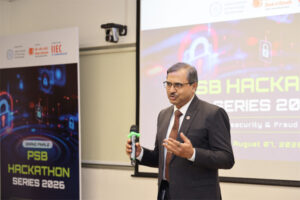
Addressing the gathering, Prof Rajat Moona, Director, IIT Gandhinagar, pointed to the transformative impact of India’s digital public infrastructure on financial services. Aadhaar and UPI, he noted, have opened up vast possibilities in authentication, data security, transaction security and reconciliation.
“The fintech space has a huge scope in building digital trust and developing tools that can make financial services more efficient and accessible,” he said, urging participants to continue experimenting, learning and developing solutions for the rapidly evolving fintech ecosystem.
His message underscored a larger reality: as banking becomes increasingly digital, innovation must address not only speed and convenience but also trust, security and accessibility.
‘The real challenge’ is implementation
Sanjay V. Mudaliar, Executive Director, Bank of Baroda, challenged innovators to take the next decisive step—from conceptual brilliance to deployable solutions.
“The real challenge is not just to develop a solution, but to see whether it can be implemented in a real-life scenario,” he said.
Mudaliar stressed the importance of bringing academia and industry closer so that promising student innovations can be refined into practical and commercially viable solutions. The hackathon, he said, offered students an opportunity to understand the actual challenges and expectations of the banking industry while gaining exposure relevant to the commercial world.
Saurabh Shukla, Chief Technology Officer, Bank of Baroda, described hackathons as a powerful bridge between academia and industry, with academic institutions contributing fresh thinking, research and innovation, and industry bringing practical context, scale and an understanding of real-world challenges.
“This collaboration enables young innovators to transform ideas into solutions that can create meaningful impact,” he said, adding that such initiatives strengthen the innovation ecosystem and help prepare talent for emerging challenges in a rapidly changing digital world.
IIT Bhilai team takes the top spot
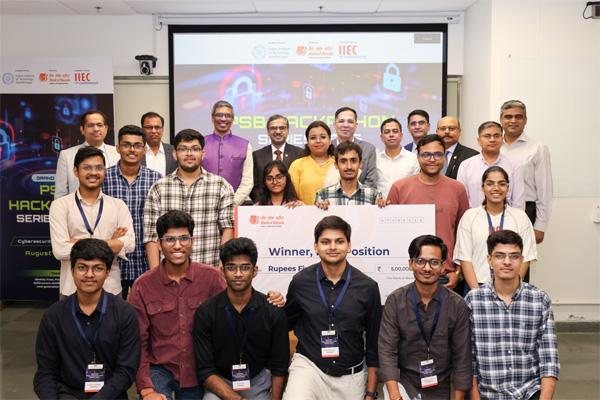
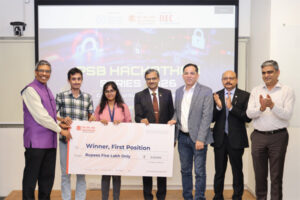
The final rankings reflected the diversity and competitive strength of the participating institutions. Team Admas 2.0 from IIT Bhilai emerged first after rigorous evaluation.
Team CrunchHack from SVNIT secured the second position, followed by Team Sach Ka Kavach from Rajasthan Technical University, Kota, in third place. Team Never Settle from IIT Gandhinagar finished fourth.
The jury evaluated the projects on innovation, technical excellence, feasibility, scalability and potential for implementation, identifying solutions that could make a meaningful impact on the future of digital banking.
The jury comprised Prof Manisha Padala, Faculty, IIT Gandhinagar; Vikram Kishnani, Digital Delivery Head, HCLTech; Anand Pandey, Chief Operating Officer, IIT Gandhinagar Innovation and Entrepreneurship Center; Saurabh Shukla, CTO, Bank of Baroda; and Arun Kumar, Deputy General Manager–IT, Bank of Baroda.
The event also featured addresses by Amit Prashant, Dean, External Relations, IIT Gandhinagar, and Rajeev Ranjan Prasad, Senior Advisor, Indian Banks’ Association, who highlighted the importance of nurturing young talent and strengthening innovation in banking and financial technology.
The finalist teams represented institutions, including IIT Gandhinagar, IIT Bhilai, IIT Guwahati, NIT Patna, SVNIT, MANIT Bhopal, Rajasthan Technical University, IIIT Vadodara, VGEC, Thapar University, GTU-SET, Rashtriya Raksha University, Charusat and LDCE/JEC.
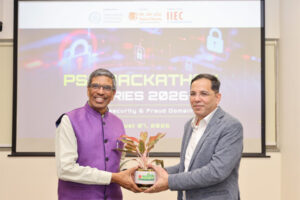
With the valedictory ceremony and prize distribution, the Grand Finale ended not simply as a contest of code and concepts but as an exercise in turning student ingenuity into solutions for national-scale challenges.
The bigger takeaway was perhaps the most important one: in India’s rapidly digitising banking landscape, the winners will not necessarily be those with the most futuristic ideas—but those capable of making innovation secure, scalable, commercially viable and useful to millions.