- Asiatic lion population rises from 523 in 2015 to 891 in 2025 as Gujarat expands conservation beyond traditional landscapes
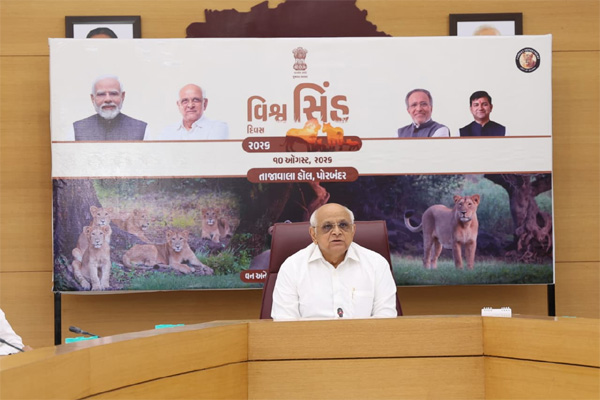
- CM Bhupendrabhai Patel joins World Lion Day celebrations virtually from Porbandar; calls lion conservation a commitment to the entire ecosystem
- Lion range expands from three to 11 districts over 25 years, signalling a remarkable landscape-level conservation success
- After 143 years, Barda emerges as a new natural home for Asiatic lions, with 26 lions now inhabiting the sanctuary
- Project Lion strengthens habitat restoration, disease monitoring, scientific tracking, technology interventions and community participation
- Forest officials, conservationists, local communities and coexistence emerge as the pillars of India’s growing lion conservation story
NE ENVIRONMENT BUREAU
GANDHINAGAR/NEW DELHI, AUG 10
The Asiatic lion is no longer merely a symbol of Gujarat’s wilderness—it is becoming the roaring emblem of a conservation model that is expanding across landscapes, communities and ecosystems. On World Lion Day 2026, Gujarat highlighted a remarkable conservation journey in which the Asiatic lion population has risen from 523 in 2015 to 891 in 2025, while its range has expanded from three districts to 11 across Saurashtra.
The milestone was showcased at Porbandar, where Gujarat Chief Minister Bhupendrabhai Patel virtually joined the World Lion Day celebrations organised under the chairmanship of State Forest and Environment Minister Arjunbhai Modhwadia.
The celebrations underscored a larger message: the success of lion conservation is not simply about increasing numbers, but about securing habitats, strengthening ecosystems, involving communities and ensuring sustainable coexistence between people and wildlife.
891 LIONS: A CONSERVATION MILESTONE
Union Environment, Forest and Climate Change Minister Bhupender Yadav, marking World Lion Day, highlighted the steady rise in the Asiatic lion population from 523 in 2015 to 891 in 2025.
Yadav attributed the achievement to the dedication of forest officials, conservationists, local communities and all those working tirelessly to protect the species.
He said India’s success in conserving the Asiatic lion was a proud testament to the country’s commitment to wildlife and biodiversity, while reaffirming the resolve to ensure that the roar of the Asiatic lion continues to resonate for generations.
Union Minister of State for Environment, Forest and Climate Change Kirti Vardhan Singh said that by protecting critical habitats, strengthening conservation programmes and fostering coexistence, India has demonstrated that development and nature can thrive together.
For Gujarat, the achievement represents the outcome of a sustained conservation strategy combining modern technology, scientific research, public participation and effective administration, Patel said.
From three districts to 11
Patel said the growing lion population across 11 districts of Saurashtra was not merely a statistic but reflected the combined strength of conservation initiatives and public participation in preserving the heritage and pride associated with the Asiatic lion.
He noted that the lion’s ranging area has expanded from three districts to 11 districts over the past two-and-a-half decades, reflecting the strengthening of coexistence between local communities and the big cats.
The Chief Minister said the Asiatic lion is an integral part of India’s national pride and identity and pointed out that Gujarat is the only home of free-ranging Asiatic lions in the world.
He stressed that protecting the species is both a matter of pride and a major responsibility for Gujarat.
Barda’s roar after 143 years
One of the most striking developments in Gujarat’s conservation landscape is the return of lions to Barda Wildlife Sanctuary.
After a gap of 143 years, lions have returned to the Barda landscape and naturally adopted it as a new habitat. The development is expected to strengthen the coastal ecosystem while opening fresh opportunities for responsible tourism in and around the Porbandar-Barda region.
Forest and Environment Minister Arjunbhai Modhwadia described Barda as becoming the second home of the lion after the Gir landscape.
The first lion arrived in Barda in 2023, and the area now has a family of 26 lions, according to the State Government.
The State is also planning a safari park over approximately 270 hectares following the development of a jungle safari in Barda. Work is also underway to develop Mokar Sagar and Medhakreek as bird sanctuaries, while efforts are being made to secure Ramsar-site status for Mokar Sagar.
Project Lion: Protecting the Big Cat and its ecosystem
At the national level, Project Lion, announced by Prime Minister Narendra Modi on August 15, 2020, provides a landscape-level and holistic framework for the long-term conservation of the Asiatic lion.
The lion range has expanded from approximately 30,000 sq km in 2020 to nearly 35,000 sq km, according to the Union Government.
The project focuses on habitat enhancement, disease monitoring and veterinary support, scientific population tracking, technology-aided interventions, biodiversity protection, benefit sharing and community involvement.
Patel said Gujarat has also undertaken initiatives aimed at protecting and restoring lion habitats, involving local communities and maintaining a balance between ecology and development.
He stressed that tourism linked to lion sightings must grow without disturbing the animals or compromising wildlife safety.
‘Not just a numbers game’
The Chief Minister delivered the defining message of Gujarat’s conservation philosophy by stating:
“Lion conservation is not merely a programme to increase the number of lions, but a commitment to protect the entire ecosystem.”
He said forests must remain protected to safeguard water sources, while secure water resources are essential for agriculture and human life. He also called for wider public participation in conservation efforts to strengthen human–wildlife coexistence and prevent undesirable human–wildlife conflict.
Modhwadia reinforced the ecological message with a powerful observation: “Only if wildlife survives can humanity survive.”
He highlighted the remarkable coexistence between lions, pastoral communities and local residents, while urging citizens and tourists not to disturb wildlife and to maintain a safe distance from animals.
He also called for greater wildlife awareness among schoolchildren and students through outreach programmes conducted by the Forest Department.
A people-powered conservation model
The State Government said local communities have played a major role in the conservation of the Asiatic lion, with coexistence increasingly becoming an integral part of the conservation framework.
Principal Chief Conservator of Forests and Head of Forest Force Dr Jaypal Singh credited sustained conservation efforts by the State and Central governments for the significant growth in the Asiatic lion population.
He also said the return of lions to Barda was creating new possibilities for tourism at the local level. World Lion Day programmes were organised across 11 districts of Saurashtra.
The Porbandar programme also saw the flagging off of patrolling bikes and rescue vehicles, inauguration of forest staff offices and residential facilities, and foundation-laying for various wildlife infrastructure projects.
Across Saurashtra, World Lion Day programmes focused on wildlife conservation, lion protection, human–wildlife coexistence and environmental stewardship.
The message emerging from Gujarat on World Lion Day was therefore larger than the spectacular rise in lion numbers: a successful conservation story is ultimately measured by the health of the entire landscape, the security of its wildlife, the participation of its people and the ability of nature and development to coexist.
From Gir to Barda, from 523 to 891, and from three districts to 11, Gujarat’s Asiatic lion story is evolving into a wider experiment in landscape-scale wildlife conservation.