R MANICKAVASAGAM
MAHABALIPURAM, AUG 20
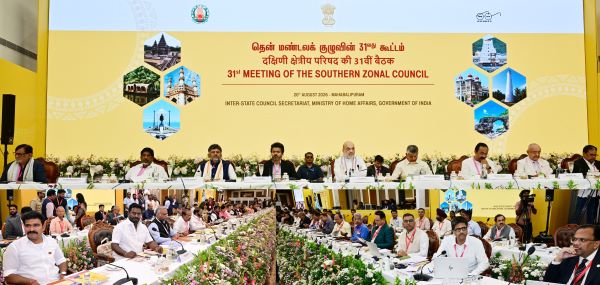
What happens when a region that contributes more than 30 per cent of India’s GDP begins asking whether its economic success, population discipline and developmental achievements are being adequately reflected in political representation and fiscal federalism? The answer emerged with unusual clarity at the 31st Southern Zonal Council meeting, where the South’s chief ministers placed a formidable catalogue of political, economic, social, environmental and inter-State concerns before the Centre.
மாண்புமிகு ஒன்றிய உள்துறை மற்றும் கூட்டுறவுத் துறை அமைச்சர் திரு.அமித் ஷா அவர்கள் தலைமையில் இன்று (20.8.2026) மகாபலிபுரத்தில் நடைபெற்ற 31-வது தென் மண்டலக் குழுக் கூட்டத்தில், மாண்புமிகு தமிழ்நாடு முதலமைச்சர் திரு.ச.ஜோசப் விஜய் அவர்கள் கலந்துகொண்டு வரவேற்புரையாற்றினார்.… pic.twitter.com/kSPwOIrcTs
— CMOTamilNadu (@CMOTamilnadu) August 20, 2026
Chaired by Union Home Minister Amit Shah, the meeting became a broad conversation on what the southern States want from India’s federal architecture—from protecting their parliamentary voice after delimitation to resolving water disputes, fighting narcotics trafficking, building economic corridors, safeguarding fragile coastlines and expanding maritime opportunities.
- Southern Zonal Council turns into a high-stakes forum for protecting political representation and asserting the region’s economic weight
- Vijay seeks safeguards for population-performing States, 543-seat Lok Sabha freeze and Class 12-based medical admissions
- Mullaperiyar resurfaces as Keralam offers to fund new dam while Tamil Nadu reiterates its position on storage height and safety
- ‘Drug-Free South India’ call joins push for intelligence sharing, economic corridors and a common Blue Economy strategy
- Southern States seek stronger fiscal federalism, coastal protection, infrastructure links and greater say over natural resources
- Amit Shah-chaired council puts Centre-State and inter-State questions under one roof as South seeks dialogue, dignity and development
Tamil Nadu Chief Minister C. Joseph Vijay called for greater cooperation among the southern States and argued that the region should operate increasingly as an integrated economic bloc. Keralam Chief Minister V. D. Satheesan, meanwhile, pressed for cooperative federalism across healthcare, infrastructure, environmental protection and regional security, while also bringing the contentious Mullaperiyar issue back into the spotlight.
At the heart of the discussions was a common concern: how can the South’s contribution to India’s growth be matched by an equally strong voice in the country’s political and fiscal decision-making?
Delimitation: South seeks protection for population success
Vijay called for a legislative assurance that delimitation should not reduce any State’s percentage share of parliamentary representation because of successful population control.
The Tamil Nadu Chief Minister argued that States which responded successfully to the national call for population stabilisation should not be penalised for that achievement.
“Public policy must not penalise states for fulfilling national objectives,” he said.
The Chief Minister also sought continuation of the existing freeze on Lok Sabha representation.
Energy Resources and Law Minister R. Nirmal Kumar, briefing reporters after the meeting, said Vijay had conveyed to Shah that the existing arrangement capping Lok Sabha seats at 543 nationally and 39 in Tamil Nadu should continue.
“Our stand remains unchanged and committed to the existing freeze capping Lok Sabha seats at 543 nationally and 39 in Tamil Nadu,” Kumar said.
He said Tamil Nadu had conveyed its concern that southern States could face reduced political representation under population-based reallocation.
“We expressed our serious concerns that the southern states could face reduced political representation on population-based reallocation. These apprehensions were directly conveyed to Union Home Minister. The Centre will now decide,” he remarked.
The delimitation question thus emerged as one of the meeting’s most politically consequential issues, cutting across the development and governance agenda of the southern region.
Vijay’s blueprint: One South, many economic engines
Vijay said southern States contribute more than 30 per cent of India’s GDP and remain among the country’s major centres of manufacturing, exports and services.
His prescription was greater economic integration through manufacturing zones, logistics parks and freight corridors.
The Chief Minister welcomed the extension of the Bengaluru Metro from Bommasandra to Hosur, describing it as a model of interstate cooperation, and called for its speedy implementation.
He also placed the Blue Economy at the centre of the South’s future development strategy.
With Tamil Nadu possessing a 1,076-km coastline, Vijay said the State was ready to work with neighbouring States on a comprehensive approach encompassing ports, coastal shipping, fisheries, marine industries, maritime services and tourism.
The message was clear: the South’s coastline should not merely be viewed as a geographical boundary but as an enormous economic and strategic asset.
‘Drug-Free South India’: A common security front
Vijay also called for a concerted southern campaign against narcotics trafficking, seeking a “Drug-Free South India” through stronger intelligence-sharing and coordinated enforcement against interstate trafficking of narcotic and psychotropic substances.
He called for tighter regulation of online prescription medicine sales and action against unauthorised distribution.
The security agenda found resonance in Satheesan’s proposals for institutionalised cooperation among southern States.
He suggested appointing Inter-State Police Nodal Officers at headquarters level, creating real-time intelligence-sharing mechanisms and conducting joint border operations against narcotics trafficking, cyber threats and cross-border crime.
The proposals seek to move inter-State security cooperation from episodic coordination towards a more permanent institutional framework.
Water wars return to the federal table
Water remained another sensitive fault line.
Vijay said the rights of lower-riparian States must be protected through implementation of court judgments, tribunal awards and statutory mechanisms.
He sought timely enforcement of directions relating to Cauvery water and said the safety and storage level of Mullaperiyar, including the question of raising the level to 152 feet, should be governed by judicial decisions.
However, R. Nirmal Kumar clarified that the Cauvery water-sharing dispute and matters relating to the Cauvery Tribunal were not discussed during this council session.
The Mullaperiyar issue, meanwhile, took a sharper turn with Keralam putting forward a proposal for a new dam.
Satheesan said Keralam was prepared to provide Tamil Nadu with its full share of water from a new Mullaperiyar dam, with Tamil Nadu managing its design, location and construction while Keralam would bear the entire cost.
Tamil Nadu has maintained that the existing dam is safe, while Keralam has consistently expressed concern over its safety and the consequences of higher water levels for downstream populations.
The contrasting positions underline how deeply entrenched the issue remains despite repeated judicial and inter-governmental interventions.
Kerala’s cooperative-federalism agenda spans health to coasts
Addressed the Southern Zonal Council meeting in Mahabalipuram chaired by Union Home Minister Shri Amit Shah. Pressed for cooperative federalism across healthcare funding, infrastructure, environmental protection, and regional security.
Key Demands & Major State Concerns… pic.twitter.com/JYDCkx0wfL
— V D Satheesan (@vdsatheesan) August 20, 2026
Satheesan widened Keralam’s federal agenda well beyond Mullaperiyar.
He pressed for greater cooperation in healthcare funding, infrastructure, environmental protection and regional security, while highlighting the financial burden borne by the State under centrally sponsored schemes.
On Ayushman Bharat Pradhan Mantri Jan Arogya Yojana, he said Keralam was bearing nearly 90 per cent of the financial burden through its Karunya Arogya Suraksha Padhathi.
He sought State-specific premiums instead of a uniform national premium, alignment of eligibility with the National Food Security Act database, and revision of the Centre’s share to reflect actual expenditure on centrally sponsored beneficiaries.
He also raised the financial implications of the Vay Vandana Scheme for States.
Climate change formed another major component of his intervention.
Satheesan said 63 per cent of Keralam’s 586-km coastline was actively eroding, and sought central support for coastal erosion protection and resettlement through the National and State Disaster Response Funds.
He urged the Centre to expedite a national policy on coastal erosion.
‘Do not auction offshore blocks’
Keralam’s environmental concerns extended to offshore mining.
Satheesan urged the Centre to halt auction of offshore sand blocks off the Keralam coast until a rigorous scientific assessment of their environmental impact is completed.
“In view of the potential environmental and social consequences for our fragile coastal ecosystem and for our fishing communities, I reiterate our request that offshore mineral blocks off our coast not be auctioned until a rigorous scientific assessment and a robust Standard Operating Procedure are in place, and that the concerns repeatedly raised by the state be given their due weight,” he said.
He also sought withdrawal of recent amendments to the Mines and Minerals (Development and Regulation) Act, arguing that States should retain control over coastal sand and mineral resources.
NEET, Finance Commission and the South’s fiscal voice
Vijay also reiterated Tamil Nadu’s opposition to NEET, urging the Centre to permit admissions to State-quota medical, dental and AYUSH seats on the basis of Class 12 marks.
He argued that the examination disadvantages students from rural and underprivileged backgrounds.
On fiscal federalism, he called for the next Finance Commission’s devolution formula to recognise both need and performance, arguing that States which have achieved economic growth, fiscal discipline and population stabilisation should not be penalised.
He also sought greater flexibility for States in setting tax rates following the introduction of GST.
The larger concern is that developmental success should strengthen—not diminish—a State’s ability to shape national policy.
From rail lines to ports: the south’s connectivity map
The meeting also produced a broad infrastructure agenda.
Satheesan sought cooperation from Karnataka and the Railway Ministry to finalise alignments and detailed project reports for the Thalassery-Mysore and Nilambur-Nanjangud railway lines.
He sought relief for State road transport undertakings through toll exemptions or concessional toll rates.
He also proposed scientifically determined time windows and regulated convoy movement through forest borders instead of blanket night traffic restrictions that disrupt trade and travel.
On maritime development, he sought cooperation from southern States for “to transform Keralam into a premier port city and maritime economic hub centred around Vizhinjam”.
He also sought continuation of central funding for the fast-track special court scheme, claiming that it had achieved more than 78 per cent compliance in investigation timelines.
A Southern platform for a stronger India
The Southern Zonal Council comprises Andhra Pradesh, Karnataka, Keralam, Tamil Nadu and Telangana, along with the Union Territories of Puducherry, Andaman and Nicobar Islands and Lakshadweep.
The council provides a formal platform for resolving issues between the Centre and member States and Union Territories, as well as inter-State concerns.
Its latest meeting showed just how wide that federal conversation has become.
From delimitation to dams, drugs to digital crime, NEET to healthcare funding, railways to ports and climate change to fiscal federalism, the South’s agenda was anything but narrow.
The discussions also demonstrated that the region’s States do not necessarily speak with one voice on every issue. Water disputes, dam safety and resource-sharing remain contested. Yet there is considerable common ground on the need for stronger connectivity, economic integration, security cooperation and a federal framework that recognises the South’s contribution to national growth.
Vijay summed up Tamil Nadu’s approach by stressing that strong States make India stronger, while pledging cooperation in resolving differences through dialogue, mutual respect and the rule of law.
The 31st Southern Zonal Council meeting, therefore, was more than another inter-governmental gathering. It became a test of whether India’s federal compact can accommodate a region that wants to grow faster, speak louder and retain the political weight earned through decades of economic and demographic transformation.