NE DEFENCE BUREAU
NEW DELHI, AUG 20
India and Japan have opened a significant new chapter in their defence and maritime partnership, with the two countries agreeing to explore joint development of naval ships and ship designs, deepen maritime-security coordination and leverage Japan’s advanced technological expertise alongside India’s expanding production capabilities.
会談で合意に至った海洋安全保障に関する協力の覚書にシン国防大臣@rajnathsingh… pic.twitter.com/bfzlHgC89K
— 小泉進次郎 (@shinjirokoiz) August 20, 2026
- Tokyo to explore joint development of naval ships and designs, combining Japanese technology with India’s manufacturing strength
- Maritime Security pact opens wider cooperation in MDA, search-and-rescue and disaster-relief operations
- Japan’s shipbuilding expertise meets India’s ‘Make in India’ ambitions as both sides eye reciprocal repair facilities
- Veer Guardian 26 marks new airpower milestone as Japanese fighter aircraft prepare to join exercise in India
- UNICORN communications system becomes first defence equipment transfer project, signalling deeper technology partnership
- New Working Group to fast-track cooperation across operations, intelligence, technology, R&D and defence industry
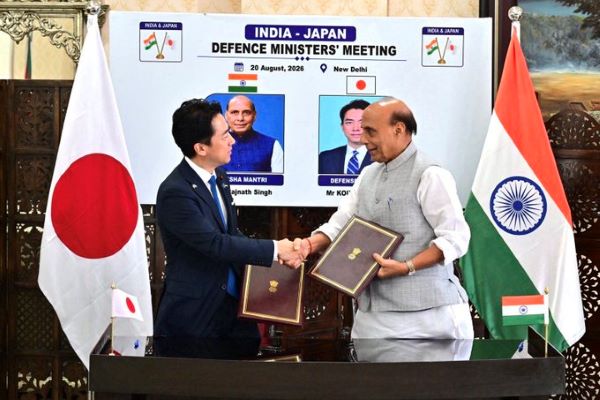
The far-reaching understandings were reached at a bilateral meeting between Defence Minister Rajnath Singh and Japanese Defence Minister Shinjiro Koizumi in New Delhi on Thursday, where the two sides also signed a Memorandum of Arrangement on Maritime Security Cooperation.
The package of agreements assumes particular significance as India seeks to transform itself into a major global shipbuilding and maritime manufacturing hub, while Japan brings decades of shipbuilding, naval engineering and advanced maritime technology expertise to the partnership.
The two Ministers specifically agreed to explore the possibility of joint development in naval shipbuilding and design, leveraging Japan’s technological capabilities and India’s production strengths in accordance with the respective policies of the two countries.
They also discussed deeper Japanese use of India’s production capabilities under the “Make in India” framework, potentially giving a major boost to India’s ambitions in defence shipbuilding.
A maritime partnership with strategic depth
The latest agreement comes against the backdrop of India’s efforts to expand its naval and commercial shipbuilding ecosystem, including plans for new shipyards and greater domestic production capacity.
The two countries also agreed to move swiftly towards practical maritime-security cooperation, including enhanced mine-countermeasure capabilities, naval shipbuilding and design, reciprocal access to ship-repair facilities and greater logistical support.
“The two Ministers concurred on moving swiftly to realise concrete maritime security cooperation that serves the strategic and operational needs. They further shared the view that both sides should maximise synergies to enhance mine countermeasures capabilities,” the joint statement said.
The Ministers also agreed to work towards a ship-repair arrangement in the near future, potentially enabling reciprocal access to repair and maintenance facilities.
For India, the partnership could provide access to Japanese expertise while helping domestic shipyards build greater technological sophistication. For Japan, India offers a large manufacturing base, an expanding naval ecosystem and a strategic location at the heart of the Indo-Pacific.
Maritime security pact widens operational canvas
The two Ministers signed the Memorandum of Arrangement on Maritime Security Cooperation, creating a formal framework for expanding cooperation between the Japan Maritime Self-Defense Force and the Indian Navy.
“The Memorandum provides a framework for further advancing cooperation between the two countries in the field of maritime security. Specifically, it includes the strengthening of cooperation between the Japan Maritime Self-Defense Force and the Indian Navy, including information sharing in the field of Maritime Domain Awareness (MDA), as well as enhanced cooperation in areas such as Search and Rescue (SAR) and Humanitarian Assistance and Disaster Relief (HADR),” the statement said.
The arrangement is aimed at strengthening the ability of both countries to monitor and respond to developments across the maritime domain, while enhancing coordination in search and rescue, humanitarian assistance and disaster relief.
The two sides will also strengthen coordination for protecting Sea Lines of Communications (SLOCs) through naval-ship visits, joint exercises, personnel and Subject Matter Expert exchanges and logistical cooperation involving ports, maintenance and repair facilities.
“Such cooperation is vital not only to Japan and India, but also to the region and the international community,” the statement said.
From exercises to integrated combat cooperation
The defence partnership is also moving beyond traditional military exercises towards greater operational integration.
The two Ministers welcomed the continuing expansion of Dharma Guardian, the India-Japan Army exercise, and JAIMEX, the bilateral maritime exercise.
Particular importance was attached to Veer Guardian 26, the India-Japan Air Force exercise scheduled for this year. Japanese Air Self-Defence Force fighter aircraft are set to visit India and participate in the exercise for the first time, marking a new milestone in bilateral airpower cooperation.
“The two Ministers concurred on further deepening cooperation in bilateral exercises through enhanced complexities, integration of unmanned systems and pursuing joint exercises at short notice, whenever the opportunities arise,” the statement said.
The two sides will also promote exchanges between their Special Operations Forces and explore cooperation with India’s integrated theatre commands following their establishment.
UNICORN project opens technology-transfer gateway
The partnership is simultaneously acquiring a sharper technology and industrial dimension.
Defence Minister Rajnath Singh welcomed Japan’s recent review of its framework governing the transfer of defence equipment and technology and expressed the expectation that Japan would contribute further to peace and stability in the Indo-Pacific and beyond.
The two countries identified the shipborne UNICORN integrated communications antenna system as a landmark project.
The joint statement described it as the first defence equipment transfer project between India and Japan, calling it a symbol of the deepening defence-equipment and technology partnership.
The two Ministers committed themselves to working towards its early realisation and agreed to advance discussions on other defence-equipment and technology projects based on the operational requirements of their respective Services.
They also agreed to deepen defence R&D cooperation between India’s DRDO and Japan’s ATLA in advanced defence technologies and decided to convene a Defence Industry Forum.
Indo-Pacific cooperation gets wider footprint
India and Japan also agreed to expand cooperation with third countries as part of their shared commitment to a free and open Indo-Pacific.
The Ministers welcomed the first trilateral naval PASSEX involving India, Japan and Indonesia, conducted in February this year, and agreed to deepen cooperation with other countries through high-level exchanges, exercises and related initiatives.
They also backed greater use of the Indo-Pacific Logistics Network (IPLN) to assist partner countries during natural disasters by facilitating the movement of personnel and supplies.
The second IPLN tabletop exercise is scheduled to be held at Japan’s Ministry of Defence in September.
The Ministers further agreed to accelerate consultations for convening the Fourth Japan-India Foreign and Defence Ministerial Meeting, or “2+2”, in Tokyo later this year.
New Working Group to drive implementation
To ensure that the expanding partnership translates into concrete outcomes, India and Japan agreed to establish a Working Group headed at the Director-General/Joint Secretary level.
The group will coordinate cooperation across operations, intelligence, equipment, technology and defence industry, while respecting the sovereign choices and policies of both countries.
It will also seek to maximise synergies among different areas of cooperation and accelerate implementation of decisions taken by the two Defence Ministers.
The joint statement underlined the broader strategic context, with both sides reaffirming the importance of sharing assessments of the regional and international security environment amid heightened global tensions.
The Ministers expressed strong opposition to unilateral actions that undermine freedom and safety of navigation and overflight, as well as attempts to alter the status quo through force or coercion.
A partnership moving from exercises to co-creation
The latest India-Japan defence understanding is significant because the relationship is steadily evolving from military exercises and strategic consultations towards co-development, technology transfer, industrial cooperation, maritime logistics and joint operational capabilities.
Japan’s technological expertise and India’s production scale could create a powerful complementary model in defence shipbuilding, while the maritime-security arrangement provides an institutional framework for closer coordination across the Indo-Pacific.
Before the meeting, Koizumi paid homage to India’s fallen heroes by laying a wreath at the National War Memorial in New Delhi and received a ceremonial Tri-Service Guard of Honour. He also visited the Western Naval Command in Mumbai and Indian Naval Ship Chennai.