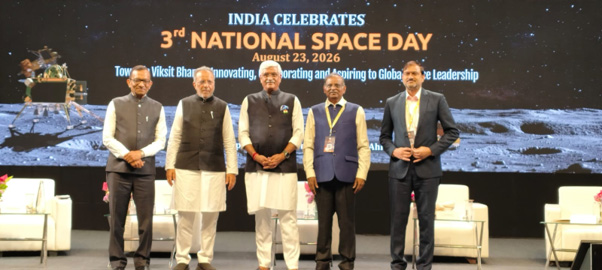
- National Space Day in Ahmedabad spotlights India’s march towards global space leadership
- Space technology moves from laboratories to the lives of millions through agriculture, healthcare, connectivity and disaster management
- AI, quantum computing, robotics and semiconductors set to redefine the next phase of India’s space economy
- Gujarat eyes a pivotal role as private industry, start-ups and research institutions fuel the new space ecosystem
- ISRO Chairman V Narayanan says Chandrayaan-3 has given India’s scientific capabilities a new global identity
NE SCIENCE & TECHNOLOGY BUREAU
AHMEDABAD, AUG 23
The sky may have once been the limit for India’s space ambitions. Today, it is increasingly becoming the launchpad for a much bigger dream — to make India a global space leader by combining scientific heritage with frontier technologies, private enterprise, youthful innovation and an unwavering national resolve.
That ambition resonated strongly in Ahmedabad on Sunday as the Third National Space Day was celebrated at the Space Applications Centre (SAC), bringing together the country’s space leadership, policymakers, scientists, industry representatives, start-ups and students around the theme “Towards Viksit Bharat: Innovating, Collaborating and Aspiring to Global Space Leadership.”
Union Minister for Culture and Tourism Gajendra Singh Shekhawat, Gujarat Cabinet Minister Arjun Modhwadia, Secretary, Department of Space and Chairman, ISRO Dr V. Narayanan, IN-SPACe Chairman Dr Pawan Kumar Goenka, SAC Director Dr V N Rao and Dr Kartikeya Sarabhai were among those who underlined how India’s space programme is entering an era in which innovation is no longer confined to government laboratories but is becoming an engine of national development and economic growth.
From people-centric space to a technology powerhouse
Shekhawat said India’s space journey had begun amid severe resource constraints, but the determination of its scientists and the vision of Dr Vikram Sarabhai had never wavered.
Sarabhai’s dream, he emphasised, was not simply to make India successful in space but to ensure that space technology transformed the lives of ordinary citizens.
That vision is now visible across sectors. Satellites are supporting agriculture, weather forecasting, disaster management, potential fishing-zone advisories, connectivity, education and healthcare, making space technology an increasingly indispensable instrument of people-centric governance.
“Curiosity is the beginning of knowledge, research and innovation,” Shekhawat said, linking India’s contemporary space ambitions with its ancient scientific heritage.
He recalled the contributions of Aryabhata, Varahamihira and Bhaskaracharya to astronomy and mathematics and said India’s traditional knowledge systems were also being brought into the digital age.
With Artificial Intelligence and Optical Character Recognition, efforts are under way to digitise ancient Indian manuscripts and make their contents accessible in multiple languages, taking the country’s knowledge heritage to a global audience.
When space meets AI, Quantum and Robotics
The next technological revolution, Shekhawat indicated, will not be driven by any single discipline.
The convergence of space technology, Artificial Intelligence, quantum computing, robotics, humanoids and semiconductors, he said, will increasingly influence the global economy, human life and geopolitics.
For India, the three defining aspirations are innovation, collaboration and global leadership, with the country’s young population at the heart of this transformation.
The message was significant: India’s space programme is no longer being viewed merely through the prism of rockets and satellites. It is becoming part of a much larger technological ecosystem in which advances in one field can accelerate progress across several others.
Ahmedabad’s Sarabhai legacy gets a new-age boost
For Gujarat, the National Space Day celebration in Ahmedabad carried special significance.
Modhwadia said Ahmedabad, Gujarat and India’s space programme share a historic and deep-rooted relationship, shaped by the pioneering vision of Dr Vikram Sarabhai.
From that foundation, Ahmedabad has emerged as one of the key centres of India’s space journey. The establishment of the IN-SPACe headquarters in Ahmedabad, he said, has injected fresh momentum into Gujarat’s emerging space ecosystem.
The reforms in the space sector have opened doors for private companies, academic institutions, researchers and start-ups, creating opportunities that were largely unavailable in the earlier era of India’s space programme.
Gujarat is already witnessing the emergence of space start-ups developing new technologies and applications, while facilities for small-satellite manufacturing are being developed at the Gujarat Space Park.
Modhwadia invited domestic as well as international space companies to invest in Gujarat and establish manufacturing facilities in the state.
Gujarat’s technology bet goes beyond space
The state’s ambitions, however, extend well beyond the space sector.
Gujarat is rapidly expanding its capabilities in semiconductors, Artificial Intelligence, quantum technology, biotechnology and supercomputing, Modhwadia said, pointing out that a significant share of the semiconductor projects approved in India is coming to Gujarat.
He projected Gujarat as a potential national leader in semiconductor manufacturing in the coming years.
The state is also seeking to build a deeper culture of scientific curiosity. Through Science City, Ahmedabad, and science centres spread across the regions and districts, efforts are being made to popularise science among students and the wider public.
The larger objective, Modhwadia said, is not merely to consume technology but to make Gujarat a centre for developing new technologies and innovation.
Chandrayaan-3: The moment India changed the narrative
The choice of Ahmedabad to host the National Space Day celebration was particularly appropriate, according to ISRO Chairman Dr V Narayanan.
He recalled how Dr Vikram Sarabhai laid the foundations for institutions such as the Physical Research Laboratory (PRL) and Space Applications Centre (SAC) in Ahmedabad.
The city has also played a major role in payload development, a critical component of satellites and launch vehicles.
India’s transformation from a space programme operating with limited resources to one of the world’s leading space programmes has been remarkable, Narayanan said.
India has made major advances in science, satellite technology and launch-vehicle technology, with countries and companies across the world increasingly placing their confidence in India’s launch capabilities and technological expertise.
Among the defining milestones, he highlighted Chandrayaan-1, Chandrayaan-3 and Aditya-L1.
The discovery of water molecules on the Moon through Chandrayaan-1, the scientific data being generated by Aditya-L1 for solar studies and, above all, the successful soft landing of Chandrayaan-3 have demonstrated the breadth of India’s scientific capabilities.
Chandrayaan-3, in particular, he said, “gave India’s scientific capabilities a new global identity.”
2047: The space economy must scale up
The journey towards Viksit Bharat 2047 will demand a massive expansion of India’s space infrastructure.
Narayanan said the country would require a large number of satellites in the coming years, making it imperative to build a larger and more dynamic space ecosystem.
The space-sector reforms introduced since 2020 have created opportunities for private industry, academic institutions, researchers and start-ups to participate more actively in the sector.
The future, therefore, is expected to be defined by a much broader partnership between ISRO, private space companies, universities, research institutions and technology entrepreneurs.
Narayanan said India’s space community remains committed to taking the country to global leadership through new technologies, innovation and international collaboration.
From space quiz to space hackathon: Nurturing the next generation
The celebration also placed a strong emphasis on the next generation of space innovators.
Awards were presented to winning teams of the ISRO Robotics Challenge, Indian Space Hackathon and Dr Vikram Sarabhai Space Quiz, underscoring the growing importance of hands-on innovation and scientific problem-solving among young Indians.
Expert sessions examined how India can prepare the next generation for careers in space science and technology, expand its emerging space ecosystem and create new avenues for international collaboration.
Scientists, academics, private space companies, start-ups and technical experts participated in the discussions.
The presence of a large number of students added another dimension to the event — a reminder that the most important payload India is carrying into the future may not be on a rocket, but in the minds of its young innovators.
The new space frontier
The Third National Space Day thus went beyond celebrating past achievements. It offered a glimpse of an India preparing for the next frontier.
From Sarabhai’s pioneering vision to Chandrayaan-3’s historic lunar landing, from government-led missions to a growing private space industry, and from satellites serving farmers and fishermen to AI, quantum computing and robotics shaping tomorrow’s economy, India’s space story is undergoing a fundamental transformation.
Ahmedabad, the city where much of that vision first took institutional shape, now finds itself at the centre of a new chapter.
The ambition is no longer merely to reach space. It is to build technologies in space, industries around space and solutions through space — and to ensure that India’s ascent benefits both its citizens and the world.